Regular verbs: use the ending for the person
The dictionary form is the infinitive: (play an instrument), (live) and (sleep). Remove -ar from or -ir from and add the present ending. and already show I, so is usually optional. The present tense gives the ordinary forms for now and routines.
| Person | Meaning | ||
|---|---|---|---|
| I | |||
| I | |||
| you, familiar singular | |||
| you, familiar singular | |||
| / / | he / she / you politely | ||
| he / she / you politely | |||
| / | we | ||
| we | |||
| / | you, familiar plural (Spain) | ||
| you, familiar plural (Spain) | |||
| / / | they / ustedes | ||
| they / ustedes | |||
The familiar plural forms are and . Keep their written accents. The verbs do not change with a speaker’s gender: both Lena and Lukas say .
Vivo abajo.I live downstairs.
Clara vive arriba.Clara lives upstairs.
Javier toca la trompeta.Javier plays the trumpet.
: the vowel changes in some forms
means want. Notice , , and , but and . Do not guess every form by adding a regular ending to quier-.
| Person | Form | Meaning |
|---|---|---|
| I | ||
| I | ||
| you, familiar singular | ||
| you, familiar singular | ||
| / / | he / she / you politely | |
| he / she / you politely | ||
| / | we | |
| we | ||
| / | you, familiar plural (Spain) | |
| you, familiar plural (Spain) | ||
| / / | they / you politely plural | |
| they / you politely plural | ||
Want to do something: + infinitive
Use the conjugated form and then the unchanged infinitive: , . The second verb stays an infinitive; it does not agree with the subject. Spanish normally keeps the two verbs together. Put before the conjugated verb: .
Quiero dormir.I want to sleep.
Queremos vivir aquí.We want to live here.
No quiero tocar ahora.I do not want to play now.
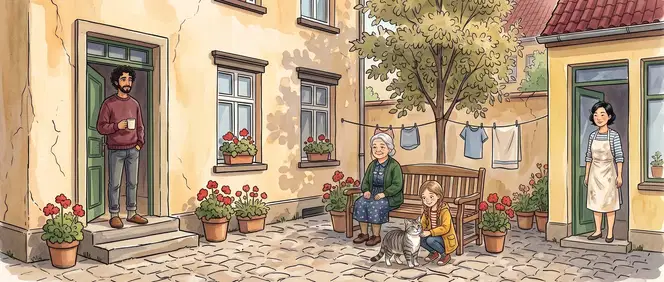
In this scene, is a useful request. is I cannot sleep. Learn these as complete phrases for now. The forms of are taught later. and belong to ; recognising them does not mean you need its full conjugation yet.
Practice 1/9 · Finding words
Notice who the verb refers to
Tap the conjugated verb. Use its form to identify the person.
.
I want to sleep.
.
You want a coffee.
.
Clara wants to play.
.
We want to live here.
.
You want silence.
.
They want a juice.
Practice 2/9 · The right form
Different people, different actions
Choose the right word for the gap.
Yo la trompeta.
I play the trumpet.
Tú en voz baja.
You play quietly.
Javier aquí.
Javier plays here.
Nosotras mañana.
We play tomorrow.
Vosotros arriba.
You play upstairs.
Ellos aquí.
They play here.
Practice 3/9 · Fill the gaps
Rehearsing together
Fill the gaps with the words from the box.
Yo arriba. Tú abajo.
I play upstairs. You play downstairs.
Javier ahora. Nosotras mañana.
Javier plays now. We play tomorrow.
Vosotros en voz baja. Ellos muy alto.
You play quietly. They play very loudly.
Practice 4/9 · The right form
Find the matching home
Choose the right word for the gap.
Yo en esta casa.
I live in this house.
Tú aquí.
You live here.
Elvira abajo.
Elvira lives downstairs.
Nosotras arriba.
We live upstairs.
Vosotros allí.
You live there.
Ellas en esta casa.
They live in this house.
Practice 5/9 · Fill the gaps
Who lives where?
Fill the gaps with the words from the box.
Yo abajo. Tú arriba.
I live downstairs. You live upstairs.
Clara aquí. Nosotros allí.
Clara lives here. We live there.
Vosotras aquí. Ellos allí.
You live here. They live there.
Practice 6/9 · The right form
What do they want?
Choose the right word for the gap.
Yo un café.
I want a coffee.
Tú dormir.
You want to sleep.
Clara un té.
Clara wants a tea.
Nosotros vivir aquí.
We want to live here.
Vosotras tocar mañana.
You want to play tomorrow.
Ellas silencio.
They want silence.
Practice 7/9 · Fill the gaps
Keep the second verb unchanged
Fill the gaps with the words from the box.
Nosotros .
We want to sleep.
Vosotros aquí.
You want to live here.
Practice 8/9 · Building sentences
Change the message, keep the pattern
Put the words in order.
I do not want to play now.
We want to live here.
Tomorrow I will play quietly.
Practice 9/9 · In situations
A noisy neighbour
Choose the right words for the situation.
Javier wants to start another song. You are tired and need sleep.
You say:
Say what you need; querer is followed by the infinitive dormir.
Javier wants to start another song. You are tired and need sleep.
You say:
Say what you need; querer is followed by the infinitive dormir.

Unit complete