Bonus storyPremium
La primera llave de Michi
Michi’s first key
Module 10 · StayingGet to know the neighbours and practise what you've learned in a new story.
The storyManuel, Diego and Elvira tell the story of Michi’s first arrival, bringing the memory to life in the present.
New words in the story
- muerde bites
- cada vez más more and more
- como si nada as if nothing were happening
- la mañana siguiente the next morning
Tap a word to see what it means.
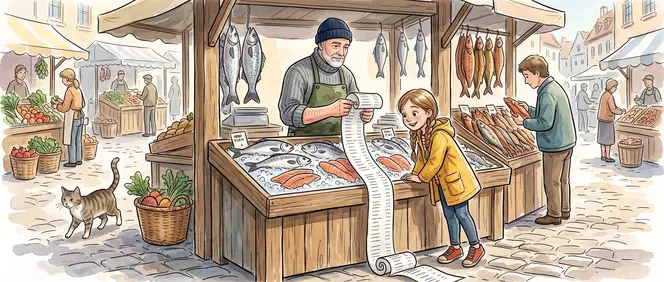
A Saturday morning in June. The market square is full. You and Lucía stop at the fish stall. Uwe unrolls a very long paper bill.
 Manuel
¡Buenos días! ¡El número siete! Otra vez por aquí.
Good morning! Number seven! Here again.
 Lucía
LucíaBuenos días, Manuel. Pescado para Michi, por favor.
Good morning, Manuel. Fish for Michi, please.
- Manuel
¿Para Michi? Su cuenta es cada vez más larga.
For Michi? His bill gets longer and longer.
¿Lo conoces desde hace mucho?
Have you known him for a long time?
¿Lo conoces desde hace mucho?
Have you known him for a long time?
- Manuel
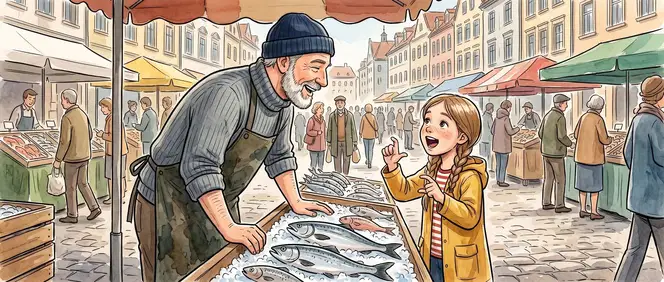
Sí. Desde pequeño. Te cuento su primer día aquí.
Yes. Since he was little. I will tell you about his first day here.
 Lucía
Lucía¿Tan pequeño? ¿Como mi mano?
That small? Like my hand?
- Manuel
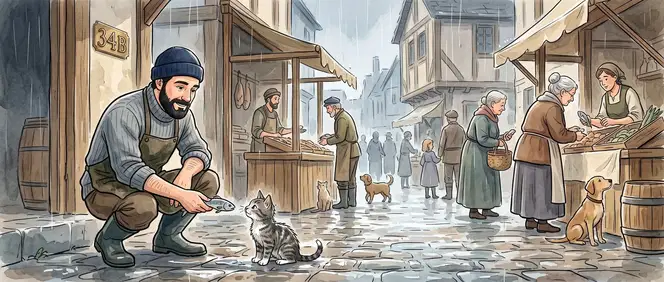
Sí. Una mañana llega al mercado. Hace frío.
Yes. One morning he arrives at the market. It is cold.
 Manuel
Está mojado y tiene hambre. Le doy pescado.
He is wet and hungry. I give him fish.
¿Y después?
And then?
¿Y después?
And then?
- Manuel
Después empieza su cuenta.
Then his bill starts.
- Lucía
¿Y su oreja? ¿Por qué es diferente?
And his ear? Why is it different?
- Manuel
Por un perro del mercado. Le muerde la oreja.
Because of a dog at the market. It bites his ear.
- Manuel
Por eso no le gustan los perros.
That is why he does not like dogs.
Karim from the corner shop comes over with a box of apples.
 Diego
DiegoBuenos días. ¿La historia de Michi? Yo también la conozco.
Good morning. Michi’s story? I know it too.
- Diego
Todos le damos algo. Pescado, leche. Pero nadie sabe de quién es.
We all give him something. Fish, milk. But nobody knows who he belongs to.
- Lucía
¿Se queda en el mercado?
Does he stay at the market?
- Diego
No. Busca una casa.
No. He looks for a home.
- Diego
Una casa de verdad. Con puerta y cama.
A real home. With a door and bed.
 Diego
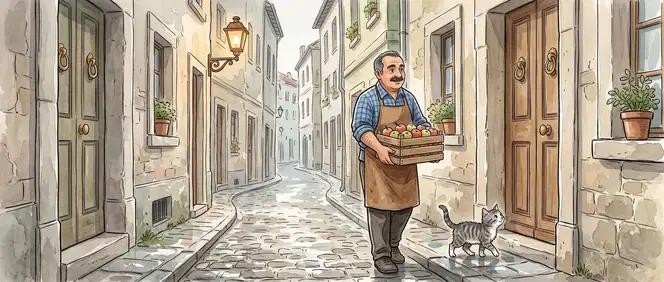
DiegoVa conmigo. De una casa a otra.
He goes with me. From one house to another.
- Diego
Mira las puertas. Pero no se queda.
He looks at the doors. But does not stay.
- Lucía
¡Hasta el número siete!
Until number seven!
- Diego
Exactamente. Se sienta en la puerta. Y espera.
Exactly. He sits at the door. And waits.
That afternoon, in the courtyard of number 7. Elvira sits on her bench, and you tell her what you have heard.
 Elvira
Claro que conozco la historia. Estoy allí.
Of course I know the story. I am there.
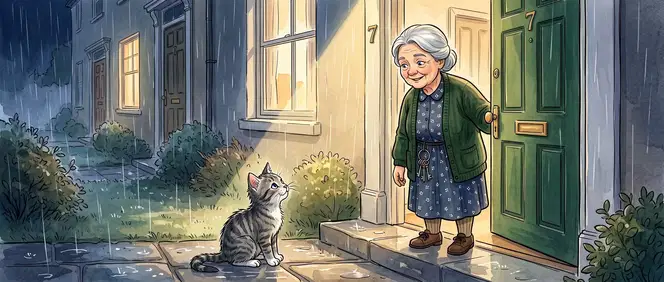 Elvira
Llueve. Abro la puerta. Hay un gatito gris.
It is raining. I open the door. There is a little grey cat.
- Elvira
Le digo: ¡Tú no eres mi gato!
I tell him: You are not my cat!
- Lucía
¿Y qué hace?
And what does he do?
- Elvira
Entra. Como si nada. Como el jefe.
He comes in. As if nothing were happening. Like the boss.
¿Dónde duerme?
Where does he sleep?
¿Dónde duerme?
Where does he sleep?
- Elvira
En el piso tres. Está vacío.
In flat three. It is empty.
¿El piso tres? ¡Mi piso!
Flat three? My flat!
¿El piso tres? ¡Mi piso!
Flat three? My flat!
- Elvira
Sí. Es su casa antes de ser la tuya.
Yes. It is his home before becoming yours.
- Lucía
¿Quién le pone el nombre?
Who names him?
- Elvira
Yo. Michi. Le queda bien.
Me. Michi. It suits him.
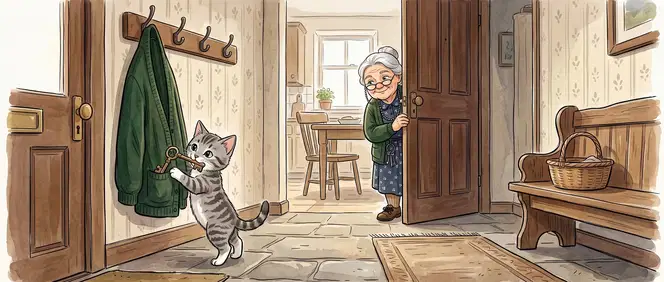 Elvira
La mañana siguiente me quita una llave del bolsillo. La primera.
The next morning he takes a key from my pocket. The first one.
- Lucía
¿Qué llave?
What key?
- Elvira
La del piso tres, claro.
Flat three’s, of course.
¿Como la mía?
Like mine?
¿Como la mía?
Like mine?
- Elvira
Exactamente. Para él, es su llave. Por eso la busca en su primera noche aquí.
Exactly. To him it is his key. That is why he looks for it on your first night here.
Michi walks across the courtyard and jumps onto the bench, between you and Elvira, a big old key under his paw.
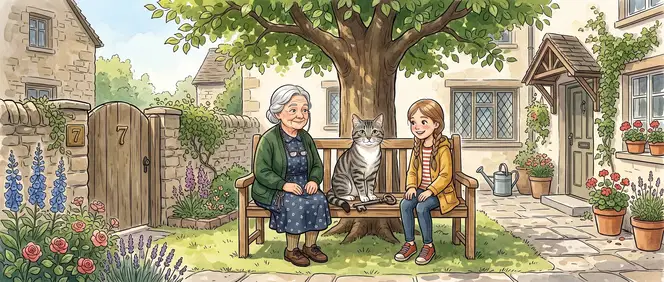 Lucía
LucíaNo es malo. Solo le gustan las llaves.
He is not naughty. He just likes keys.
- Lucía
¿Diez años más aquí? ¡Necesitas diez llaves nuevas!
Ten more years here? You need ten new keys!
Vale. Voy a comprar muchas.
All right. I am going to buy lots.
Vale. Voy a comprar muchas.
All right. I am going to buy lots.
- Elvira
¿Té? Hay más historias.
Tea? There are more stories.
Sí, gracias. ¿Y tú, Michi? ¿Prefieres pescado?
Yes, thank you. And you, Michi? Do you prefer fish?
Sí, gracias. ¿Y tú, Michi? ¿Prefieres pescado?
Yes, thank you. And you, Michi? Do you prefer fish?
Michi no dice nada. Ya está en la puerta de Elvira.
Michi says nothing. He is already at Elvira’s door.
Practice 1/3 · Who says it
Who says it?
Buenos días, Manuel. Pescado para Michi, por favor.
Buenos días, Manuel. Pescado para Michi, por favor.
Le digo: ¡Tú no eres mi gato!
No es malo. Solo le gustan las llaves.
No es malo. Solo le gustan las llaves.
Practice 2/3 · True or false
Michi’s first day
True or false?
Manuel le da pescado.
Manuel gives him fish.
Michi busca una casa.
Michi looks for a home.
Su primera llave es del piso uno.
His first key is for flat one.
Practice 3/3 · Questions
A home and a key
Answer the questions.
¿Quién le pone el nombre?
Who names him?
¿Por qué busca tu llave?
Why does he look for your key?
Unit complete