Bonus storyPremium
La pared de las fotos
The photo wall
Module 4 · Photos on the wallGet to know the neighbours and practise what you've learned in a new story.
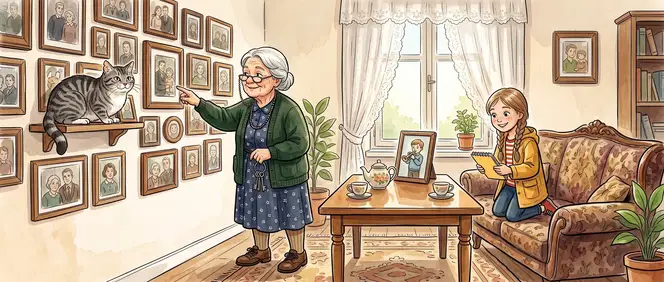
The storyThe day after Lucía's birthday, Elvira takes you and Lucía along her photo wall: Elvira at twenty, her husband, the old house, forty years as a teacher, and Marta as a little girl.
New words in the story
- la sonrisa smile
- los alumnos pupils
- desde hace for (a duration continuing now)
- la infancia childhood
- guapa pretty
- especial special
- perfecta perfect
- el reloj clock
Tap a word to see what it means.
The day after the party. Elvira's living room smells of strong black tea.
Elvira y Lucía están en el salón. Hay muchas fotos en la pared.
Elvira and Lucía are in the living room. There are many photos on the wall.
¿Dónde está ahora la foto de Javier?
Where is Javier’s photo now?
¿Dónde está ahora la foto de Javier?
Where is Javier’s photo now?
 Elvira
En la mesa. Ahora podemos verla.
On the table. Now we can see it.
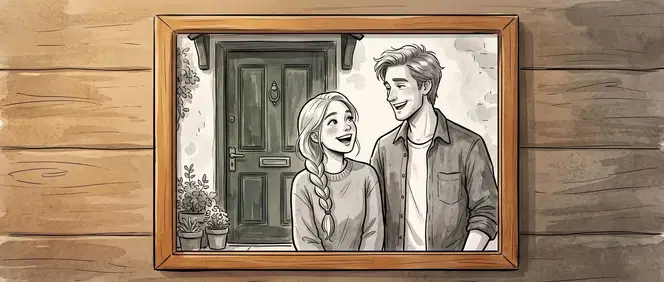
Lucía points at an old black-and-white photo of a young woman in front of a green door.
 Lucía
LucíaAbuela, ¿quién es esta joven?
Grandma, who is this young woman?
 Elvira
Soy yo. Aquí tengo veinte años.
It is me. I am twenty here.
- Lucía
¡Qué guapa!
How pretty!
- Elvira
¡Y ahora también!
And now too!
¿Y el joven a su lado?
And the young man beside you?
¿Y el joven a su lado?
And the young man beside you?
- Elvira
Mi marido. Lucía, es tu abuelo.
My husband. Lucía, he is your grandfather.
- Lucía
Solo lo conozco por las fotos.
I only know him from photos.
- Elvira
Mira su sonrisa. Es una foto muy especial para mí.
Look at his smile. It is a very special photo for me.
¿Dónde están?
Where are you?
¿Dónde están?
Where are you?
- Elvira
Al lado del río. Es agosto. Mira qué sol.
Beside the river. It is August. Look at that sun.
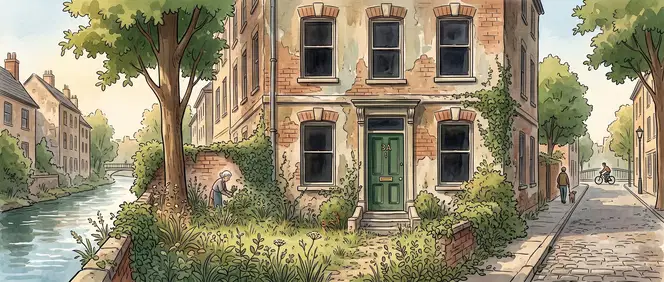
The next photo shows an old house with a green door and dark, empty windows.
 Elvira
Esta es la casa del número siete. En la foto está vacía.
This is the house at number seven. It is empty in the photo.
¡Como mi piso el primer día!
Like my flat on the first day!
¡Como mi piso el primer día!
Like my flat on the first day!
- Elvira
Es la casa de los padres de mi marido.
It is my husband’s parents’ house.
- Elvira
Para dos personas es demasiado grande.
It is too big for two people.
- Elvira
Para nosotros, perfecta. Vivo aquí desde hace cincuenta años.
Perfect for us. I have lived here for fifty years.
- Lucía
¡Cincuenta! Como el hermano de mamá.
Fifty! Like Mum’s brother.
On the next photo, a school yard full of children, and at the side a young teacher.
¿Y esta foto? ¡Cuántos niños!
And this photo? So many children!
¿Y esta foto? ¡Cuántos niños!
And this photo? So many children!
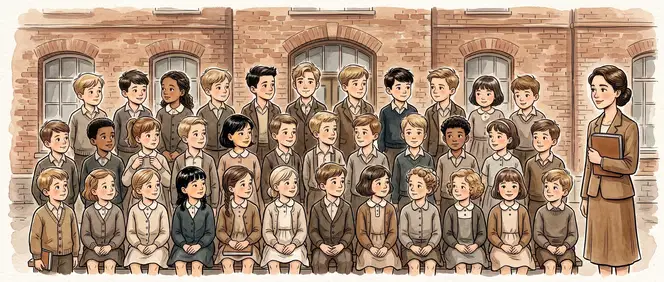 Elvira
Mi escuela. Aquí soy profesora. Siempre llevo un libro.
My school. I am a teacher here. I always carry a book.
¿Son todos sus hijos?
Are they all your children?
¿Son todos sus hijos?
Are they all your children?
- Elvira
Mis alumnos. Son como mi familia.
My pupils. They are like my family.
- Lucía
¿Y mamá? ¿Está en la foto también?
And Mum? Is she in the photo too?
- Elvira
Sí. Marta hace muchas preguntas. Como tú.
Yes. Marta asks lots of questions. Like you.
A small colour photo of a girl of seven with long light-brown hair and a big smile.
- Elvira
Aquí Marta tiene siete años.
Marta is seven here.
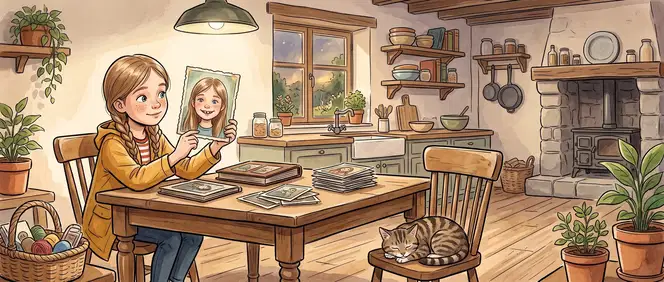 Lucía
Lucía¡Mamá! ¡Qué pequeña! Y con el pelo largo y los ojos azules.
Mum! So small! And with long hair and blue eyes.
- Elvira
Como yo. La foto es de aquí, del número siete.
Like me. The photo is from here, number seven.
- Lucía
¡Y yo ya tengo diez!
And I am ten already!
- Elvira
Este es mi hijo. Aquí tiene cinco.
This is my son. He is five here.
¡Qué tarta más grande!
What a big birthday cake!
¡Qué tarta más grande!
What a big birthday cake!
- Elvira
Mira su cara. Tiene hambre. Como usted.
Look at his face. He is hungry. Like you.
¿Yo? ¡Ahora no tengo hambre!
Me? I am not hungry now!
¿Yo? ¡Ahora no tengo hambre!
Me? I am not hungry now!
Elvira takes two small old photos out of her cardigan pocket.
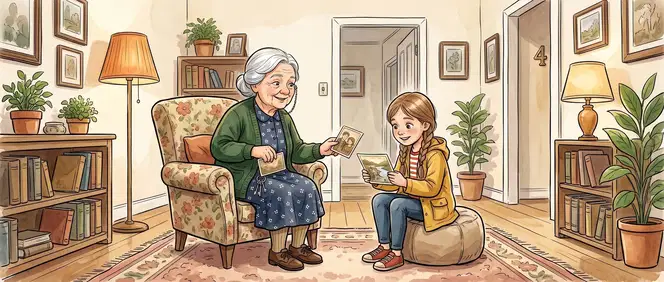 Elvira
Lucía, esta foto es para ti. Tu abuelo y yo, junto al río.
Lucía, this photo is for you. Your grandfather and me, by the river.
- Lucía
¿Para mí? Gracias, abuela.
For me? Thank you, Grandma.
- Elvira
Y esta es para usted. La casa hace cincuenta años.
And this is for you. The house fifty years ago.
- Elvira
¿Tiene alguna foto de su infancia?
Do you have a photo from your childhood?
Sí. De Hamburgo. Mis padres viven allí todavía.
Yes. From Hamburg. My parents still live there.
Sí. De Hamburgo. Mis padres viven allí todavía.
Yes. From Hamburg. My parents still live there.
Michi jumps onto the shelf and sits down in front of the photo wall.
- Lucía
Abuela, ¿dónde está la foto de Michi?
Grandma, where is Michi’s photo?
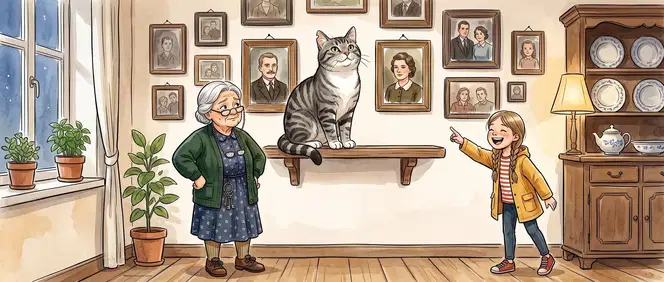 Elvira
¿De Michi? No es mi gato.
Of Michi? He is not my cat.
- Lucía
Pero está aquí todos los días. ¡Es de la familia!
But he is here every day. He is part of the family!
- Elvira
Vale. ¿Puedes dibujarlo?
All right. Can you draw him?
- Lucía
¡Sí! En mi cuaderno nuevo.
Yes! In my new sketchbook.
That evening a bright yellow page hangs among the old photos.
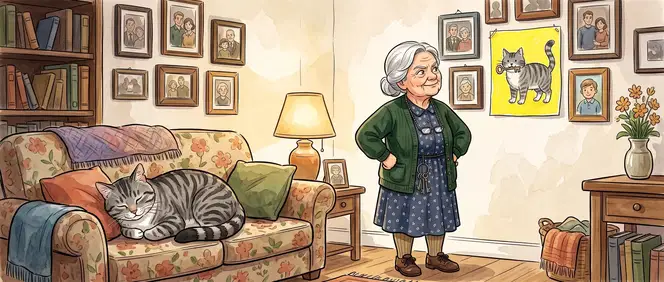
Por la noche hay un dibujo nuevo en la pared: Michi con una llave. Ahora está con la familia.
At night there is a new drawing on the wall: Michi with a key. Now he is with the family.
Practice 1/3 · Who says it
Who says it?
Abuela, ¿quién es esta joven?
Abuela, ¿quién es esta joven?
Soy yo. Aquí tengo veinte años.
Soy yo. Aquí tengo veinte años.
¿Para mí? Gracias, abuela.
¿Para mí? Gracias, abuela.
Practice 2/3 · True or false
Look at the photographs
True or false?
Elvira tiene veinte años en la primera foto.
Elvira is twenty in the first photo.
Marta tiene diez años en la foto.
Marta is ten in the photo.
Lucía dibuja a Michi.
Lucía draws Michi.
Practice 3/3 · Questions
The family wall
Answer the questions.
¿Quién recibe la foto del río?
Who receives the river photo?
¿Qué hay de nuevo en la pared?
What is new on the wall?
Unit complete