Two families of lowercase shapes
Recognise the same word when a font localises its letters.
About this unit
Bulgarian print uses two families of small-letter shapes. Learn to read the same word in both.
- In many Bulgarian fonts, д can look like g, и like u, п like n and т like m.
- Other fonts use upright shapes, as in Russian print.
- The letter and its sound stay the same in both.
Read the examples
Tap a card and listen. Try saying it too.
Words to read

дом
home / housedom
парк
parkpark
ри́ба
fishríbaReading tips
Many Bulgarian fonts use localised small letters: д can resemble g, и can resemble u, п can resemble n and т can resemble m. Other fonts use the Russian-style upright forms. The word and its sounds stay the same. The page language must remain bg in either font.
Reading practice
Read with support
Match the words to their pictures.
Read without a sound cue
Match the words to their pictures.
Sound to spelling
Listen. Choose the spelling.
Spelling to sound
Read the word. Choose its sound.
Sound to spelling
Listen. Choose the spelling.
Read and decide
Read the word in another print style.
Build the word
Listen and build the word in typing order.
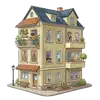
Build the word
Listen and build the word in typing order.
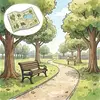
Build the word
Listen and build the word in typing order.
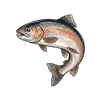
Recall the spelling
Listen and build the word without its picture.
Recall the spelling
Listen and build the word without its picture.
Recall the spelling
Listen and build the word without its picture.
Finish practice to save this unit.
You can read and write this
Recognise the same word when a font localises its letters.
дом
home / houseпарк
parkри́ба
fishUse a Bulgarian keyboard
Bulgarian has a standard BDS layout and widely used phonetic layouts. Either is optional: the guided course has on-screen tiles. Keep ъ and ь separate. Teaching acute accents may be omitted in input; the grave in ѝ belongs to the word and is not a removable stress hint.
 LernLaterne