Module 10Grammar reviewPremium
Croatian in everyday situations
Reviews practise both sides: wherever Lukas and Lena would say something differently, you do it once as each.
Rezervirati, jednu noć, uključen
Use to book a room. describes the room and therefore has feminine agreement, regardless of the guest’s sex.
A duration can be ; with dates . uses instrumental, genitive. describes the masculine breakfast.
Future plans can use futureI or present with a time: , . Ordinary links a possible visit. A past booking, , keeps real learner variants.
| Pattern | Example | Meaning |
|---|---|---|
| I want to book a room. | ||
| I want to book a room. | ||
| For one night. | ||
| For one night. | ||
| I want a single room. | ||
| I want a single room. | ||
| The room comes with breakfast. | ||
| The room comes with breakfast. | ||
Iskustvo, mogu, od ožujka
Give personal details using exact identity nouns: , . stays the same for both. Languages remain .
For current experience, continues up to now. For earlier work, . is a direct statement about experience. Avoid pretending every duration requires an English perfect calque.
A flat advert uses , , . The listed30-square-metre flat is €950 per month. asks for time to consider rather than accepting immediately.
| Pattern | Example | Meaning |
|---|---|---|
| I am German. | ||
| I am German. | ||
| I am an engineer. | ||
| I am an engineer. | ||
| I have worked here since March. | ||
| I have worked here since March. | ||
| I worked in Hamburg. | ||
| I worked in Hamburg. | ||
Pozivam, žao mi je, drugi put
Invite with or . Accept with thanks and a plan. Decline with ; a short reason is enough.
suggests another time. , and have normal negative agreement. The pronoun nobody does not make an affirmative verb negative by itself.
A learner can say . can also mean alone or by oneself, a describing word separate from the auxiliary . The gendered forms in refer to the cook, not the soup.
| Pattern | Example | Meaning |
|---|---|---|
| I invite you to dinner. | ||
| I invite you to dinner. | ||
| I am sorry, I cannot. | ||
| I am sorry, I cannot. | ||
| Maybe another time. | ||
| Maybe another time. | ||
| Everyone is busy. | ||
| Everyone is busy. | ||
Čiji, iz džepa, njegove stvari
asks whose and agrees with the owned thing: , , . Possessive adjectives from names include , , , , with endings agreeing with the object.
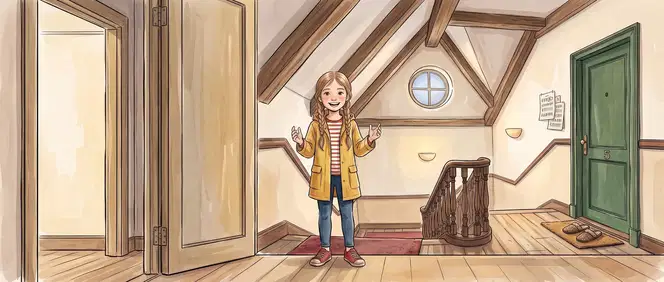
takes genitive, locative. Inanimate direct objects can keep their masculine form while animate becomes . Keep object and owner distinct when describing the attic.
Past agrees with the missing object, not its owner. Learner agrees with the learner. is a simple relative phrase with a known subject; do not leave the referent unclear.
| Pattern | Example | Meaning |
|---|---|---|
| Whose key is it? | ||
| Whose key is it? | ||
| Whose pen is it? | ||
| Whose pen is it? | ||
| Whose things are they? | ||
| Whose things are they? | ||
| The key is from the pocket. | ||
| The key is from the pocket. | ||
Ostajem, jer, ako vlak vozi
announces I am staying. says I decided. Give a clear reason with , or contrast a good job and the familiar town with .
Revisit past and future without inventing learner-sex forms in the future: , . FutureI has the same person form for both sexes; perfect participles differ.
An invitation uses or a future plan with . An ordinary condition can use present: . Polite thanks and the original neighbour greeting close the course’s social progression.
| Pattern | Example | Meaning |
|---|---|---|
| I am staying in Javorgrad. | ||
| I am staying in Javorgrad. | ||
| I decided to stay. | ||
| I decided to stay. | ||
| I called Anna. | ||
| I called Anna. | ||
| Tomorrow I will call Anna. | ||
| Tomorrow I will call Anna. | ||
Practice 1/6 · Finding words
Notice the useful pattern
Tap the form practised in this unit.
As Lukas
.
I booked a room.
As Lena
.
I booked a room.
As Lukas
.
I am German.
As Lena
.
I am German.
.
I want to book a room.
As Lukas
.
I am German.
As Lena
.
I am German.
Practice 2/6 · The right form
Choose the form
Use the English meaning and the pattern in this unit.
As Lukas
sam sobu.
I booked a room.
As Lena
sam sobu.
I booked a room.
As Lukas
Ja sam .
I am German.
As Lena
Ja sam .
I am German.
Želim rezervirati .
I want to book a room.
As Lukas
Ja sam .
I am German.
As Lena
Ja sam .
I am German.
Pozivam vas na .
I invite you to dinner.
je ključ?
Whose key is it?
u Javorgradu.
I am staying in Javorgrad.
Za jednu .
For one night.
Practice 3/6 · Fill the gaps
Complete the messages
Fill the gaps with the words from the box.
Želim rezervirati .
I want to book a room.
Želim rezervirati .
I want to book a room.
As Lukas
Ja sam .
I am German.
As Lena
Ja sam .
I am German.
Pozivam vas na .
I invite you to dinner.
Pozivam vas na .
I invite you to dinner.
je ključ?
Whose key is it?
je ključ?
Whose key is it?
u Javorgradu.
I am staying in Javorgrad.
u Javorgradu.
I am staying in Javorgrad.
Za jednu .
For one night.
Za jednu .
For one night.
Practice 4/6 · Building sentences
Build a sentence
Put the words in order.
Too hard? Listen to the sentence first.
As Lukas
I booked a room.
As Lena
I booked a room.
As Lukas
I am German.
As Lena
I am German.
I want to book a room.
As Lukas
I am German.
As Lena
I am German.
I invite you to dinner.
Whose key is it?
Practice 5/6 · In situations
What would you say?
Choose the right words for the situation.
As Lukas
I booked a room.
You say:
Use the meaning and Croatian pattern explained in this unit.
As Lena
I booked a room.
You say:
Use the meaning and Croatian pattern explained in this unit.
As Lukas
I am German.
You say:
Use the meaning and Croatian pattern explained in this unit.
As Lena
I am German.
You say:
Use the meaning and Croatian pattern explained in this unit.
I want to book a room.
You say:
Use the meaning and Croatian pattern explained in this unit.
I want to book a room.
You say:
Use the meaning and Croatian pattern explained in this unit.
As Lukas
I am German.
You say:
Use the meaning and Croatian pattern explained in this unit.
As Lena
I am German.
You say:
Use the meaning and Croatian pattern explained in this unit.
Practice 6/6 · Matching
Connect messages and meanings
Match the pairs.
Unit complete
 LernLaterne