Bonus storyPremium
Chlapec s trumpetou
The boy with the trumpet
Module 9 · The festivalGet to know the neighbours and practise what you've learned in a new story.
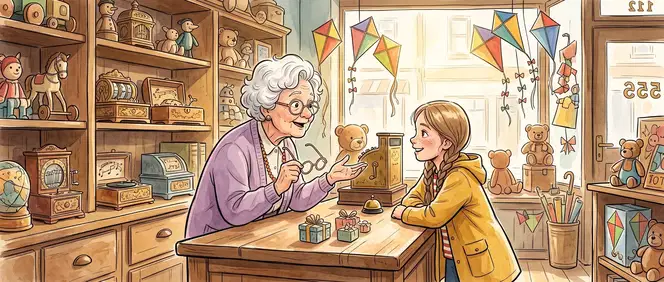
The storySaturday morning, the day of the festival. On the way to the market square, you and Eliška stop at the old toy and gift shop, and Mrs Jana tells you about a boy of ten, his first trumpet and his first festival, eighteen years ago.
New words in the story
- orchestr orchestra
- tenkrát back then
- poprvé for the first time
- přestat to stop
- účes haircut
- schodech the stairs / steps, as in on the steps
- písničku a little song; song as an object
- vrátili returned; came back (a male or mixed group)
Tap a word to see what it means.
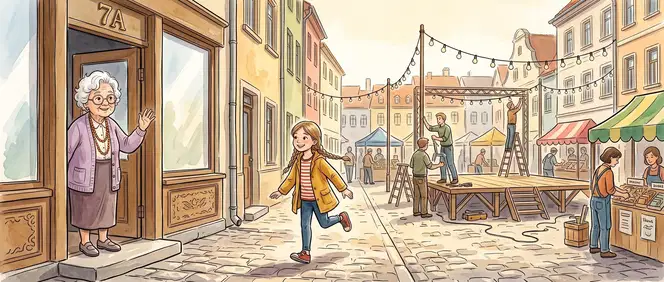
Saturday morning, the day of the festival. The sun is out. On the way to the market square, you and Eliška pass the old toy and gift shop. Mrs Jana is standing in the doorway.
 Jana
JanaDobré ráno! Jdete na slavnost?
Good morning! Off to the festival?
 Eliška
Dobré ráno, paní Jano! Ano. Jan dnes večer hraje první!
Good morning, Mrs Jana! Yes. Tonight Jan is playing first!
- Jana
Malý Jan? Dnes? Pojďte dál!
Little Jan? Tonight? Come in, come in!
Inside, the shop smells of wood and old paper. Mrs Jana sits down behind her counter and takes off her glasses.
- Jana
Znám malého Jana moc dlouho. Tenkrát mu bylo deset.
I've known little Jan for a very long time. Back then he was ten.
 Jana
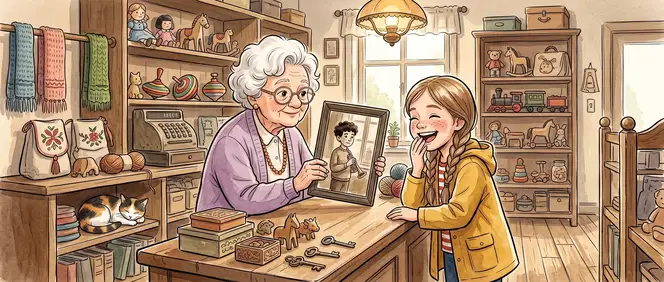
JanaEliško, viděla jsi jeho fotku? S trumpetou u okna?
Eliška, have you seen his photo? With the trumpet, at the window?
- Eliška
Viděla! A s hrozným účesem!
I have! And with a terrible haircut!
Tenkrát bydlel v domě číslo sedm, že?
He lived at number 7 then, didn't he?
Tenkrát bydlel v domě číslo sedm, že?
He lived at number 7 then, didn't he?
- Jana
Ano. S maminkou a tatínkem ve druhém patře. Ve vašem bytě.
Yes. With his mum and dad, on the second floor. In your flat.
Vím. Jan mi to řekl.
I know. Jan told me.
Vím. Jan mi to řekl.
I know. Jan told me.
- Jana
Maminka a tatínek hodně pracovali. Celý den, každý den.
His mum and dad worked a lot. All day, every day.
- Jana
Po škole byl malý Jan sám. Sám s trumpetou.
And after school little Jan was on his own. On his own with a trumpet.
- Eliška
S trumpetou? Odkud měl trumpetu?
With a trumpet? Where did he get a trumpet?
- Jana
Trumpeta byla Mariina. Malá, stará. Marie mu ji dala.
The trumpet was Marie's. A small, old trumpet. Marie gave it to him.
- Eliška
Babiččina? A odkud měla babička trumpetu?
Grandma's? And where did Grandma get a trumpet?
- Jana
Nevím. Marie ví všechno. Já ne.
I don't know. Marie knows everything, and I don't.
 Jana
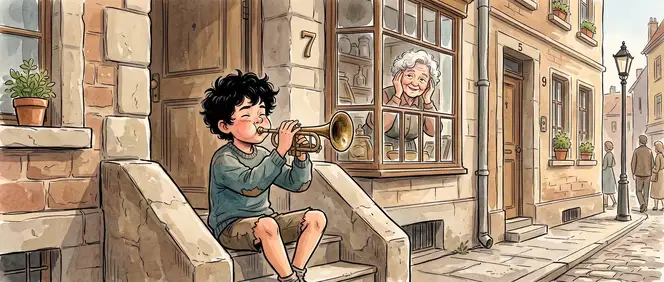
JanaKaždý den seděl na schodech pod mým oknem a hrál.
Every day he sat on the steps under my window and played.
- Jana
Nejdřív hrál špatně. Moc hlasitě a moc špatně!
At first he played very badly. Very loudly and very badly!
A vy jste poslouchala? Každý den?
And you listened? Every day?
A vy jste poslouchala? Každý den?
And you listened? Every day?
- Jana
Poslouchala. Co jsem mohla dělat? Pracovala jsem tady.
I listened. What could I do? I worked here.
- Jana
Potom hrál líp. A přišla městská slavnost.
After a while he played better. And then came the town festival.
- Eliška
A hrál na slavnosti?
And he played at the festival?
- Jana
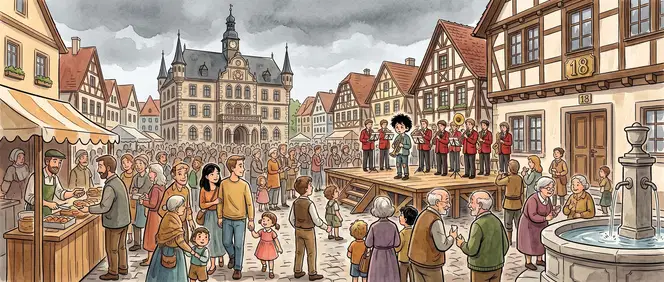
Ano. Na náměstí s orchestrem. Poprvé.
He did. On the square, with the orchestra. For the first time.
 Jana
JanaNejdřív to bylo špatné. Moc se bál. Na náměstí bylo hodně lidí.
At first it was very bad. He was very frightened. There were lots of people on the square.
- Jana
Orchestr hrál jednu písničku a malý Jan jinou. Špatnou!
The orchestra played one song, and little Jan another. The wrong one!
- Jana
Potom pršelo. Hodně! A hodně lidí šlo domů.
Then it rained. It poured! And lots of people went home.
- Jana
Malý Jan byl mokrý a smutný. Taky chtěl domů.
Little Jan was wet and very sad. He wanted to go home too.
- Eliška
A babička? Kde byla babička?
And Grandma? Where was Grandma?
- Jana
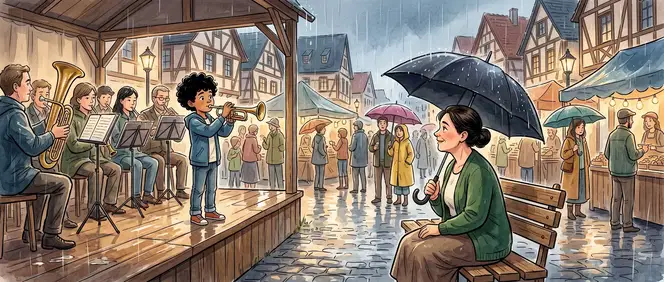
Marie seděla na lavičce před pódiem. S deštníkem.
Marie was sitting on the bench in front of the stage. With an umbrella.
- Jana
Řekla: Jane, nejdeš domů! Hraj!
She said: 'Jan, you're not going home! Play!'
A hrál?
And he played?
A hrál?
And he played?
 Jana
JanaHrál. V dešti. Stejnou písničku jako orchestr. Moc krásně.
He did. In the rain. The same song as the orchestra. And very beautifully.
- Jana
Potom přestalo pršet. Lidé se vrátili.
At last the rain stopped, and the people came back.
- Jana
Všichni jsme poslouchali. A potom celé náměstí zpívalo.
We all listened. And then the whole square sang.
- Eliška
Vy jste taky zpívala, paní Jano?
And did you sing, Mrs Jana?
- Jana
Jistě! Já, Marie, všichni.
Of course! I sang, Marie sang, we all sang.
A maminka s tatínkem? Byli tam?
And his mum and dad? Were they there?
A maminka s tatínkem? Byli tam?
And his mum and dad? Were they there?
- Jana
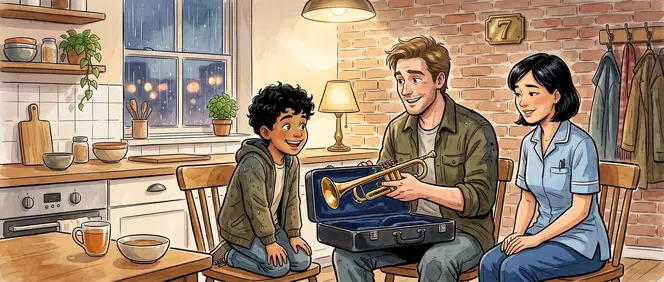
Přišli po práci. Pozdě. Ale slyšeli poslední písničku.
They came after work, late. But they heard the last song.
 Jana
JanaTatínek byl moc šťastný. Potom rodiče koupili Janovi novou velkou trumpetu.
His dad was very happy. Afterwards his parents bought little Jan a new, big trumpet.
- Eliška
A malá trumpeta?
And the little trumpet?
- Jana
Zůstala u Marie. Možná tam pořád je. Kdo ví?
The little one stayed with Marie. Maybe it's still there. Who knows?
- Eliška
Babička ví. Babička ví všechno!
Grandma knows. Grandma knows everything!
Mrs Jana puts her glasses back on and looks out at the sunny street.
- Jana
A dnes bude zase hrát na náměstí. Jako před osmnácti lety.
And today he'll play on the square again. Like eighteen years ago.
Přijdete, paní Jano?
Will you come, Mrs Jana?
Přijdete, paní Jano?
Will you come, Mrs Jana?
- Jana
Přijdu. Sednu si vedle Marie. A když bude pršet, mám deštník!
I'll come. I'll sit next to Marie. And if it rains, I've got an umbrella!
 Eliška
A všichni budeme zpívat!
And we'll all sing!
Practice 1/4 · Who says it
Who said it?
Who says it?
Dobré ráno! Jdete na slavnost?
Dobré ráno! Jdete na slavnost?
Dobré ráno, paní Jano! Ano. Jan dnes večer hraje první!
Dobré ráno, paní Jano! Ano. Jan dnes večer hraje první!
Tenkrát bydlel v domě číslo sedm, že?
Tenkrát bydlel v domě číslo sedm, že?
Practice 2/4 · True or false
Right or wrong?
True or false?
Janovi bylo deset.
Jan was ten.
První trumpeta byla nová.
The first trumpet was new.
Na slavnosti pršelo.
It rained at the festival.
Marie šla domů.
Marie went home.
Rodiče koupili novou trumpetu.
His parents bought a new trumpet.
Practice 3/4 · What happens
What happened first?
Put what happens in order.
Practice 4/4 · Questions
Understand the story
Answer the questions.
Čí byla malá trumpeta?
Whose was the little trumpet?
This detail is stated in the story.
Co dělala Marie?
What did Marie do?
This detail is stated in the story.
Co koupili rodiče?
What did his parents buy?
This detail is stated in the story.
Unit complete
