An infinitive is the dictionary verb form, such as . It does not mark grammatical person.
Pronoun: A person or thing word: , , , , .
Adjective: A word describing a person or thing, such as or .
Plural: More than one; plural verbs usually use the infinitive form.
to be and pronouns
Use to say who someone is. In Dutch, subject pronouns are very important: . Here, the landlady and other adult strangers use formal to the learner, and the learner uses back. With a child or a friendly neighbour, use or .
The full present forms are , , , , , , . In plural, use , , . The learner does not change adjectives or participles for sex in Dutch.
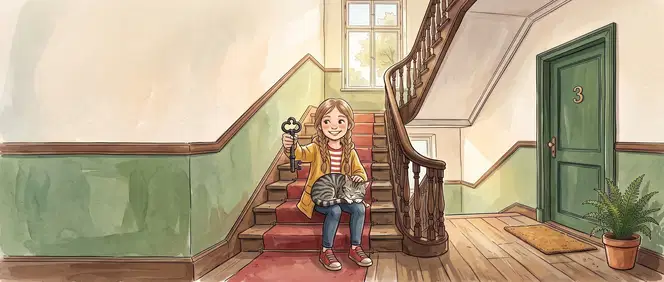
Use for introducing people and things: Use for Max because Max is a male cat. For Emma, use . For things like , use .
For neighbour words, Dutch really has a sex difference: for a male neighbour and for a female neighbour. Use the real one only when it matters.
| Form | Example | Meaning |
|---|---|---|
| I am Lukas. | ||
| I am Lukas. | ||
| You are the new neighbour. | ||
| You are the new neighbour. | ||
| You are Emma. | ||
| You are Emma. | ||
| He is not mine. | ||
| He is not mine. | ||
| She is here. | ||
| She is here. | ||
| It is my key. | ||
| It is my key. | ||
| We are friends. | ||
| We are friends. | ||
| You are here. | ||
| You are here. | ||
| They are at home. | ||
| They are at home. | ||
Ik ben Lukas.I am Lukas.
Ik ben Lena.I am Lena.
U bent de nieuwe buurman.You are the new neighbour.
U bent de nieuwe buurvrouw.You are the new neighbour.
Jij bent Emma.You are Emma.
Hij is Max.He is Max.
Zij is hier.She is here.
Het is mijn huis.It is my house.
Wij zijn hier.We are here.
U bent mijn buurman.You are my male neighbour.
Practice 1/6 · Finding words
Notice the useful pattern
Tap the form practised in this unit.
.
I am Lukas.
.
I am Lena.
.
You are the new neighbour.
.
You are the new neighbour.
.
You are Emma.
.
He is Max.
Practice 2/6 · The right form
Choose the form
Use the English meaning and the pattern in this unit.
Ik Lukas.
I am Lukas.
Ik Lena.
I am Lena.
U de nieuwe buurman.
You are the new neighbour.
U de nieuwe buurvrouw.
You are the new neighbour.
Jij Emma.
You are Emma.
Hij Max.
He is Max.
Zij hier.
She is here.
Het mijn huis.
It is my house.
Wij hier.
We are here.
Ik ben de nieuwe .
I am the new neighbour.
Ik ben de nieuwe .
I am the new neighbour.
Practice 3/6 · Fill the gaps
Complete the messages
Fill the gaps with the words from the box.
Jij Emma.
You are Emma.
Hij Max.
He is Max.
Zij hier.
She is here.
Het mijn huis.
It is my house.
Wij hier.
We are here.
Ik ben de nieuwe .
I am the new neighbour.
Ik ben de nieuwe .
I am the new neighbour.
Practice 4/6 · Building sentences
Build a sentence
Put the words in order.
I am Lukas.
I am Lena.
You are the new neighbour.
You are the new neighbour.
You are Emma.
He is Max.
She is here.
It is my house.
Practice 5/6 · In situations
What would you say?
Choose the right words for the situation.
I am Lukas.
You say:
Use the meaning and Dutch pattern explained in this unit.
I am Lukas.
You say:
Use the meaning and Dutch pattern explained in this unit.
You are the new neighbour.
You say:
Use the meaning and Dutch pattern explained in this unit.
You are the new neighbour.
You say:
Use the meaning and Dutch pattern explained in this unit.
You are Emma.
You say:
Use the meaning and Dutch pattern explained in this unit.
You are Emma.
You say:
Use the meaning and Dutch pattern explained in this unit.
He is Max.
You say:
Use the meaning and Dutch pattern explained in this unit.
He is Max.
You say:
Use the meaning and Dutch pattern explained in this unit.
Practice 6/6 · Matching
Connect messages and meanings
Match the pairs.
Unit complete