More than one thing and whose it is
Plural naming forms end in -t: tuoli → tuolit, ovi → ovet, pöytä → pöydät. Some stems change, so learn the pair. The genitive ending -n also uses this stem: , . asks whose:
After a number of two or more, use singular partitive: . The form is singular even though the meaning is more than one. After , keep the basic form: . Standard ownership adds the personal ending: . Learn (now let us eat) as a whole invitation; ordinary requests come later.
| Form | Example | Meaning |
|---|---|---|
| These are the chairs. | ||
| These are the chairs. | ||
| These are the doors. | ||
| These are the doors. | ||
| Here is one cup. | ||
| Here is one cup. | ||
| Here are two cups. | ||
| Here are two cups. | ||
| Here are two chairs. | ||
| Here are two chairs. | ||
| The lamp is under the table. | ||
| The lamp is under the table. | ||
| Whose table is this? | ||
| Whose table is this? | ||
| It is Sanna’s. | ||
| It is Sanna’s. | ||
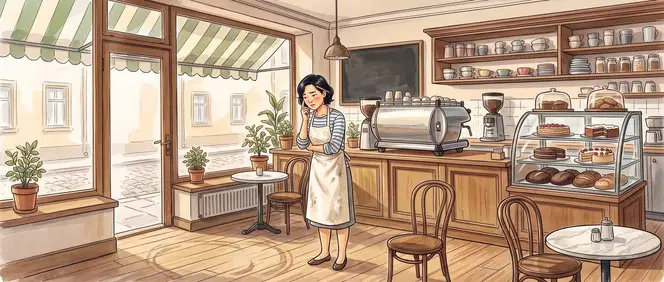
Nämä ovat tuolit.These are the chairs.
Nämä ovat ovet.These are the doors.
Tässä on yksi kuppi.Here is one cup.
Tässä on kaksi kuppia.Here are two cups.
Tässä on kaksi tuolia.Here are two chairs.
Lamppu on pöydän alla.The lamp is under the table.
Kenen pöytä tämä on?Whose table is this?
Se on Sannan.It is Sanna’s.
Practice 1/6 · Finding words
Notice the useful pattern
Tap the form practised in this unit.
.
These are the chairs.
.
These are the doors.
.
Here is one cup.
.
Here are two cups.
.
Here are two chairs.
.
The lamp is under the table.
?
Whose table is this?
.
It is Sanna’s.
Practice 2/6 · The right form
Choose the form
Use the English meaning and the pattern in this unit.
Nämä ovat .
These are the chairs.
Nämä ovat .
These are the doors.
Tässä on yksi .
Here is one cup.
Tässä on kaksi .
Here are two cups.
Tässä on kaksi .
Here are two chairs.
Lamppu on alla.
The lamp is under the table.
pöytä tämä on?
Whose table is this?
Se on .
It is Sanna’s.
Practice 3/6 · Fill the gaps
Complete the messages
Fill the gaps with the words from the box.
Tässä on yksi .
Here is one cup.
Tässä on kaksi .
Here are two cups.
Tässä on kaksi .
Here are two chairs.
Lamppu on alla.
The lamp is under the table.
pöytä tämä on?
Whose table is this?
Se on .
It is Sanna’s.
Practice 4/6 · Building sentences
Build a sentence
Put the words in order.
These are the chairs.
These are the doors.
Here is one cup.
Here are two cups.
Here are two chairs.
The lamp is under the table.
Whose table is this?
It is Sanna’s.
Practice 5/6 · In situations
What would you say?
Choose the right words for the situation.
These are the chairs.
You say:
Use the meaning and Finnish pattern explained in this unit.
These are the chairs.
You say:
Use the meaning and Finnish pattern explained in this unit.
These are the doors.
You say:
Use the meaning and Finnish pattern explained in this unit.
These are the doors.
You say:
Use the meaning and Finnish pattern explained in this unit.
Here is one cup.
You say:
Use the meaning and Finnish pattern explained in this unit.
Here is one cup.
You say:
Use the meaning and Finnish pattern explained in this unit.
Here are two cups.
You say:
Use the meaning and Finnish pattern explained in this unit.
Here are two cups.
You say:
Use the meaning and Finnish pattern explained in this unit.
Practice 6/6 · Matching
Connect messages and meanings
Match the pairs.
Unit complete
