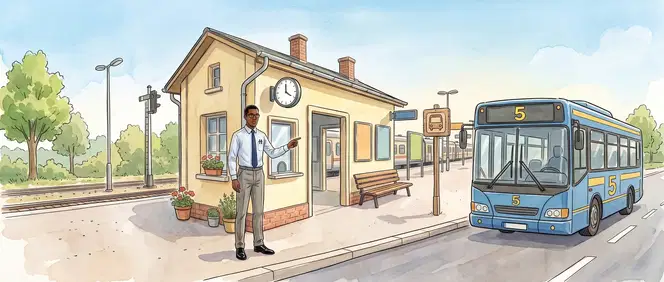
Use , and for common transport, but and . Timetables use twenty-four-hour readings: , . A return ticket is .
| Transport | Example | Meaning |
|---|---|---|
| We go to the lake by train. | ||
| We go to the lake by train. | ||
| I go to the station by bicycle. | ||
| I go to the station by bicycle. | ||
| We walk to the station. | ||
| We walk to the station. | ||
Our and our (plural)
Use with one singular noun: , , . Use with plural nouns: , .
Like and , these words agree with the thing owned, not with the owner. So is singular because is singular, and is plural because is plural.
French often uses these words in everyday talk about shared things: , , . They are very frequent and worth learning early.
At this level, the most useful contrast is simple: one thing = ; more than one thing = .
| Form | Example | Meaning |
|---|---|---|
| our plan | ||
| our plan | ||
| our town | ||
| our town | ||
| our tickets | ||
| our tickets | ||
| our children | ||
| our children | ||
Voilà notre plan B.Here is our plan B.
Où sont nos billets ?Where are our tickets?
Le lac, c'est notre idée pour dimanche.The lake is our idea for Sunday.
Voici nos pommes de terre et notre fromage.Here are our potatoes and our cheese.
Karim et Hélène aiment leur magasin.Karim and Hélène like their shop.
Lukas, où est notre carte ?Lukas, where is our map?
Lena, ce sont nos places dans le train ?Lena, are these our seats in the train?
Zoé a sa carte, et nous avons notre carte.Zoé has her map, and we have our map.
Practice 1/6 · Finding words
Notice the pattern
Tap the form practised in this unit.
.
Here is our plan B.
?
Where are our tickets?
, .
The lake is our idea for Sunday.
.
Here are our potatoes and our cheese.
Practice 2/6 · The right form
Choose the form
Use the English meaning and the pattern in this unit.
Voilà plan B.
Here is our plan B.
Où sont billets ?
Where are our tickets?
Le lac, c'est idée pour dimanche.
The lake is our idea for Sunday.
Voici pommes de terre et notre fromage.
Here are our potatoes and our cheese.
Karim et Hélène aiment magasin.
Karim and Hélène like their shop.
Lukas, où est carte ?
Lukas, where is our map?
Lena, ce sont places dans le train ?
Lena, are these our seats in the train?
Zoé a carte, et nous avons notre carte.
Zoé has her map, and we have our map.
Practice 3/6 · Fill the gaps
Complete the messages
Fill the gaps with the words from the box.
Voilà plan B.
Here is our plan B.
Où sont billets ?
Where are our tickets?
Le lac, c'est idée pour dimanche.
The lake is our idea for Sunday.
Voici pommes de terre et notre fromage.
Here are our potatoes and our cheese.
Karim et Hélène aiment magasin.
Karim and Hélène like their shop.
Lukas, où est carte ?
Lukas, where is our map?
Lena, ce sont places dans le train ?
Lena, are these our seats in the train?
Zoé a carte, et nous avons notre carte.
Zoé has her map, and we have our map.
Practice 4/6 · Building sentences
Build a sentence
Put the words in order.
Here is our plan B.
Where are our tickets?
The lake is our idea for Sunday.
Here are our potatoes and our cheese.
Karim and Hélène like their shop.
Lukas, where is our map?
Practice 5/6 · In situations
What would you say?
Choose the right words for the situation.
Here is our plan B.
You say:
Use the meaning and the French form explained in this unit.
Here is our plan B.
You say:
Use the meaning and the French form explained in this unit.
Where are our tickets?
You say:
Use the meaning and the French form explained in this unit.
Where are our tickets?
You say:
Use the meaning and the French form explained in this unit.
The lake is our idea for Sunday.
You say:
Use the meaning and the French form explained in this unit.
The lake is our idea for Sunday.
You say:
Use the meaning and the French form explained in this unit.
Here are our potatoes and our cheese.
You say:
Use the meaning and the French form explained in this unit.
Here are our potatoes and our cheese.
You say:
Use the meaning and the French form explained in this unit.
Practice 6/6 · Matching
Connect sentences and meanings
Match the pairs.
Unit complete