
Scene 25 of 50
Contrôle du chat
Cat check
Your goalI can read a short notice and write a short message to colleagues.


Prepare the wordsPremium
Meet the 7 words of this scene before you read. You can also go straight to the story.
 Thomas
Vendredi, seize heures. Contrôle du chat.
Friday, sixteen hundred. Cat check.
Félix est ici. Il est venu tous les jours depuis mercredi.
Félix is here. He's come every day since Wednesday.
Félix est ici. Il est venu tous les jours depuis mercredi.
Félix is here. He's come every day since Wednesday.
- Thomas
Et il n'est jamais en retard. Pas comme vous.
And he's never late. Unlike you.

He looks at Félix, who is asleep on the printer. - Thomas
Voilà mon affiche. Pour le mur de la cuisine.
Here's my notice. For the kitchen wall.
« Règles pour le chat du bureau. Un : le chat vient à neuf heures. Deux : le chat mange à douze heures et à cinq heures. »
'Rules for the office cat. One: the cat comes at nine. Two: the cat eats at twelve and at five.'
« Règles pour le chat du bureau. Un : le chat vient à neuf heures. Deux : le chat mange à douze heures et à cinq heures. »
'Rules for the office cat. One: the cat comes at nine. Two: the cat eats at twelve and at five.'
« Trois : le chat ne s'assoit pas sur les ordinateurs. Quatre : pas de chats sur l'imprimante. »
'Three: the cat does not sit on computers. Four: no cats on the printer.'
« Trois : le chat ne s'assoit pas sur les ordinateurs. Quatre : pas de chats sur l'imprimante. »
'Three: the cat does not sit on computers. Four: no cats on the printer.'
- Thomas
La règle quatre est très importante.
Rule four is very important.
Il mange combien de fois ?
How often does he eat?
Il mange combien de fois ?
How often does he eat?
- Thomas
Deux fois par jour. Seulement deux fois.
Twice a day. Only twice.
Et qu'est-ce qu'il fait l'après-midi ?
And what does he do in the afternoon?
Et qu'est-ce qu'il fait l'après-midi ?
And what does he do in the afternoon?
- Thomas
Il dort. Comme vous.
He sleeps. Like you.
Je ne dors pas ! Je travaille !
I don't sleep! I work!
Je ne dors pas ! Je travaille !
I don't sleep! I work!
- Thomas
Maintenant, écrivez un message à tout le monde, s'il vous plaît.
Now write a message to everyone, please.
« Bonjour tout le monde ! Il y a un chat dans le bureau maintenant. Merci de lire les règles sur le mur de la cuisine. »
'Hello everyone! There's a cat in the office now. Please read the rules on the kitchen wall.'
« Bonjour tout le monde ! Il y a un chat dans le bureau maintenant. Merci de lire les règles sur le mur de la cuisine. »
'Hello everyone! There's a cat in the office now. Please read the rules on the kitchen wall.'
- Thomas
Bien. Et il y a aussi la règle sept.
Good. And there's rule seven too.
Sept ? Et cinq et six ?
Seven? And five and six?
Sept ? Et cinq et six ?
Seven? And five and six?
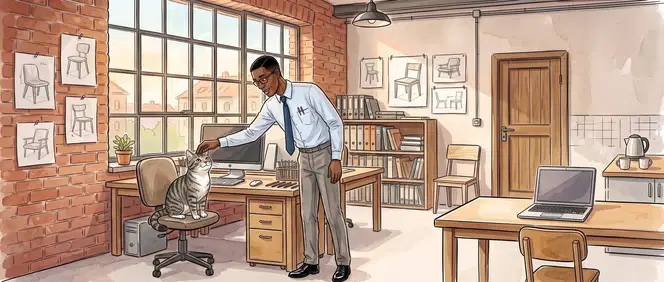
Félix is already on his chair. Thomas strokes him, carefully, with one finger. - Thomas
Il n'y a pas encore de règle cinq ou six. Sept : le vendredi, le chat s'assoit sur ma chaise.
There's no five or six yet. Seven: on Fridays, the cat sits on my chair.
Sur votre chaise ?
On your chair?
Sur votre chaise ?
On your chair?
- Thomas
Oui. Et aujourd'hui, c'est vendredi.
Yes. And today is Friday.
Who says this?
Vendredi, seize heures. Contrôle du chat.
Vendredi, seize heures. Contrôle du chat.
What does it mean?
Et il n'est jamais en retard. Pas comme vous.
Which line do you hear?
Rule four is very important.
Put the words in order.
How often does he eat?
How often does he eat?
Who says this?
Il dort. Comme vous.
Il dort. Comme vous.
What does it mean?
Je ne dors pas ! Je travaille !
Je ne dors pas ! Je travaille !
Which line do you hear?
Seven? And five and six?
Seven? And five and six?
Put the words in order.
Yes. And today is Friday.
What happens first?
Put the lines in the order they come in the scene.
Scene complete
Contrôle du chat
Goal reachedI can read a short notice and write a short message to colleagues.
