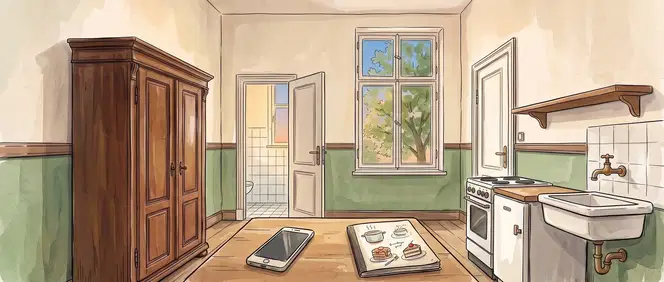
Scene 47 of 50
L’entretien
The interview
Your goalI can introduce myself fully and answer questions about my work, my languages and my past.

Prepare the wordsPremium
Meet the 5 words of this scene before you read. You can also go straight to the story.
 Lucie
LucieBonjour. Je suis Lucie. Asseyez-vous, s’il vous plaît.
Good day. I'm Lucie. Please sit down.
- Lucie
Je suis espagnole, mais j’habite ici depuis dix ans maintenant. Alors, nous allons parler français.
I'm Spanish, but I've lived here for ten years now. So we'll speak French.
- Lucie
Parlez-moi de vous. Vous venez d’où ? Qu’est-ce que vous faites ?
Tell me about yourself. Where are you from? What do you do?
Je suis Lukas Becker. Je suis allemand, de Hambourg. J’ai trente ans.
I'm Lukas Becker. I'm German, from Hamburg. I'm thirty.
Je suis Lena Becker. Je suis allemande, de Hambourg. J’ai trente ans.
I'm Lena Becker. I'm German, from Hamburg. I'm thirty.
Je suis ingénieur. Je travaille dans une entreprise de meubles, dans une petite ville au bord de la rivière.
I'm an engineer. I work at a furniture company, in a small town by the river.
Je suis ingénieur. Je travaille dans une entreprise de meubles, dans une petite ville au bord de la rivière.
I'm an engineer. I work at a furniture company, in a small town by the river.

She laughs. - Lucie
Quelles langues est-ce que vous parlez ?
Which languages do you speak?
L’allemand, l’anglais et un peu de français.
German, English and a little French.
L’allemand, l’anglais et un peu de français.
German, English and a little French.
- Lucie
Pas seulement un peu. Vous parlez bien.
Not just a little. You speak well.
- Lucie
Et qu’est-ce que vous pouvez faire ?
And what can you do?
Je peux dessiner des meubles. Et je peux m’occuper d’un chat.
I can design furniture. And I can look after a cat.
Je peux dessiner des meubles. Et je peux m’occuper d’un chat.
I can design furniture. And I can look after a cat.
- Lucie
Un chat ?
A cat?
C’est une longue histoire.
It's a long story.
C’est une longue histoire.
It's a long story.

She stands up and holds out her hand. - Lucie
Pourquoi est-ce que vous êtes venu ici, dans cette petite ville ?
Why did you come to this little town?
Pour le travail. Mais maintenant... pour les gens.
For the job. But now... for the people.
Pour le travail. Mais maintenant... pour les gens.
For the job. But now... for the people.
- Lucie
Quand est-ce que vous allez pouvoir commencer ?
When will you be able to start?
Ma période d’essai finit le trente juin.
My trial period ends on the thirtieth of June.
Ma période d’essai finit le trente juin.
My trial period ends on the thirtieth of June.
- Lucie
Excellent. Le travail est à vous. Est-ce que vous pouvez commencer le premier juillet ?
Excellent. The job is yours. Can you start on the first of July?
Si vite ? J’ai besoin de réfléchir.
So soon? I need to think about it.
Si vite ? J’ai besoin de réfléchir.
So soon? I need to think about it.
- Lucie
Bien sûr. J’attends votre réponse jusqu’à vendredi.
Of course. I'll wait for your answer until Friday.

Outside the office, a grey cat sits on a wall. It is not Félix. Félix ? Non... pas Félix.
Félix? No... Not Félix.
Félix ? Non... pas Félix.
Félix? No... Not Félix.
« Appartement au centre. Trente mètres carrés. Neuf cent cinquante euros par mois. »
'Flat in the centre. Thirty square metres. Nine hundred and fifty euros a month.'
« Appartement au centre. Trente mètres carrés. Neuf cent cinquante euros par mois. »
'Flat in the centre. Thirty square metres. Nine hundred and fifty euros a month.'
Neuf cent cinquante ! Et sans chat.
Nine hundred and fifty! And without a cat.
Neuf cent cinquante ! Et sans chat.
Nine hundred and fifty! And without a cat.
Who says this?
Bonjour. Je suis Lucie. Asseyez-vous, s’il vous plaît.
Bonjour. Je suis Lucie. Asseyez-vous, s’il vous plaît.
What does it mean?
Quelles langues est-ce que vous parlez ?
Which line do you hear?
Not just a little. You speak well.
Put the words in order.
And what can you do?
Who says this?
Quand est-ce que vous allez pouvoir commencer ?
Quand est-ce que vous allez pouvoir commencer ?
What does it mean?
Pour le travail. Mais maintenant... pour les gens.
Pour le travail. Mais maintenant... pour les gens.
Which line do you hear?
So soon? I need to think about it.
So soon? I need to think about it.
Put the words in order.
Félix? No... Not Félix.
Félix? No... Not Félix.
What happens first?
Put the lines in the order they come in the scene.
Scene complete
L’entretien
Goal reachedI can introduce myself fully and answer questions about my work, my languages and my past.