Module 1Word reviewPremium
Words of module 1: Arrival
Reviews practise both sides: wherever Lukas and Lena would say something differently, you do it once as each.
In this module you learned to
- greet an older neighbour politely and say my name
- say hello to a child, ask her name, get my key back and ask where something is
- introduce myself in a café, choose coffee or tea, and say if I like something
- knock on a neighbour's door, say that I want to sleep, and ask someone to do something tomorrow
- ask how someone is, and ask where people live
From this module's scenes


nouveau
new
Bonsoir ! Vous êtes le nouveau voisin ?Good evening! Are you the new neighbour?
Bonsoir ! Vous êtes la nouvelle voisine ?Good evening! Are you the new neighbour?
Bonsoir !
voisin
neighbour
Bonsoir ! Vous êtes le nouveau voisin ?Good evening! Are you the new neighbour?
Bonsoir ! Vous êtes la nouvelle voisine ?Good evening! Are you the new neighbour?
Bonsoir !oui
yes
Oui. Je m’appelle Lukas Becker.Yes. My name is Lukas.
Oui. Je m’appelle Lena Becker.Yes. My name is Lena.
Bonsoir !
enchanté
nice to meet you
Enchantée. Moi, c’est Mme Martin. C’est ma maison.Nice to meet you. I'm Mrs Martin. This is my house.
Bonsoir !
maisonfem.
house / building
Enchantée. Moi, c’est Mme Martin. C’est ma maison.Nice to meet you. I'm Mrs Martin. This is my house.
Bonsoir !


là-bas
there
Là means there (sometimes here in context); là-bas means over there.
Félix ? Ici. Et là. Et là. Félix, c’est le chef ici.Félix? Here. And there. And there. Félix is the boss here.
Qui habite où ?


salut
hi
Salut ! Tu t’appelles comment ?Hi! What's your name?
Salut ! Tu t’appelles comment ?Hi! What's your name?
Tu as ma clé !
la grand-mèrefem.
grandmother
Mamie is a familiar, affectionate word for grand-mère.
Zoé. Mme Martin, c’est ma grand-mère. Et toi, tu es le nouveau voisin, oui ?Zoé. Mrs Martin is my grandmother. And you're the new neighbour, right?
Zoé. Mme Martin, c’est ma grand-mère. Et toi, tu es la nouvelle voisine, oui ?Zoé. Mrs Martin is my grandmother. And you're the new neighbour, right?
Tu as ma clé !
avoir
have
Oui, je suis Lukas. Oh ! Tu as ma clé !Yes, I'm Lukas. Oh! You have my key!
Oui, je suis Lena. Oh ! Tu as ma clé !Yes, I'm Lena. Oh! You have my key!
Tu as ma clé !

chatmasc.
cat
Un chat is male; une chatte is female. Félix is male, and Zoé corrects the learner’s mistaken word in the story.
Méchante chatte !Bad she-cat!
Méchante chatte !Bad she-cat!
Tu as ma clé !
juste
just / simply
C’est un chat, pas une chatte ! Et il n’est pas méchant. Il a juste faim.It's a male cat, not a female cat! And he isn't bad. He's just hungry.
Tu as ma clé !
avoir faim
hungry
Affamé/affamée means very hungry; avoir faim is the ordinary expression.
Tu as ma clé !aussi
too / also
Faim ? Moi aussi, j’ai faim.Hungry? I'm hungry too.
Faim ? Moi aussi, j’ai faim.Hungry? I'm hungry too.
Tu as ma clé !


savoir
know (a fact)
Bonjour ! Vous le savez comment ?Good morning! How do you know?
Bonjour ! Vous le savez comment ?Good morning! How do you know?
Bon appétit !tout
everything
Par Mme Martin. Mme Martin sait tout.From Mrs Martin. Mrs Martin knows everything.
Bon appétit !


gâteaumasc.
cake
Merci ! Mais ce n’est pas mon gâteau.Thank you! But this isn't my cake.
Merci ! Mais ce n’est pas mon gâteau.Thank you! But this isn't my cake.
Bon appétit !mais
but
Merci ! Mais ce n’est pas mon gâteau.Thank you! But this isn't my cake.
Merci ! Mais ce n’est pas mon gâteau.Thank you! But this isn't my cake.
Bon appétit !maintenant
now
Maintenant, si. Vous avez très faim. Mme Martin sait.Now it is. You're very hungry. Mrs Martin knows.
Bon appétit !

aimer
like
J’aime beaucoup ! Merci, Claire !I like it very much! Thank you, Claire!
J’aime beaucoup ! Merci, Claire !I like it very much! Thank you, Claire!
Bon appétit !

la trompettefem.
trumpet
La nuit. En haut, une trompette joue.Night. Upstairs, a trumpet is playing.
Bonne nuit
jouer
play (an instrument)
La nuit. En haut, une trompette joue.Night. Upstairs, a trumpet is playing.
Bonne nuit

habiter
live
Salut. Je suis Lukas. J’habite en bas.Hi. I'm Lukas. I live downstairs.
Salut. Je suis Lena. J’habite en bas.Hi. I'm Lena. I live downstairs.
Bonne nuit


vouloir
want
Je veux vraiment dormir. Vous pouvez jouer demain ?I really want to sleep. Could you play tomorrow?
Je veux vraiment dormir. Vous pouvez jouer demain ?I really want to sleep. Could you play tomorrow?
Bonne nuit

pouvoir
can (be able to)
Je veux vraiment dormir. Vous pouvez jouer demain ?I really want to sleep. Could you play tomorrow?
Je veux vraiment dormir. Vous pouvez jouer demain ?I really want to sleep. Could you play tomorrow?
Bonne nuit


la journéefem.
day
Non. Mais elle est ici tous les jours. Ma petite-fille !No. But she's here every day. My granddaughter!
Qui habite où ?
la petite-fillefem.
granddaughter
Non. Mais elle est ici tous les jours. Ma petite-fille !No. But she's here every day. My granddaughter!
Qui habite où ?


Additional words

content
happy
Vous êtes content ici à Valbois.You are happy here in Valbois.
Vous êtes contente ici à Valbois.You are happy here in Valbois.
Bonsoir ! (P)

monsieur
gentleman, Mr, sir
Bonjour, monsieur, vous allez à Paris ?Hello, sir, are you going to Paris?
Table numéro trois
chienmasc.
dog
Le chien dort devant la boulangerie.The dog is sleeping in front of the bakery.
Tu as ma clé ! (P)
donner
give
Donne-moi means give me, to one familiar person.
Mme Martin me donne la clé de la chambre.Mrs Martin gives me the room key.
Le chat au bureau
dire
say
Je dis : « Un thé sans sucre, un petit pain et l'addition, s'il vous plaît. »I say: “A tea without sugar, a small roll, and the bill, please.”
Le formulaire

regarder
look / watch
Je regarde le Grand Lac depuis le bus.I look at the Great Lake from the bus.
L'appartement vide
bruyant
loud
For sound, fort means loud or loudly; bruyant means noisy.
Le marché est bruyant le matin.The market is loud in the morning.
Bonne nuit (P)

le silencemasc.
silence
Après le concert, il y a un grand silence.After the concert, there is great silence.
Bonne nuit (P)
la musiquefem.
music
La musique de Julien est très forte aujourd’hui.Julien's music is very loud today.
Bonne nuit (P)
chercher
look for
Je cherche mon téléphone dans ma veste.I am looking for my phone in my jacket.
Un cadeau pour Zoé
trouver
find
Je trouve enfin mon téléphone sous la veste.I finally find my phone under the jacket.
Le festival commence
Practice 1/7 · Pictures
Pictures and words
Match the words to the pictures.
Pictures and words
Match the words to the pictures.
Pictures and words
Match the words to the pictures.
Pictures and words
Match the words to the pictures.
Pictures and words
Match the words to the pictures.
Pictures and words
Match the words to the pictures.
Pictures and words
Match the words to the pictures.
Pictures and words
Match the words to the pictures.
Pictures and words
Match the words to the pictures.
Pictures and words
Match the words to the pictures.
Pictures and words
Match the words to the pictures.
Pictures and words
Match the words to the pictures.
Practice 2/7 · Listening
Listen and choose
Listen and choose the word you hear.
enchanté: nice to meet you
qui: who
clé: key
nom: name
voici: here is
Practice 3/7 · Meanings
What does it mean?
merci
nouveau
qui
ce
maison
enchanté
Practice 4/7 · Matching
Messages from the module
Match the pairs.
Practice 5/7 · Fill the gaps
Recall the conversations
Fill the gaps with the words from the box.
As Lukas
. Je m’appelle Lukas Becker.
Yes. My name is Lukas.
As Lena
. Je m’appelle Lena Becker.
Yes. My name is Lena.
As Lukas
, je suis Lukas. Oh ! Tu as ma clé !
Yes, I'm Lukas. Oh! You have my key!
As Lena
, je suis Lena. Oh ! Tu as ma clé !
Yes, I'm Lena. Oh! You have my key!
As Lukas
. Je suis Lukas.
Nice to meet you. I'm Lukas.
As Lena
e. Je suis Lena.
Nice to meet you. I'm Lena.
As Lukas
. Je suis Lukas. J’habite en bas.
Hi. I'm Lukas. I live downstairs.
As Lena
. Je suis Lena. J’habite en bas.
Hi. I'm Lena. I live downstairs.
, merci. Et vous ?
Fine, thanks. And you?
, merci. Et vous ?
Fine, thanks. And you?
Practice 6/7 · In situations
Use the messages
Choose the right words for the situation.
As Lukas
Yes. My name is Lukas.
You say:
As Lena
Yes. My name is Lena.
You say:
As Lukas
Yes, I'm Lukas. Oh! You have my key!
You say:
As Lena
Yes, I'm Lena. Oh! You have my key!
You say:
As Lukas
Nice to meet you. I'm Lukas.
You say:
As Lena
Nice to meet you. I'm Lena.
You say:
As Lukas
Hi. I'm Lukas. I live downstairs.
You say:
As Lena
Hi. I'm Lena. I live downstairs.
You say:
As Lukas
Fine, thanks. And you?
You say:
As Lena
Fine, thanks. And you?
You say:
Practice 7/7 · Comic strip
Bonjour, Mme Martin ! Vous allez bien ?
Fill the speech bubbles.
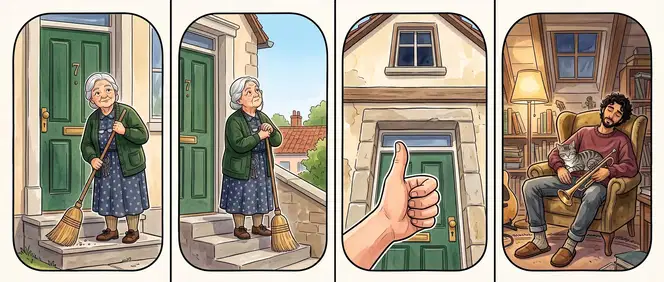 1 Lukas
Bonjour, Mme Martin ! Vous allez ?
Good morning, Mrs Martin! How are you?
2 Madeleine, merci. Et la nuit, c’était comment ?
Fine, thanks. And how was the night?
3 Lukasbien ! Julien ne joue pas.
Very good! Julien isn't playing.
4 MadeleineJulien dort. Félix aussi.
Julien is asleep. And so is Félix.
1 LenaBonjour, Mme Martin ! Vous allez ?
Good morning, Mrs Martin! How are you?
2 Madeleine, merci. Et la nuit, c’était comment ?
Fine, thanks. And how was the night?
3 Lenabien ! Julien ne joue pas.
Very good! Julien isn't playing.
4 MadeleineJulien dort. Félix aussi.
Julien is asleep. And so is Félix.
Unit complete