Reading & listening
Sein Vater, ihre Mutter
Possessive articles his, her, their: sein, ihr
His and her: sein, ihr
You know , and . For someone else there are two more: when the owner is a man or a boy (his), and when the owner is a woman or a girl (her). also means their. The owner picks the word; the noun picks the ending, as before: -e with a feminine noun and in the plural.
Practice · His and her: sein, ihr
Spot his and her
Tap the word that says whose.
. .
Lotte is nine. Her brother is still a baby.
. .
Jonas plays loudly. His trumpet is very old.
.
Hilde and her daughter are drinking tea.
sein or ihr?
Look at the owner first, then at the noun.
Mikesch und Schlüssel!
Mikesch and his key!
Katrin ist Lottes Mutter. Lotte ist Tochter.
Katrin is Lotte's mother. Lotte is her daughter.
Jonas wohnt oben. Wohnung ist klein.
Jonas lives upstairs. His flat is small.
Frau Brandt, ist das Sohn?
Mrs Brandt, is that your son?
Frau Brandt, ist das Sohn?
Mrs Brandt, is that your son?
Hallo, Lotte! Wo ist Mutter?
Hello, Lotte! Where is your mother?
Hallo, Lotte! Wo ist Mutter?
Hello, Lotte! Where is your mother?
All done.
right first time
Sein Vater, ihre Mutter
The direct object: meinen, seinen
When a masculine noun is the direct object, its article changes, just as becomes : becomes . Every ownership word does it: , , , . Feminine, neuter and plural nouns keep the forms you know.
Kennen Sie meinen Sohn?Do you know my son?
Lotte mag ihren Bruder sehr.Lotte likes her brother a lot.
Practice · The direct object: meinen, seinen
The direct object
Tap the ownership word in front of the direct object.
?
Do you know my son?
.
Lotte likes her brother a lot.
.
I can see your family in the photo.
-en or not?
Only a masculine direct object takes -en.
Lotte mag Bruder.
Lotte likes her brother.
Kennst du Mann?
Do you know my husband?
Katrin hat Baby dabei.
Katrin has her baby with her.
Jonas spielt Trompete.
Jonas plays his trumpet.
Frau Brandt, ich sehe Mann auf dem Foto.
Mrs Brandt, I can see your husband in the photo.
Frau Brandt, ich sehe Mann auf dem Foto.
Mrs Brandt, I can see your husband in the photo.
Kennen Sie Tochter?
Do you know my daughter?
All done.
right first time
Sein Vater, ihre Mutter
Lottes Mutter: a name with -s
To say whose with a name, put the name first and add -s, with no article and no apostrophe: , , . A name that already ends in an s sound takes only an apostrophe: .
Practice · Lottes Mutter: a name with -s
Whose is it?
A name with -s, or with an apostrophe after an s sound.
Das ist Bruder.
That is Lotte's brother.
Hier ist Café.
Here is Greta's café.
Das ist Familie.
That is Hilde's family.
Trompete ist sehr laut.
Jonas's trumpet is very loud.
Build the sentence
Put the words in order.
The woman with the long hair is Lotte's mother.
Too hard? Listen to the sentence first.
Hilde's son is fifty, and her daughter is forty-four.
Too hard? Listen to the sentence first.
That is Greta's café, and Jonas lives upstairs.
Too hard? Listen to the sentence first.
All done.
right first time
Practice · All together at the photo wall
Frau Brandt shows her photos
Fill the gaps with the words from the box.
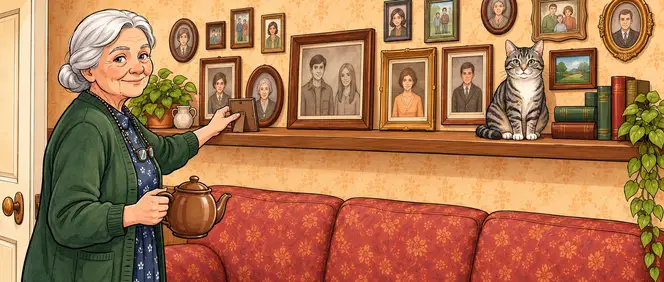
Das ist Familie. Hier ist Sohn, und das ist Tochter Katrin. Lotte ist Tochter, und Bruder ist noch ein Baby. Und das ist Mann. Er war ein guter Mensch.
This is my family. Here is my son, and that is my daughter Katrin. Lotte is her daughter, and Lotte's brother is still a baby. And this is my husband. He was a good person.
You and the neighbours
Fill the gaps with the words from the box.
Frau Brandt, Familie wohnt in Hamburg. Ich habe einen Bruder. Kennen Sie Bruder? Nein? Aber ich kenne jetzt Lotte und Bruder. Und Mikesch und Schlüssel! Und Kuchen mag ich sehr. Ich bin gern Nachbar.
Mrs Brandt, my family lives in Hamburg. I have a brother. Do you know my brother? No? But now I know Lotte and her brother. And Mikesch and his key! And I really like Greta's cake. I am glad to be your neighbour.
Frau Brandt, Familie wohnt in Hamburg. Ich habe einen Bruder. Kennen Sie Bruder? Nein? Aber ich kenne jetzt Lotte und Bruder. Und Mikesch und Schlüssel! Und Kuchen mag ich sehr. Ich bin gern Nachbarin.
Mrs Brandt, my family lives in Hamburg. I have a brother. Do you know my brother? No? But now I know Lotte and her brother. And Mikesch and his key! And I really like Greta's cake. I am glad to be your neighbour.
All done.
right first time
- His and her: sein, ihr
- The direct object: meinen, seinen
- Lottes Mutter: a name with -s
Goal reachedI can name family members and say how old people are.
- Dialog & questionsFotos an der Wand23 sentences heard
- Words21 new wordsPhotos on the wallPremium
- GrammarDone8 exercises
30-day money-back guarantee
Make this scene stick
Practise this scene’s words and grammar while they’re still fresh, so they stay with you.
With a free account, you get extra practice for all 5 scenes in Module 1.
25% off all yearly plans