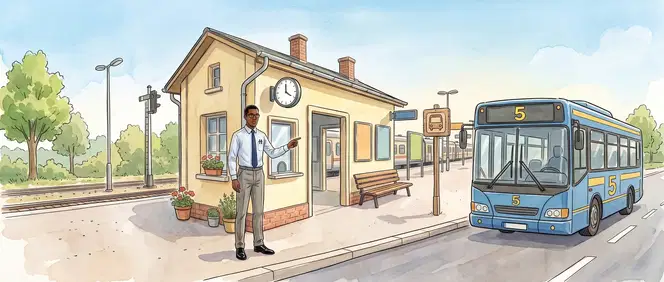
How are you travelling?
Use plus the dative for transport: , , , . Walking is . Ask or, more generally,
Departure and arrival
means depart, and means arrive. In a main statement their prefixes go to the end. changes its vowel with and / / ; keeps its vowel.
| Person | Depart | Arrive |
|---|---|---|
Read the timetable precisely
Use official hour-and-minute times for a timetable: . The departure place uses : , . For a journey’s start and destination use : . gives a time period: .
When the service is cancelled
The announcement means the train is cancelled. The display may simply say . You can ask and check the practical meaning: .
Practice 1/5 · Finding words
Notice the useful forms
Tap the marked grammar forms.
.
We travel by train.
.
The train departs at nine twelve.
.
We arrive at ten.
.
I walk.
Practice 2/5 · The right form
Travel with the right verb
Choose the right word for the gap.
Ich um neun ab.
I depart at nine.
Du heute mit dem Bus.
You travel by bus today.
Der Zug von Gleis zwei ab.
The train departs from platform two.
Wir zum See.
We travel to the lake.
Ihr mit dem Fahrrad.
You travel by bike (several people).
Wann Sie ab?
When do you depart (polite)?
Arrive, leave and choose transport
Choose the right word for the gap.
Ich um zehn an.
I arrive at ten.
Du heute früh an.
You arrive early today.
Greta um acht an.
Greta arrives at eight.
Wir morgen an.
We arrive tomorrow.
Ihr um zwölf an.
You arrive at twelve (several people).
Wann Sie an?
When do you arrive (polite)?
Wir fahren mit Bus.
We travel by bus.
Sie fährt mit Bahn.
She travels by rail.
Practice 3/5 · Fill the gaps
Complete the conversation
Fill the gaps with the words from the box.
Ich ab. Du mit dem Bus.
I depart. You travel by bus.
Der Zug ab. Wir zum See.
The train departs. We travel to the lake.
Ihr früh ab. Wann Sie ab?
You depart early (several people). When do you depart (polite)?
Ich um zehn an. Du später an.
I arrive at ten. You arrive later.
Greta heute an. Wir morgen an.
Greta arrives today. We arrive tomorrow.
Ihr früh an. Wann Sie an?
You arrive early (several people). When do you arrive (polite)?
Practice 4/5 · Building sentences
Put the message together
Put the words in order.
The train departs from platform two.
We arrive at ten o’clock.
I travel on a bike.
The train is not running today.
Practice 5/5 · In situations
Respond to the situation
Choose the right words for the situation.
You need to return the same evening. The clerk asks whether you want a single or a return.
You say:
Hin und zurück includes both journeys.
You need to return the same evening. The clerk asks whether you want a single or a return.
You say:
Hin und zurück includes both journeys.
The display says ausgefallen. You want to check whether there is a train today.
You say:
The question checks the meaning of the cancellation.
The display says ausgefallen. You want to check whether there is a train today.
You say:
The question checks the meaning of the cancellation.

Unit complete