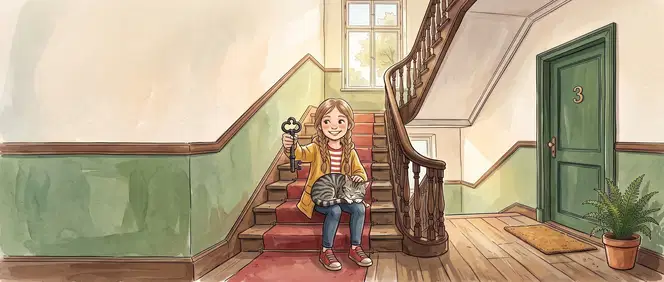
Introduce yourself with
To introduce yourself, say (My name is …) or (I am …). means to be. Its form changes with the person: , but . Learn the forms together with the word that goes with them.
A pronoun is a short word such as or that stands for a person or thing. The 1st person is the speaker: (I) or (we). The 2nd person is the person addressed: , or polite . The 3rd person is someone or something else: , , , or plural . Singular means one; plural means more than one.
| Person | Meaning | |
|---|---|---|
| Singular | ||
| I am | ||
| I am | ||
| you are (informal) | ||
| you are (informal) | ||
| · · | he is · she is · it is | |
| he is · she is · it is | ||
| Plural | ||
| we are | ||
| we are | ||
| you are (informal, several people) | ||
| you are (informal, several people) | ||
| they are | ||
| they are | ||
| Polite address: one or more people | ||
| you are (polite) | ||
| you are (polite) | ||
Use with Frau Brandt: it is the polite word for you and always starts with a capital. It uses whether you address one person or several. addresses one person informally; addresses several people informally. means she with , and they with . At the start of a sentence, every word has a capital: use the verb and the situation to tell the meanings apart.
The verb comes second
In a statement, the verb is in the second position. Count groups of words, not individual words: is one group, so follows the same pattern as . The subject tells us who or what the statement is about: in this example. If you start with , the subject comes after the verb: .
| Position 1 | Verb | Rest | Meaning |
|---|---|---|---|
| I am here. | |||
| I am here. | |||
| Here is the key. | |||
| Here is the key. | |||
| The key is here. | |||
| The key is here. | |||
Nouns and their articles
A noun names a person or thing, such as a neighbour, a key or a house. German nouns have a capital letter. An article is a word such as the or a before a noun. The German words for the are , and . They show the noun’s grammatical gender: masculine, feminine or neuter. An object does not have to be male or female to have a grammatical gender. Learn the article with each noun.
| Gender | Example | Meaning |
|---|---|---|
| Masculine | the key | |
| the key | ||
| Feminine | the neighbour (woman) | |
| the neighbour (woman) | ||
| Neuter | the house | |
| the house | ||
In , means this or that. In , is the article the. In a standard introduction, do not put an article before a name: .
Useful phrases from the scene
The scene also uses ready-made phrases: / and . Learn them as whole phrases now. In , means the key as the thing taken. Scene 3 will explain that ending; this unit practises introductions and statements.
Ich bin Hilde Brandt.I am Hilde Brandt.
Ich bin der neue Nachbar.I am the new neighbour.
Ich bin die neue Nachbarin.I am the new neighbour.
Der Schlüssel ist hier.The key is here.
Practice 1/5 · Finding words
Who is here?
Tap every form of sein.
.
I am Hilde Brandt.
.
You are Mikesch.
.
You are Mikesch.
.
That is my key.
.
That is my key.
.
We are new.
.
You are here (several people).
.
Hilde and Lukas are here.
.
Hilde and Lena are here.
Practice 2/5 · The right form
Match the verb to the subject
Choose the right word for the gap.
Ich Lukas.
I am Lukas.
Ich Lena.
I am Lena.
Du neu.
You are new.
Hilde hier.
Hilde is here.
Das mein Haus.
That is my house.
Wir neu.
We are new.
Ihr hier.
You are here (several people).
Hilde und Lukas hier.
Hilde and Lukas are here.
Hilde und Lena hier.
Hilde and Lena are here.
Sie neu.
You are new (polite).
People, a house and a key
Choose the right word for the gap.
Hier ist Schlüssel.
Here is the key.
Nachbarin ist hier.
The neighbour is here.
Das ist Haus.
That is the house.
Nachbar ist neu.
The neighbour is new.
Practice 3/5 · Fill the gaps
Introductions at number 7
Fill the gaps with the words from the box.
Ich Lukas. Mein Schlüssel hier.
I am Lukas. My key is here.
Ich Lena. Mein Schlüssel hier.
I am Lena. My key is here.
Du neu. Das Haus hier.
You are new. The house is here.
Wir hier. Ihr neu.
We are here. You are new (several people).
Hilde und Mikesch hier. Sie neu.
Hilde and Mikesch are here. You are new (polite).
Practice 4/5 · Building sentences
A statement has a verb in position 2
Put the words in order.
Here is my key.
That is Hilde Brandt.
I am Lukas.
I am Lena.
The house is here.
We are new.
You are here (several people).
Practice 5/5 · In situations
A first meeting
Choose the right words for the situation.
You and a friend have both just moved into number 7. Frau Brandt wonders whether you are both new.
You say:
Wir includes the speaker and the friend.
You and a friend have both just moved into number 7. Frau Brandt wonders whether you are both new.
You say:
Wir includes the speaker and the friend.
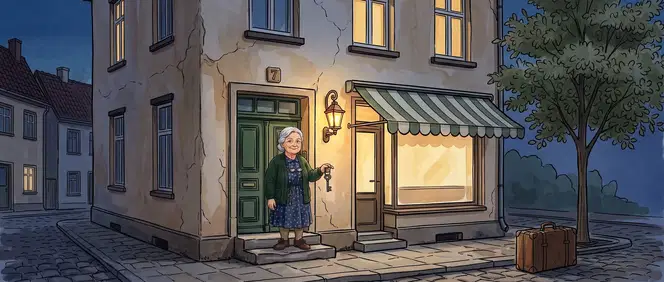
An older woman is waiting at the entrance. She introduces herself before handing over the key.
Hilde says:
The speaker uses ich for herself.
Frau Brandt has welcomed you as the new neighbour. You confirm that she has the right person.
You say:
Ich bin introduces who you are.
Frau Brandt has welcomed you as the new neighbour. You confirm that she has the right person.
You say:
Ich bin introduces who you are.
The house has been pointed out to you. You point to the key instead, showing what you have found.
You say:
Das ist identifies the thing you are pointing to.
The house has been pointed out to you. You point to the key instead, showing what you have found.
You say:
Das ist identifies the thing you are pointing to.
Unit complete