Reading & listening
Ich bin hier
I am, you are: sein
means to be. Its form changes with its subject, often a pronoun: , , . The table goes from the 1st person (the speaker) to the 2nd person (the one you talk to) and the 3rd person (anyone else), first in the singular, then in the plural.
Ich bin Hilde Brandt.I am Hilde Brandt.
Ich bin der neue Nachbar.I am the new neighbour.
Ich bin die neue Nachbarin.I am the new neighbour.
Practice · I am, you are: sein
Spot sein
Tap the form of sein.
.
I am Hilde Brandt.
.
That is my house.
.
We are new.
Which form of sein?
Choose the right word for the gap.
Ich Lukas.
I am Lukas.
Ich Lena.
I am Lena.
Du neu.
You are new.
Hilde hier.
Hilde is here.
Und Sie Hilde Brandt?
And you are Hilde Brandt?
Und Sie Hilde Brandt?
And you are Hilde Brandt?
All done.
right first time
Ich bin hier
Definite articles and gender: der, die, das
der, die, das
Every German noun is masculine, feminine or neuter, and its article, the word for “the”, shows which: , or . A key is not male, but is masculine, so learn every noun with its article. Nouns always start with a capital.
Practice · der, die, das
Spot the article
Tap the article, the word for “the”.
Careful: Das can also mean that.
.
That is the house.
.
The neighbour is here.
.
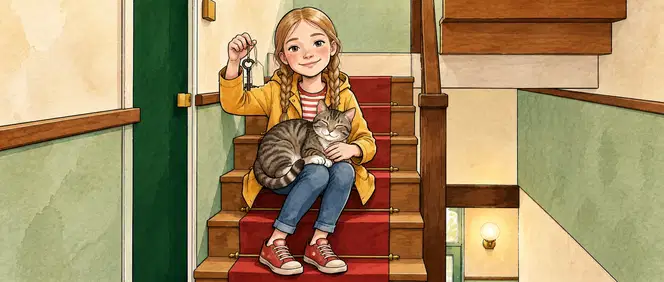
Here is the key.
der, die or das?
Choose the right word for the gap.
Haus ist hier.
The house is here.
Nachbar ist neu.
The neighbour is new.
Hier ist Treppe.
Here are the stairs.
Das ist Kater.
That is the tomcat.
All done.
right first time
Ich bin hier
The verb comes second
In a statement, the verb comes second. Count groups of words, not single words: is one group. When another group comes first, such as , the verb stays second and the subject moves behind it: .
Practice · The verb comes second
Find the verb
Tap the verb.
Whatever comes first, the verb is second.
.
Here is my key.
.
The key is here.
.
Mikesch takes the key.
Build the statement
Put the words in order.
Here is the new neighbour.
Too hard? Listen to the sentence first.
I am Hilde Brandt, and this is my house.
Here are the stairs, and that is Mikesch.
Too hard? Listen to the sentence first.
All done.
right first time
Practice · All together at number 7
Frau Brandt at the door
Fill the gaps with the words from the box.
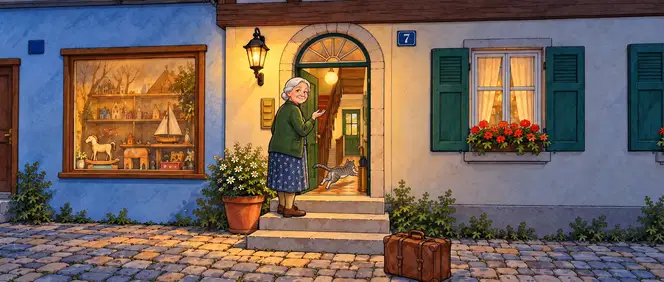
Guten Abend! Ich Hilde Brandt. ist mein Haus, und hier Treppe. Schlüssel ist hier, und das Mikesch. Er ist nicht mein Kater!
Good evening! I am Hilde Brandt. This is my house, and here are the stairs. The key is here, and that is Mikesch. He is not my tomcat!
You introduce yourself
Fill the gaps with the words from the box.
Ich Lukas, neue Nachbar. ist Haus, und hier mein Schlüssel. Mikesch? Er nicht mein Kater!
I am Lukas, the new neighbour. That is the house, and here is my key. Mikesch? He is not my tomcat!
Ich Lena, neue Nachbarin. ist Haus, und hier mein Schlüssel. Mikesch? Er nicht mein Kater!
I am Lena, the new neighbour. That is the house, and here is my key. Mikesch? He is not my tomcat!
All done.
right first time
- I am, you are: sein
- der, die, das
- The verb comes second
Goal reachedI can greet an older neighbour politely and say my name.
- Dialog & questionsGuten Abend11 sentences heard
- Words18 new wordsGood eveningPremium
- GrammarDone8 exercises
Or open module 1 with a free account
Make this scene stick
Practise this scene’s words and grammar while they’re still fresh, so they stay with you.
With a free account, you get extra practice for all 5 scenes in Module 1.
25% off all yearly plans