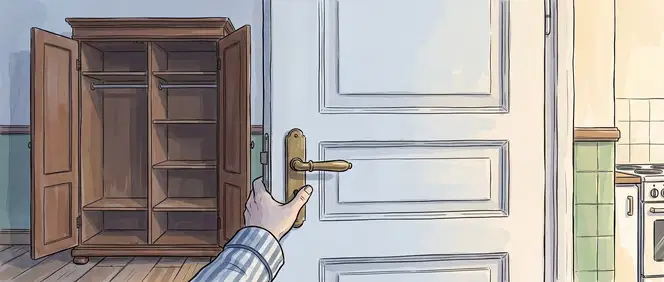
Introduce something new
Use an indefinite article when you introduce a person or thing without saying which particular one: , , . With a masculine direct object, changes to . Feminine and neuter stay and .
| Gender | Subject or after | Direct object |
|---|---|---|
| Masculine | ||
| Feminine | ||
| Neuter | ||
| Plural |
Say you do not have any
Use to negate a noun phrase that would have or no article. Its ending follows the same pattern: , , , but as a masculine object. The plural form is : . This changes the article; it does not create a new negative conjugation of the verb.
| Gender | Subject or after | Direct object |
|---|---|---|
| Masculine | ||
| Feminine | ||
| Neuter | ||
| Plural |
What is there?
The phrase means there is or there are. What exists comes after it as an accusative object: . The phrase stays with a plural too: . Use for an absent thing and for a description: , but .
Es gibt eine Lampe.There is a lamp.
Ich habe keinen Tisch.I do not have a table.
Die Wohnung ist nicht groß.The flat is not big.
Practice 1/5 · Finding words
Notice the useful forms
Tap the complete indefinite or negative noun phrases.
.
That is a suitcase.
.
Lotte has a cat.
.
There are no chairs.
.
We need a table.
Practice 2/5 · The right form
Name it or have it
Choose the right word for the gap.
Das ist Tisch.
That is a table.
Ich habe Koffer.
I have a suitcase.
Das ist Lampe.
That is a lamp.
Es gibt Bett.
There is a bed.
Hast du Schlüssel?
Do you have a key?
Wir haben Katze.
We have a cat.
Absent, or simply not like that?
Choose the right word for the gap.
Ich habe Tisch.
I do not have a table.
Es gibt Lampe.
There is no lamp.
Lotte hat Sofa.
Lotte does not have a sofa.
Hier gibt es Stühle.
There are no chairs here.
Das Bett ist klein.
The bed is not small.
, die Wohnung ist nicht groß.
No, the flat is not big.
Practice 3/5 · Fill the gaps
Complete the conversation
Fill the gaps with the words from the box.
Ist das Koffer? Nein, das ist Kleiderschrank.
Is that a suitcase? No, that is a wardrobe.
Ich habe Lampe, aber Tisch.
I have a lamp, but no table.
Es gibt Bett und Stühle.
There is a bed and no chairs.
Die Wohnung ist groß. Ich habe Sofa.
The flat is not big. I do not have a sofa.
Practice 4/5 · Building sentences
Put the message together
Put the words in order.
There are no chairs here.
I need a table.
The lamp is not old.
Do you have a cat?
Practice 5/5 · In situations
Respond to the situation
Choose the right words for the situation.
Lotte wants to sit down, but you have no chairs in the flat.
You say:
Keine negates the plural noun; the problem is that the chairs are absent.
Lotte wants to sit down, but you have no chairs in the flat.
You say:
Keine negates the plural noun; the problem is that the chairs are absent.
A visitor asks whether the wardrobe in the corner is a suitcase. You identify the object.
You say:
You introduce the object with nominative ein after sein.
A visitor asks whether the wardrobe in the corner is a suitcase. You identify the object.
You say:
You introduce the object with nominative ein after sein.
You want a table for your new kitchen and explain what you need.
You say:
Brauchen takes a direct object, so masculine Tisch uses einen.
You want a table for your new kitchen and explain what you need.
You say:
Brauchen takes a direct object, so masculine Tisch uses einen.
Unit complete