Reading & listening
Ich sehe ihn
mich, dich, uns: people as objects
When a person is the object of a verb such as , , or , the pronoun is in the accusative: . Only , and polite look the same as before. Polite keeps its capital: .
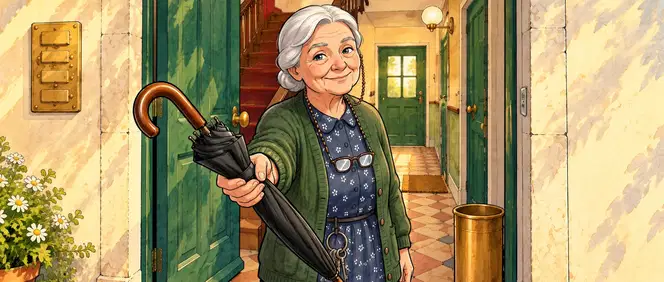
Oma, siehst du mich?Grandma, can you see me?
Ja, ich sehe dich, Lotte.Yes, I can see you, Lotte.
Practice · mich, dich, uns: people as objects
Spot the object
Tap the pronoun that is the object.
, !
Lotte, I can see you!
? .
The letter? I am sending it tomorrow.
? .
The letter? I am sending it tomorrow.
.
Mrs Brandt knows all of us.
Who is the object?
Choose the right word for the gap.
Lotte, siehst du ? Ich bin hier oben!
Lotte, can you see me? I am up here!
Lotte, siehst du ? Ich bin hier oben!
Lotte, can you see me? I am up here!
Jonas und Greta, ich sehe morgen im Café.
Jonas and Greta, I will see you tomorrow in the café.
Jonas und Greta, ich sehe morgen im Café.
Jonas and Greta, I will see you tomorrow in the café.
Herr Kühn, ich sehe am Montag.
Mr Kühn, I will see you on Monday.
Herr Kühn, ich sehe am Montag.
Mr Kühn, I will see you on Monday.
Wir sind im Café. Findest du ?
We are in the café. Can you find us?
All done.
right first time
Ich sehe ihn
Object pronouns for things by gender: ihn, sie, es
ihn, sie, es: things as objects
A pronoun can also stand for a thing. It follows the noun's gender: becomes , becomes , becomes . Plural nouns become . A short pronoun usually comes straight after the verb: .
Practice · ihn, sie, es: things as objects
ihn, sie or es?
Look at the gender of the noun.
Wo ist die Post? Ich finde nicht.
Where is the post office? I cannot find it.
Wo ist die Post? Ich finde nicht.
Where is the post office? I cannot find it.
Hier ist der Schlüssel. Brauchst du ?
Here is the key. Do you need it?
Das Geheimnis? Lotte kennt .
The secret? Lotte knows it.
Die Karten sind schön. Ich nehme .
The maps are lovely. I will take them.
Die Karten sind schön. Ich nehme .
The maps are lovely. I will take them.
Put the pronoun in
Put the words in order.
I will see you tomorrow after school.
Too hard? Listen to the sentence first.
The map is lovely, I will take it.
Too hard? Listen to the sentence first.
The map is lovely, I will take it.
Too hard? Listen to the sentence first.
Mikesch is here, but I cannot see him.
Too hard? Listen to the sentence first.
Mikesch is here, but I cannot see him.
Too hard? Listen to the sentence first.
All done.
right first time
Ich sehe ihn
ihn or ihm?
Do not mix these up with the dative from module 4. The person who receives something is in the dative: . The person or thing you see, find or know is in the accusative: .
Practice · ihn or ihm?
Object or receiver?
Choose the right word for the gap.
Mikesch ist hungrig. Ich gebe Fisch.
Mikesch is hungry. I give him fish.
Mikesch ist dort oben. Ich sehe .
Mikesch is up there. I can see him.
Lotte hat Hunger. Wir geben einen Pfannkuchen.
Lotte is hungry. We give her a pancake.
Lotte ist nicht hier. Ich suche .
Lotte is not here. I am looking for her.
All done.
right first time
Practice · All together with Lotte's map
Lotte explains her map
Fill the gaps with the words from the box.
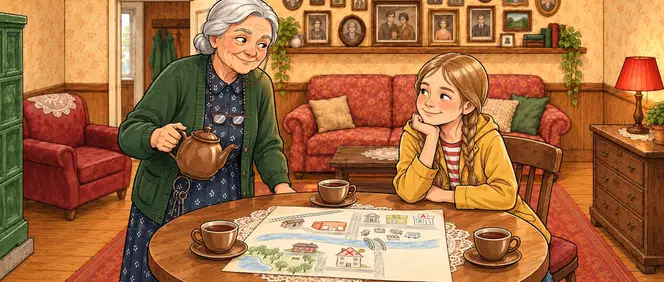
Hier, die Karte ist für dich. Du bist ja jetzt Omas Nachbar. Siehst du die Schule? Du findest gegenüber vom Park. Und der Markt? Mikesch mag sehr. Das rote X ist ein Geheimnis. Ich kenne , aber ich sage dir nicht!
Here, the map is for you. You are Grandma's neighbour now, after all. Can you see the school? You will find it opposite the park. And the market? Mikesch likes it very much. The red X is a secret. I know it, but I am not telling you!
Hier, die Karte ist für dich. Du bist ja jetzt Omas Nachbarin. Siehst du die Schule? Du findest gegenüber vom Park. Und der Markt? Mikesch mag sehr. Das rote X ist ein Geheimnis. Ich kenne , aber ich sage dir nicht!
Here, the map is for you. You are Grandma's neighbour now, after all. Can you see the school? You will find it opposite the park. And the market? Mikesch likes it very much. The red X is a secret. I know it, but I am not telling you!
You thank Lotte
Fill the gaps with the words from the box.
Danke, Lotte! Ich finde die Karte sehr schön. Morgen zeige ich Herrn Kühn. Er kennt gut, wir arbeiten zusammen. Und Mikesch? Ich sehe jeden Tag, und ich gebe manchmal Fisch. Frau Brandt macht Tee, und ich gebe ein Stück Kuchen. Lotte, ich sehe morgen!
Thank you, Lotte! I think the map is lovely. Tomorrow I will show it to Mr Kühn. He knows me well, we work together. And Mikesch? I see him every day, and sometimes I give him fish. Mrs Brandt is making tea, and I am giving her a piece of cake. Lotte, see you tomorrow!
All done.
right first time
- mich, dich, uns: people as objects
- ihn, sie, es: things as objects
- ihn or ihm?
Goal reachedI can say where places are on a map and explain the way.
- Dialog & questionsLottes Karte18 sentences heard
- Words15 new wordsLotte’s mapPremium
- GrammarDone7 exercises
30-day money-back guarantee
Make this scene stick
Practise this scene’s words and grammar while they’re still fresh, so they stay with you.
With a free account, you get extra practice for all 5 scenes in Module 1.
25% off all yearly plans