Scene 27 of 50
Mikeschs Rechnung
Mikesch’s bill
Your goalI can buy food at the market in kilos, bottles and pieces, and ask what it costs.


Prepare the wordsPremium
Meet the 9 words of this scene before you read. You can also go straight to the story.
 Greta
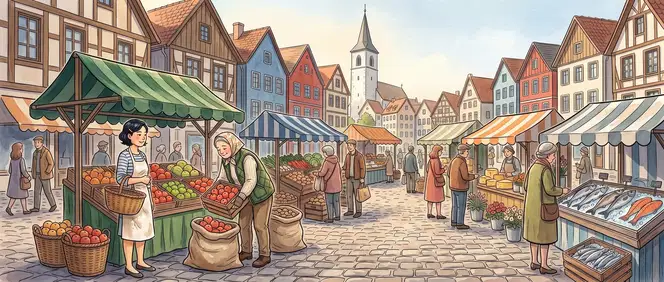
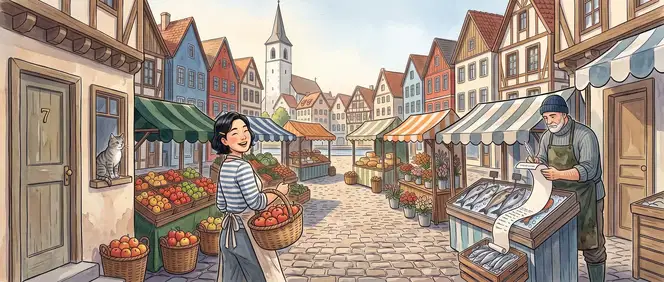
GretaHier ist der Markt. Samstags von sieben bis eins.
Here is the market. Saturdays from seven until one.
- Greta
Ich brauche zehn Kilo Äpfel fürs Café.
I need ten kilos of apples for the café.
Zehn Kilo? Das ist aber viel.
Ten kilos? That really is a lot.
Zehn Kilo? Das ist aber viel.
Ten kilos? That really is a lot.
- Greta
Für den Apfelkuchen! Und was brauchst du?
For the apple cake! And what do you need?
Tomaten, Kartoffeln, Milch und Käse. Heute koche ich zu Hause.
Tomatoes, potatoes, milk and cheese. Today I am cooking at home.
Tomaten, Kartoffeln, Milch und Käse. Heute koche ich zu Hause.
Tomatoes, potatoes, milk and cheese. Today I am cooking at home.
 die Frau
Guten Morgen. Was darf es sein?
Good morning. What would you like?
Ein Kilo Tomaten und zwei Kilo Kartoffeln, bitte.
A kilo of tomatoes and two kilos of potatoes, please.
Ein Kilo Tomaten und zwei Kilo Kartoffeln, bitte.
A kilo of tomatoes and two kilos of potatoes, please.
- die Frau
Gern. Sonst noch etwas?
Certainly. Anything else?
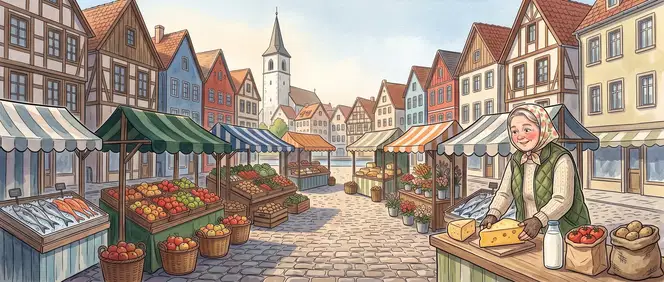
Ein halbes Kilo Käse und eine Flasche Milch.
Half a kilo of cheese and a bottle of milk.
Ein halbes Kilo Käse und eine Flasche Milch.
Half a kilo of cheese and a bottle of milk.
- die Frau
Bitte schön. Das macht zwölf Euro fünfzig.
Here you are. That comes to twelve euros fifty.
 der Mann
Guten Morgen. Sie wohnen doch in Nummer sieben?
Good morning. You live at number seven, don’t you?
Ja. Woher wissen Sie das?
Yes. How do you know?
Ja. Woher wissen Sie das?
Yes. How do you know?
- der Mann
Die Katzenhaare auf Ihrer Jacke! Mikesch kommt jeden Samstag zu mir.
The cat hairs on your jacket! Mikesch comes to me every Saturday.
Aber er gehört nicht mir.
But he is not mine.
Aber er gehört nicht mir.
But he is not mine.
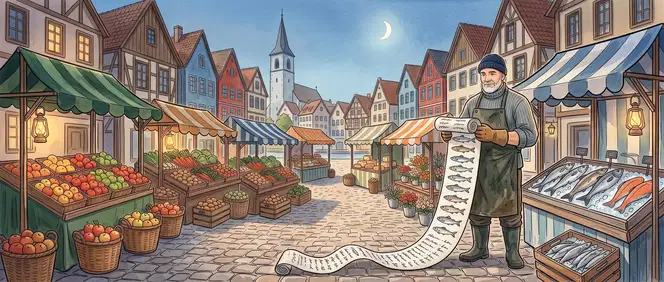
At the fish stall he unrolls a very long paper bill, down to the cobbles, with a little fish drawn on every line. - der Mann
Er wohnt bei Ihnen. Hier ist seine Rechnung für diesen Monat.
He lives at your place. Here is his bill for this month.
So viel Fisch? Was kostet das alles?
That much fish? How much does all that cost?
So viel Fisch? Was kostet das alles?
That much fish? How much does all that cost?
- der Mann
Zweiundvierzig Euro.
Forty-two euros.
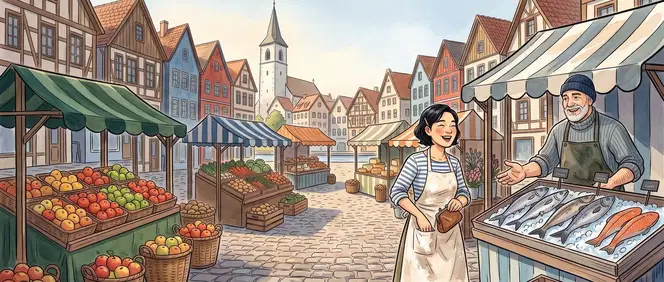
Greta laughs and takes out her purse. The fish seller grins and holds out his hand. - Greta
Du musst nichts bezahlen. Das mache ich. Wie jeden Monat.
You do not have to pay anything. I will do that. Like every month.
Du? Warum bezahlst du seinen Fisch?
You? Why do you pay for his fish?
Du? Warum bezahlst du seinen Fisch?
You? Why do you pay for his fish?
- Greta
Er sitzt jeden Morgen im Caféfenster. Die Leute sehen ihn und kommen rein. Das ist gut fürs Geschäft.
He sits in the café window every morning. People see him and come in. That is good for business.
Who says this?
Hier ist der Markt. Samstags von sieben bis eins.
Hier ist der Markt. Samstags von sieben bis eins.
What does it mean?
Zehn Kilo? Das ist aber viel.
Zehn Kilo? Das ist aber viel.
Which line do you hear?
Good morning. What would you like?
Put the words in order.
Certainly. Anything else?
Who says this?
Guten Morgen. Sie wohnen doch in Nummer sieben?
Guten Morgen. Sie wohnen doch in Nummer sieben?
What does it mean?
Aber er gehört nicht mir.
Aber er gehört nicht mir.
Which line do you hear?
That much fish? How much does all that cost?
That much fish? How much does all that cost?
Put the words in order.
You? Why do you pay for his fish?
You? Why do you pay for his fish?
What happens first?
Put the lines in the order they come in the scene.
Scene complete
Mikeschs Rechnung
Goal reachedI can buy food at the market in kilos, bottles and pieces, and ask what it costs.