Bonus storyPremium
Mikesch und die Schlüssel
Mikesch and the keys
Module 1 · ArrivalGet to know the neighbours and practise what you've learned in a new story.
The storyOne day with Mikesch, the cat who belongs to nobody: who feeds him, where he sleeps, and where your key is tonight.
New words in the story
- überall everywhere
- vielleicht perhaps
- fast almost
- noch still
- weg gone
- psst shh
- passiert happens
Tap a word to see what it means.
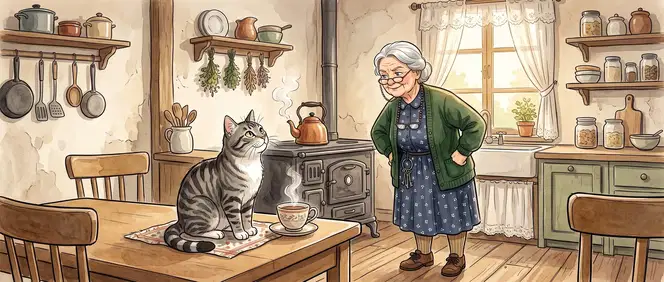
Early morning in Hilde's kitchen. Mikesch sits on the table, next to her tea.
Es ist Morgen, und es ist sehr leise. Fast alle schlafen noch. Aber Hilde und Mikesch schlafen nicht.
It is morning, and it is very quiet. Almost everyone is still asleep. But Hilde and Mikesch are not asleep.
 Hilde
Guten Morgen, Mikesch! Bist du hungrig?
Good morning, Mikesch! Are you hungry?
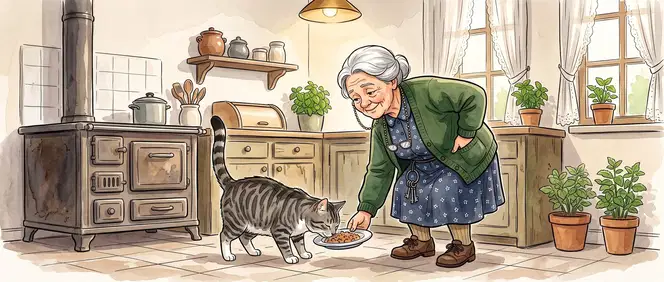
Hilde puts a little plate of food on the floor.
Ja. Mikesch ist sehr hungrig.
Yes. Mikesch is very hungry.
- Hilde
Hier, bitte schön. Guten Appetit!
Here you are. Enjoy your meal!
- Hilde
Aber du bist nicht mein Kater, Mikesch!
But you are not my tomcat, Mikesch!
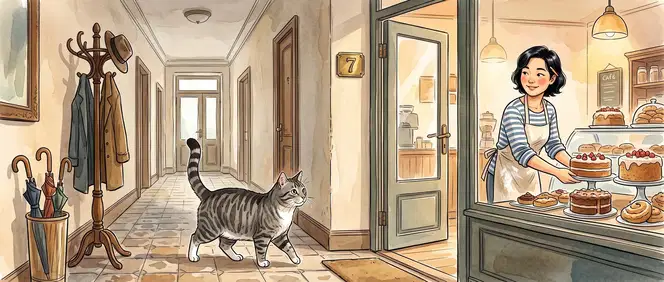
Mikesch trots down the hall to the café. Greta is putting out the cakes.
Jetzt geht Mikesch ins Café. Greta ist schon dort.
Now Mikesch goes to the café. Greta is already there.
 Greta
Guten Morgen, Chef!
Good morning, boss!
- Greta
Kaffee oder Tee?
Coffee or tea?
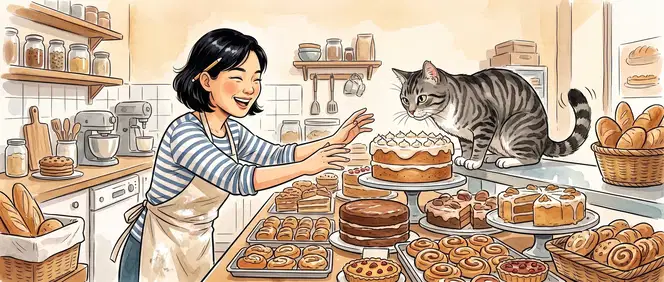
Mikesch sits on the counter, right in front of the big cake.
Kaffee? Nein. Tee? Nein. Mikesch will den Mohnkuchen.
Coffee? No. Tea? No. Mikesch wants the poppy-seed cake.
She laughs.
GretaNein, Mikesch! Das ist mein Kuchen!
No, Mikesch! That is my cake!
- Greta
Du bist sehr böse, Mikesch!
You are very naughty, Mikesch!
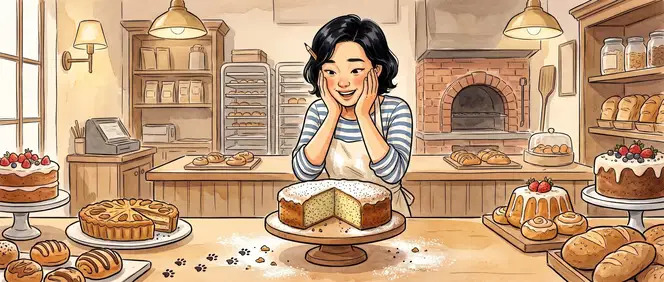
A moment later a big piece of the cake is gone. Paw prints lead away.
Und dann? Ein Stück Mohnkuchen ist weg, und Mikesch auch!
And then? A piece of poppy-seed cake is gone, and so is Mikesch!
- Greta
Mein Kuchen! Mikesch! Wo bist du?
My cake! Mikesch! Where are you?
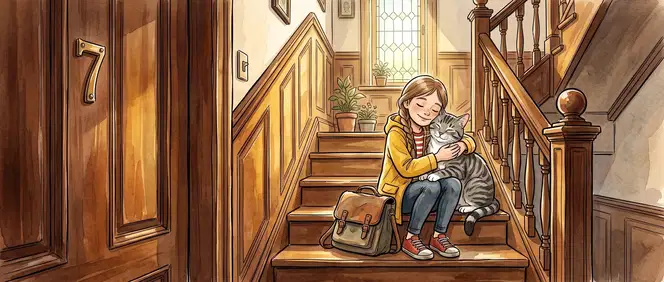
Lotte sits on the stairs with her school bag and hugs Mikesch.
Jetzt ist Mikesch bei Lotte. Lotte ist jeden Morgen hier. Sie mag Mikesch, und Mikesch mag Lotte.
Now Mikesch is with Lotte. Lotte is here every morning. She likes Mikesch, and Mikesch likes Lotte.
 Lotte
Hallo, Mikesch! Du bist mein Freund.
Hello, Mikesch! You are my friend.
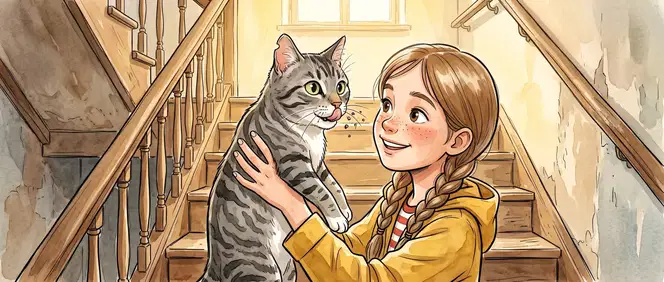
Lotte looks at the crumbs on his whiskers.
LotteOh! Mohnkuchen? Weiß Greta das?
Oh! Poppy-seed cake? Does Greta know?
- Lotte
Du bist nicht böse, Mikesch. Du bist einfach hungrig!
You are not naughty, Mikesch. You are just hungry!
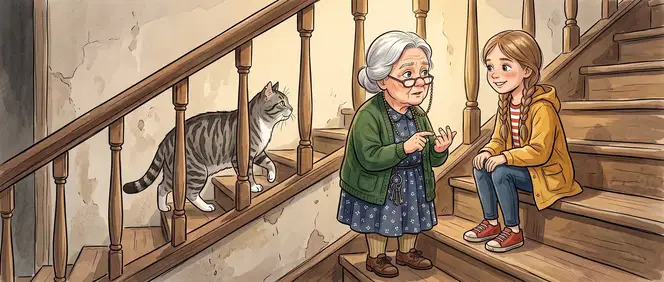
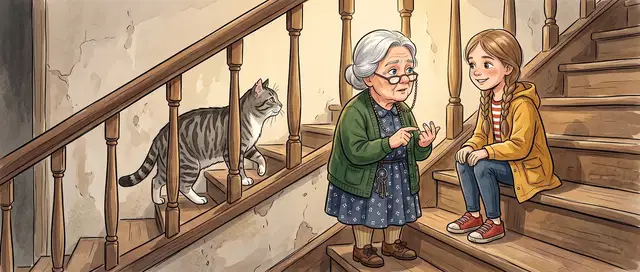
Hilde talks to Lotte on the stairs. Mikesch walks on, upstairs.
Hilde ist auch hier. Und Mikesch geht nach oben.
Hilde is here too. And Mikesch goes upstairs.
- Lotte
Oma, Mikesch ist dein Kater, oder?
Grandma, Mikesch is your tomcat, isn't he?
- Hilde
Mein Kater? Nein, Lotte!
My tomcat? No, Lotte!
- Hilde
Und Greta? Nein. Jonas? Auch nicht.
And Greta's? No. Jonas's? No, not his either.
- Lotte
Mikesch, wo wohnst du?
Mikesch, where do you live?
- Hilde
Hier, dort, oben, unten: Mikesch wohnt überall!
Here, there, upstairs, downstairs: Mikesch lives everywhere!
- Lotte
Und er nimmt gern Schlüssel, Oma!
And he likes taking keys, Grandma!
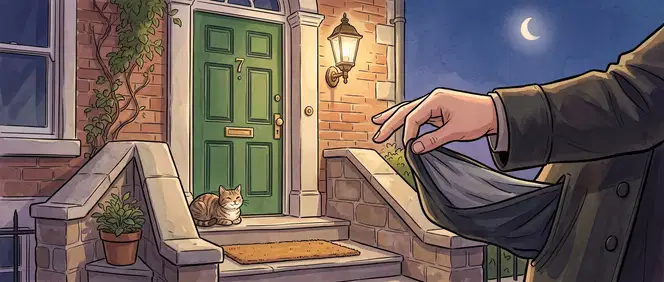
That evening you come home. Your coat pocket is empty.
Es ist Abend.
It is evening.
Nein! Wo ist mein Schlüssel?
No! Where is my key?
Nein! Wo ist mein Schlüssel?
No! Where is my key?
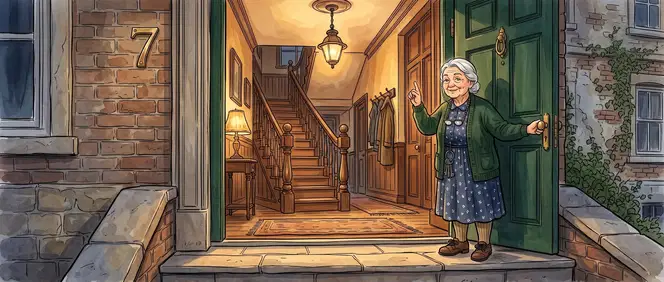
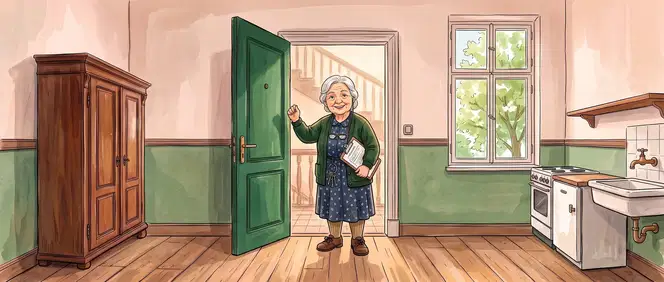
Hilde opens the green door for you. She points upstairs.
Frau Brandt! Ich habe meinen Schlüssel nicht! Wo ist Mikesch?
Mrs Brandt! I do not have my key! Where is Mikesch?
Frau Brandt! Ich habe meinen Schlüssel nicht! Wo ist Mikesch?
Mrs Brandt! I do not have my key! Where is Mikesch?
- Hilde
Ihr Schlüssel? Ich weiß es nicht.
Your key? I do not know.
- Hilde
Mikesch? Ja, er nimmt gern Schlüssel. Vielleicht ist er oben, bei Jonas.
Mikesch? Yes, he likes taking keys. Perhaps he is upstairs, at Jonas's.
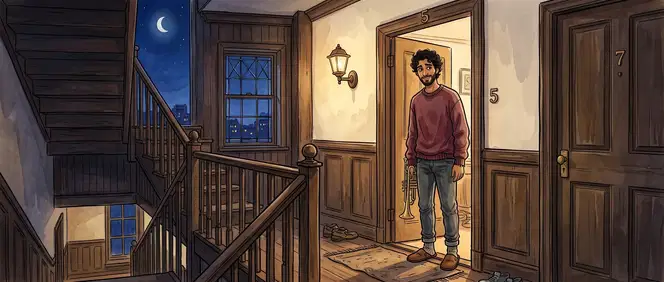
Upstairs Jonas opens his door, his trumpet in his hand.
Oben spielt Jonas Trompete. Aber er spielt sehr leise.
Upstairs Jonas is playing the trumpet. But he is playing very quietly.
Hallo, Jonas! Die Trompete ist nicht laut. Danke!
Hello, Jonas! The trumpet is not loud. Thank you!
Hallo, Jonas! Die Trompete ist nicht laut. Danke!
Hello, Jonas! The trumpet is not loud. Thank you!
 Jonas
Ja! Jetzt spiele ich leise.
Yes! Now I am playing quietly.
Ist Mikesch hier?
Is Mikesch here?
Ist Mikesch hier?
Is Mikesch here?
- Jonas
Ja! Er schläft jeden Abend hier.
Yes! He sleeps here every evening.
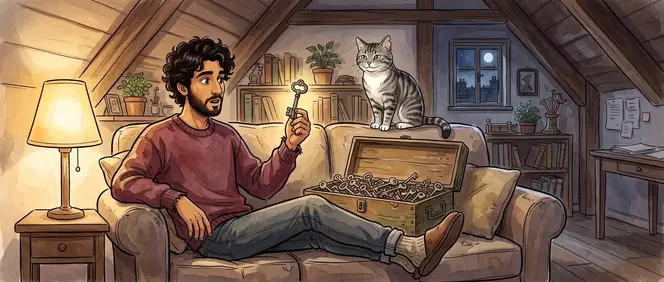
Mikesch lies on Jonas's sofa, his paws round a big old key. Jonas laughs.
Aber Mikesch schläft nicht. Er hat den Schlüssel!
But Mikesch is not asleep. He has the key!
He laughs.
JonasMikesch! Das ist nicht dein Schlüssel!
Mikesch! That is not your key!
Nein, das ist mein Schlüssel!
No, that is my key!
Nein, das ist mein Schlüssel!
No, that is my key!
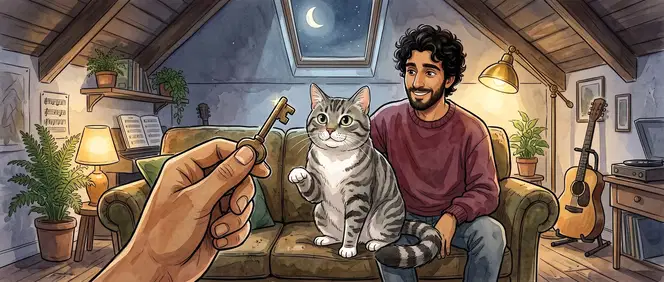
You hold your key tight. Mikesch looks at it.
Es tut mir leid, Mikesch. Du bist hier der Chef, aber den Schlüssel nehme ich!
I am sorry, Mikesch. You are the boss here, but I am taking the key!
Es tut mir leid, Mikesch. Du bist hier der Chef, aber den Schlüssel nehme ich!
I am sorry, Mikesch. You are the boss here, but I am taking the key!
Danke, Jonas! Gute Nacht.
Thank you, Jonas! Good night.
Danke, Jonas! Gute Nacht.
Thank you, Jonas! Good night.
- Jonas
Gute Nacht! Psst! Mikesch will schlafen.
Good night! Shh! Mikesch wants to sleep.
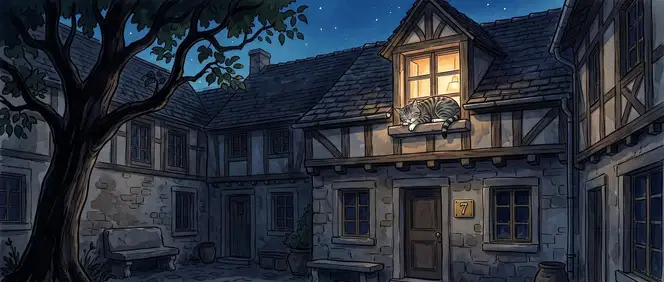
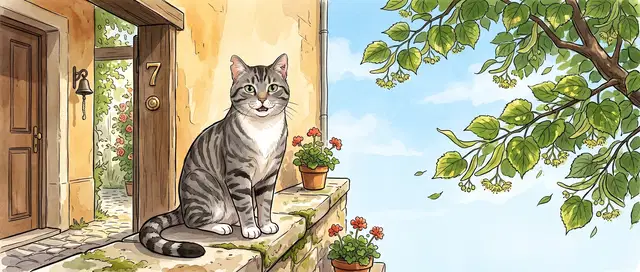
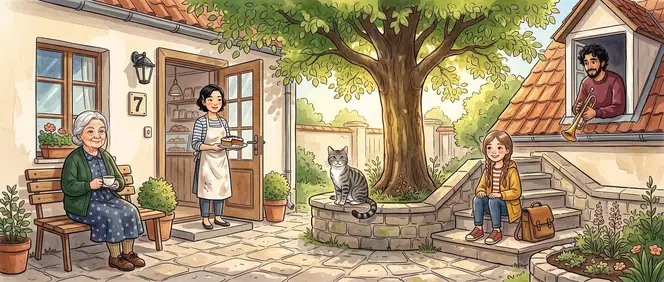
Night at number 7. Mikesch sleeps in Jonas's window under the roof.
Jetzt ist es wieder sehr leise. Und Mikesch? Er schläft. Er ist sehr glücklich. Und morgen? Morgen nimmt er wieder den Schlüssel! Gute Nacht, Mikesch!
Now it is very quiet again. And Mikesch? He is asleep. He is very happy. And tomorrow? Tomorrow he will take the key again! Good night, Mikesch!
Practice 1/2 · Listen and follow
Listen and follow
Listen and find the picture, then find what happens next.
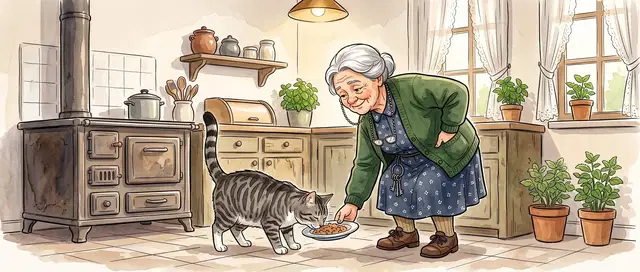 Which picture is it?
Es ist Morgen, und Mikesch ist hungrig.
It is morning, and Mikesch is hungry.
Es ist Morgen, und Mikesch ist hungrig.
It is morning, and Mikesch is hungry.
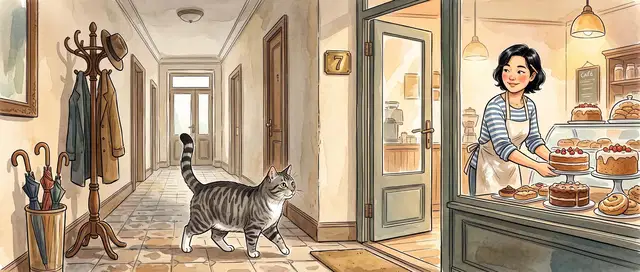
Then this happens:
He eats, then he goes to the café downstairs.
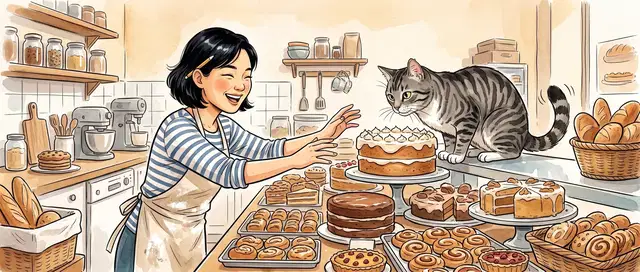 Which picture is it?
Mikesch ist im Café, und er will den Mohnkuchen.
Mikesch is in the café, and he wants the poppy-seed cake.
Mikesch ist im Café, und er will den Mohnkuchen.
Mikesch is in the café, and he wants the poppy-seed cake.
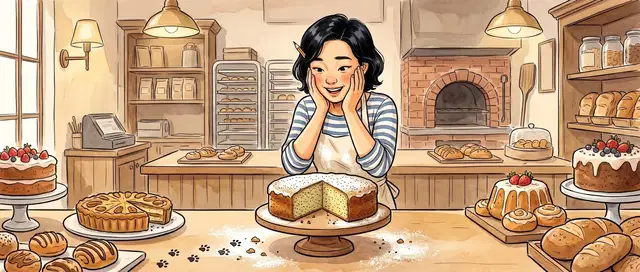
Then this happens:
A moment later a piece of Greta's cake is gone, and so is Mikesch.
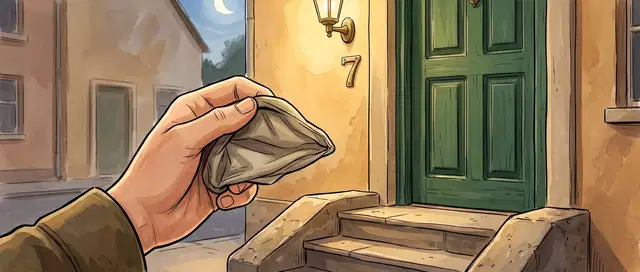 Which picture is it?
Es ist Abend, und Ihr Schlüssel ist nicht hier.
It is evening, and your key is not here.
Es ist Abend, und Ihr Schlüssel ist nicht hier.
It is evening, and your key is not here.
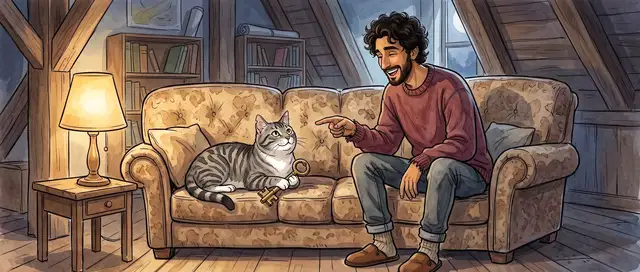
Then this happens:
Mikesch likes taking keys. He has yours on Jonas's sofa.
Practice 2/2 · In situations
What would Mikesch say?
Listen, then answer for Mikesch.
- Hilde
Mikesch! Hast du Hunger?
Mikesch! Are you hungry?
Mikesch Mikesch is always hungry, and the story says so.
- Greta
Und du, Chef? Kaffee? Tee?
And you, boss? Coffee? Tea?
Mikesch Mikesch does not want coffee or tea. He wants the cake.
 Lotte
Mikesch, wohnst du hier?
Mikesch, do you live here?
Mikesch Here and there, upstairs and downstairs: Mikesch lives everywhere.
- Jonas
Mikesch, hast du den Schlüssel?
Mikesch, do you have the key?
Mikesch Jonas asks with *hast du*, Mikesch answers with *ich habe*: he has the key under his paws.
Tap someone to hear them.
Module 1 complete · Arrival
Well done!
Get into your new flat and meet the people of number 7.
Now I can
 greet an older neighbour politely and say my name
 say hello to a child, ask her name, get my key back and ask where something is
 introduce myself in a café, choose coffee or tea, and say if I like something
 knock on a neighbour's door, say that I want to sleep, and ask someone to do something tomorrow
 ask how someone is, and ask where people live
grammar points
- der, die, das
- ich bin, wir sind
- The verb in position 2
- der Kuchen, den Kuchen
- du and Sie
- ich habe, du hast
- mein Haus, meine Katze
- nicht: not
- Sind Sie …? Wer? Wo?
- ich wohne, er spielt
- ich will schlafen
- hier, oben, ins Café
 LernLaterne