Module 1Word reviewPremium
Words of module 1: Arrival
Reviews practise both sides: wherever Lukas and Lena would say something differently, you do it once as each.
In this module you learned to
- greet an older neighbour politely and say my name
- say hello to a child, ask her name, get my key back and ask where something is
- introduce myself in a café, choose coffee or tea, and say if I like something
- knock on a neighbour's door, say that I want to sleep, and ask someone to do something tomorrow
- ask how someone is, and ask where people live
From this module's scenes

Freut mich
nice to meet you
Say this when you meet someone for the first time.
Freut mich. Ich bin Hilde Brandt. Das ist mein Haus.Nice to meet you. I am Hilde Brandt. This is my house.
Guten Abend
nehmen
take (take hold of)
In the scene: Mikesch nimmt den Schlüssel — Mikesch takes the key.
Mikesch nimmt den Schlüssel.Mikesch takes the key.
Guten Abend

Trompetefem.
trumpet
die Trompete. Plural: die Trompeten.
Es ist Nacht. Oben spielt jemand Trompete.It is night. Someone upstairs is playing the trumpet.
Gute Nacht
morgen
tomorrow
morgen is the next day. der Morgen is the morning.
Ja. Ich spiele morgen.Yes. I will play tomorrow.
Gute Nacht
Und Ihnen?
and you?
The question back, Sie-form. With du: Und dir?
Gut, danke. Und Ihnen?Fine, thank you. And you?
Gut, danke. Und Ihnen?Fine, thank you. And you?
Wer wohnt wo?
Nicht so gut
not great
Not well. So-so is Geht so.
Nicht so gut. Jonas spielt auch nachts Trompete.Not so good. Jonas plays the trumpet at night too.
Nicht so gut. Jonas spielt auch nachts Trompete.Not so good. Jonas plays the trumpet at night too.
Wer wohnt wo?jeder
every
Learn jeden Tag as every day.
Nein. Aber sie ist jeden Tag hier. Lotte ist meine Enkelin.No. But she is here every day. Lotte is my granddaughter.
Wer wohnt wo?
Enkelinfem.
granddaughter
die Enkelin: a granddaughter.
Nein. Aber sie ist jeden Tag hier. Lotte ist meine Enkelin.No. But she is here every day. Lotte is my granddaughter.
Wer wohnt wo?
Chefmasc.
master of the house, the one in charge
der Chef means the boss or person in charge. For a woman: die Chefin.
Hier. Und dort. Oben und unten. Mikesch ist hier der Chef!Here. And there. Upstairs and downstairs. Mikesch is the boss here!
Wer wohnt wo?

neu
new
Guten Abend! Sind Sie der neue Nachbar?Good evening! Are you the new neighbour?
Guten Abend! Sind Sie die neue Nachbarin?Good evening! Are you the new neighbour?
Guten Abend
Nachbarmasc.
neighbour
der Nachbar for a man; die Nachbarin for a woman. Learn der neue Nachbar / die neue Nachbarin as the new neighbour.
Guten Abend! Sind Sie der neue Nachbar?Good evening! Are you the new neighbour?
Guten Abend! Sind Sie die neue Nachbarin?Good evening! Are you the new neighbour?
Guten AbendNamemasc.
name
der Name. To give your name, say Ich heiße … .
Ja. Ich heiße Lukas.Yes. My name is Lukas.
Ja. Ich heiße Lena.Yes. My name is Lena.
Guten Abend
Hausneut.
house / building
das Haus is the house or building.
Freut mich. Ich bin Hilde Brandt. Das ist mein Haus.Nice to meet you. I am Hilde Brandt. This is my house.
Guten Abend
hier ist
here is
Hier ist der Schlüssel. More than one: Hier sind.
Hier ist Ihr Schlüssel.Here is your key.
Guten Abend
Schlüsselmasc.
key
der Schlüssel. Plural: die Schlüssel.
Hier ist Ihr Schlüssel.Here is your key.
Guten Abend
das
this
Das means this or that in Das ist … . Before a noun such as das Haus, it can instead be the article the.
Und wer ist das?And who is that?
Und wer ist das?And who is that?
Guten Abendwer
who
Wer ist das? means Who is that?
Und wer ist das?And who is that?
Und wer ist das?And who is that?
Guten Abend
Auf Wiedersehen
goodbye
A polite goodbye. Informal bye is Tschüss.
Mein Schlüssel! Auf Wiedersehen!My key! Goodbye!
Mein Schlüssel! Auf Wiedersehen!My key! Goodbye!
Guten Abend

Großmutterfem.
grandmother
die Großmutter. Oma is the familiar word for grandmother.
Ich heiße Lotte. Hilde ist meine Oma. Bist du der neue Nachbar?My name is Lotte. Hilde is my grandmother. Are you the new neighbour?
Ich heiße Lotte. Hilde ist meine Oma. Bist du die neue Nachbarin?My name is Lotte. Hilde is my grandmother. Are you the new neighbour?
Du hast meinen Schlüssel!

Bitte schön
you're welcome
Bitte schön can mean here you are when handing something over, or you’re welcome after thanks.
Ist das dein Schlüssel? Hier, bitte schön!Is that your key? Here you are!
Du hast meinen Schlüssel!sehr
very
Danke, Lotte. Danke sehr!Thank you, Lotte. Thank you very much!
Danke, Lotte. Danke sehr!Thank you, Lotte. Thank you very much!
Du hast meinen Schlüssel!
Katzefem.
cat
die Katze means cat; der Kater specifically means a male cat.
Böse Katze!Naughty cat!
Böse Katze!Naughty cat!
Du hast meinen Schlüssel!
schlecht
bad
Schlecht means bad in quality: Der Kuchen ist schlecht. For naughty behaviour, use böse: Böse Katze!
Böse Katze!Naughty cat!
Böse Katze!Naughty cat!
Du hast meinen Schlüssel!einfach
just / simply
Just, simply. Only is nur.
Kater! Er ist nicht böse. Er ist einfach hungrig.Tomcat! He is not naughty. He is just hungry.
Du hast meinen Schlüssel!
hungrig
hungry
hungrig. Also: ich habe Hunger.
Ich auch! Ich habe Hunger.Me too! I am hungry.
Ich auch! Ich habe Hunger.Me too! I am hungry.
Du hast meinen Schlüssel!auch
too / also
Also. Too big is zu: zu groß.
Ich auch! Ich habe Hunger.Me too! I am hungry.
Ich auch! Ich habe Hunger.Me too! I am hungry.
Du hast meinen Schlüssel!
gut
good
gut. The adverb is gut too: du sprichst gut.
Gut, ich gehe ins Café.Good, I am going to the café.
Gut, ich gehe ins Café.Good, I am going to the café.
Du hast meinen Schlüssel!
hier
here
hier: in this place. hierher is to here.
Hier ist ein Café. Es ist sehr gut.There is a café here. It is very good.
Du hast meinen Schlüssel!
Caféneut.
café
das Café. In this course, the café is downstairs.
Und wo ist das Café?And where is the café?
Und wo ist das Café?And where is the café?
Du hast meinen Schlüssel!wo
where
Wo asks where someone or something is. Wo ist das Café?
Und wo ist das Café?And where is the café?
Und wo ist das Café?And where is the café?
Du hast meinen Schlüssel!
unten
downstairs
unten: where. nach unten is where to.
Unten. Dort ist das Café.Downstairs. The café is there.
Du hast meinen Schlüssel!
gehen
go (on foot)
Learn Ich gehe ins Café as I am going to the café.
Gut, ich gehe ins Café.Good, I am going to the café.
Gut, ich gehe ins Café.Good, I am going to the café.
Du hast meinen Schlüssel!

Guten Morgen
good morning
Guten Morgen! Bist du der neue Nachbar?Good morning! Are you the new neighbour?
Guten Morgen! Bist du die neue Nachbarin?Good morning! Are you the new neighbour?
Guten Appetit!
wissen
know (a fact)
Wissen is knowing a fact. Learn Woher weißt du das? as How do you know that?
Hilde Brandt. Sie weiß alles.Hilde Brandt. She knows everything.
Guten Appetit!
Kaffeemasc.
coffee
der Kaffee. Plural: die Kaffees.
Kaffee, bitte.Coffee, please.
Kaffee, bitte.Coffee, please.
Guten Appetit!


Kuchenmasc.
cake
der Kuchen. Plural: die Kuchen.
Und? Wie ist der Kuchen?Well? How is the cake?
Guten Appetit!aber
but
Danke, aber das ist nicht mein Kuchen.Thank you, but that is not my cake.
Danke, aber das ist nicht mein Kuchen.Thank you, but that is not my cake.
Guten Appetit!jetzt
now
Jetzt ist das dein Kuchen. Du bist sehr hungrig. Das weiß Hilde schon.Now it is your cake. You are very hungry. Hilde already knows that.
Guten Appetit!schon
already
Schon means already: Es ist schon morgen.
Jetzt ist das dein Kuchen. Du bist sehr hungrig. Das weiß Hilde schon.Now it is your cake. You are very hungry. Hilde already knows that.
Guten Appetit!wie
how
Wie? In what way. How much is wie viel.
Und? Wie ist der Kuchen?Well? How is the cake?
Guten Appetit!
mögen
like
Learn Ich mag den Kuchen as I like the cake. The full verb is taught in module 3.
Sehr gut! Ich mag den Kuchen. Danke!Very good! I like the cake. Thank you!
Sehr gut! Ich mag den Kuchen. Danke!Very good! I like the cake. Thank you!
Guten Appetit!
Nachtfem.
night
die Nacht. Plural: die Nächte. At night: in der Nacht.
Ja. Aber es ist Nacht.Yes. But it is night.
Ja. Aber es ist Nacht.Yes. But it is night.
Gute Nacht
spielen
play (an instrument)
Spielen is used for an instrument or a game: Jonas spielt Trompete.
Ja. Ich spiele morgen.Yes. I will play tomorrow.
Gute Nacht
oben
upstairs
oben: where. nach oben is where to.
Es ist Nacht. Oben spielt jemand Trompete.It is night. Someone upstairs is playing the trumpet.
Gute Nacht
wohnen
live
Wohnen means to live or have your home somewhere: Ich wohne hier.
Gern. Ich heiße Lukas. Ich wohne unten.Gladly. My name is Lukas. I live downstairs.
Gern. Ich heiße Lena. Ich wohne unten.Gladly. My name is Lena. I live downstairs.
Gute Nacht
Musikermasc.
musician
der Musiker; die Musikerin for a woman. Say Ich bin Musiker without a word for a.
Freut mich! Ich bin Musiker.Nice to meet you! I am a musician.
Gute Nacht
Es tut mir leid
sorry
A whole phrase meaning I am sorry. Entschuldigung is useful for excuse me.
Oh! Es tut mir leid.Oh! I am sorry.
Gute Nacht
wollen
want
Wollen plus a final infinitive says what you want to do: Ich will schlafen.
Ich will schlafen. Kannst du morgen spielen?I want to sleep. Can you play tomorrow?
Ich will schlafen. Kannst du morgen spielen?I want to sleep. Can you play tomorrow?
Gute Nacht
schlafen
sleep
Schlafen changes its vowel with du and er/sie/es: du schläfst, er schläft.
Ja, mein Freund schläft hier.Yes, my friend sleeps here.
Gute Nacht
können
can (be able to)
Können plus a final infinitive says what you can do: Ich kann spielen.
Ich will schlafen. Kannst du morgen spielen?I want to sleep. Can you play tomorrow?
Ich will schlafen. Kannst du morgen spielen?I want to sleep. Can you play tomorrow?
Gute Nacht
Freundmasc.
friend
der Freund for a man; die Freundin for a woman.
Ja, mein Freund schläft hier.Yes, my friend sleeps here.
Gute Nacht
Gute Nacht
good night
At bedtime. Leaving earlier is Auf Wiedersehen or Tschüss.
Du schläfst. Ich kann nicht schlafen. Gute Nacht!You are sleeping. I cannot sleep. Good night!
Du schläfst. Ich kann nicht schlafen. Gute Nacht!You are sleeping. I cannot sleep. Good night!
Gute Nacht
Wie geht es Ihnen?
how are you?
The Sie-form. With du: Wie geht's? or Wie geht es dir?
Guten Morgen. Wie geht es Ihnen?Good morning. How are you?
Wer wohnt wo?
dort
there
dort. da is also there.
Sie wohnt dort oben. Das Café ist unten.She lives up there. The café is downstairs.
Wer wohnt wo?
Tagmasc.
day
der Tag. Plural: die Tage. Daytime. Greeting: Guten Tag.
Nein. Aber sie ist jeden Tag hier. Lotte ist meine Enkelin.No. But she is here every day. Lotte is my granddaughter.
Wer wohnt wo?
Fraufem.
Mrs (polite, before a woman's name)
Frau before a surname is a polite address: Frau Brandt. It is used for adult women regardless of marital status.
Es tut mir leid, Frau Brandt!I am sorry, Mrs Brandt!
Wer wohnt wo?
Morgenmasc.
morning
der Morgen. Plural: die Morgen. In the morning: am Morgen. Greeting: Guten Morgen.
Wer wohnt wo?
Abendmasc.
evening
der Abend. Plural: die Abende. In the evening: am Abend. Greeting: Guten Abend.
Wer wohnt wo?
Additional words


Mädchenneut.
girl
das Mädchen. Plural: die Mädchen. A child. Neuter, but she is sie.
Du hast meinen Schlüssel! (P)
Großvatermasc.
grandfather
der Großvater. Plural: die Großväter. At home: Opa.
Das ist mein Großvater.This is my grandfather.
Du hast meinen Schlüssel! (P)


Enkelmasc.
grandson
der Enkel. Plural: die Enkel.
Das ist mein Enkel.This is my grandson.
Wer wohnt wo? (P)
Practice 1/8 · Pictures
Pictures and words
Match the words to the pictures.
Pictures and words
Match the words to the pictures.
Pictures and words
Match the words to the pictures.
Pictures and words
Match the words to the pictures.
Pictures and words
Match the words to the pictures.
Pictures and words
Match the words to the pictures.
Pictures and words
Match the words to the pictures.
Pictures and words
Match the words to the pictures.
Pictures and words
Match the words to the pictures.
Pictures and words
Match the words to the pictures.
Pictures and words
Match the words to the pictures.
Pictures and words
Match the words to the pictures.
Practice 2/8 · Listening
Listen and choose
Listen and choose the word you hear.
morgen: tomorrow
Guten Abend: good evening
jeder: every
Trompete: trumpet
Nicht so gut: not great
Practice 3/8 · Meanings
What does it mean?
Enkelin
nehmen
Guten Abend
Chef
Und Ihnen?
morgen
Practice 4/8 · Matching
A phrase for the moment
Match the pairs.
Practice 5/8 · In situations
Use the words
Choose the right words for the situation.
You pass Frau Brandt on your way downstairs for breakfast.
You say:
It is the morning, and the greeting is polite.
You pass Frau Brandt on your way downstairs for breakfast.
You say:
It is the morning, and the greeting is polite.
As Lukas
Frau Brandt has been expecting the new tenant. You arrive at the entrance and introduce yourself.
You say:
Nachbar or Nachbarin identifies the new neighbour.
As Lena
Frau Brandt has been expecting the new tenant. You arrive at the entrance and introduce yourself.
You say:
Nachbar or Nachbarin identifies the new neighbour.
Lotte explains that Mikesch took the key because he wanted food. You are ready for breakfast too.
You say:
Hunger haben is the useful German phrase for feeling hungry.
Lotte explains that Mikesch took the key because he wanted food. You are ready for breakfast too.
You say:
Hunger haben is the useful German phrase for feeling hungry.
As Lukas
Lotte worries that Mikesch taking your key has upset you. You reassure her about your friendship.
You say:
The word describes a friend, not an object.
As Lena
Lotte worries that Mikesch taking your key has upset you. You reassure her about your friendship.
You say:
The word describes a friend, not an object.
The coffee and cake have reached the table. Greta wishes you a good meal.
Greta says:
The wish belongs to the meal that is about to begin.
Practice 6/8 · Fill the gaps
Number 7 in five moments
Fill the gaps with the words from the box.
As Lukas
Ich bin der neue .
I am the new neighbour.
As Lena
Ich bin die neue .
I am the new neighbour.
Mikesch nimmt den .
Mikesch takes the key.
Hilde weiß .
Hilde knows everything.
Jonas spielt . Ich will .
Jonas plays the trumpet. I want to sleep.
Lotte ist meine . Sie ist jeden hier.
Lotte is my granddaughter. She is here every day.
Practice 7/8 · Comic strip
Ein ruhiger Morgen
Fill the speech bubbles.
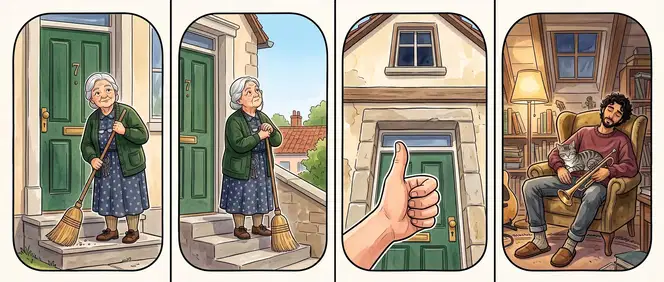 1 Lukas
Guten Morgen, Frau Brandt! Wie geht es ?
Good morning, Mrs Brandt! How are you?
2 HildeGut, . Und Ihnen?
Fine, thank you. And you?
3 LukasSehr ! Jonas spielt nicht.
Very well! Jonas is not playing.
4 HildeJonas . Und Mikesch auch.
Jonas is sleeping. And so is Mikesch.
1 LenaGuten Morgen, Frau Brandt! Wie geht es ?
Good morning, Mrs Brandt! How are you?
2 HildeGut, . Und Ihnen?
Fine, thank you. And you?
3 LenaSehr ! Jonas spielt nicht.
Very well! Jonas is not playing.
4 HildeJonas . Und Mikesch auch.
Jonas is sleeping. And so is Mikesch.
Practice 8/8 · Questions
Choose the meaning
Answer the questions.
Wo ist das Café?
Where is the café?
Unten says where: downstairs.
Wer ist Lotte?
Who is Lotte?
Lotte is Hilde’s granddaughter.
Wie geht es Ihnen?
How are you (polite)?
Gut, danke answers how you are.

Unit complete
