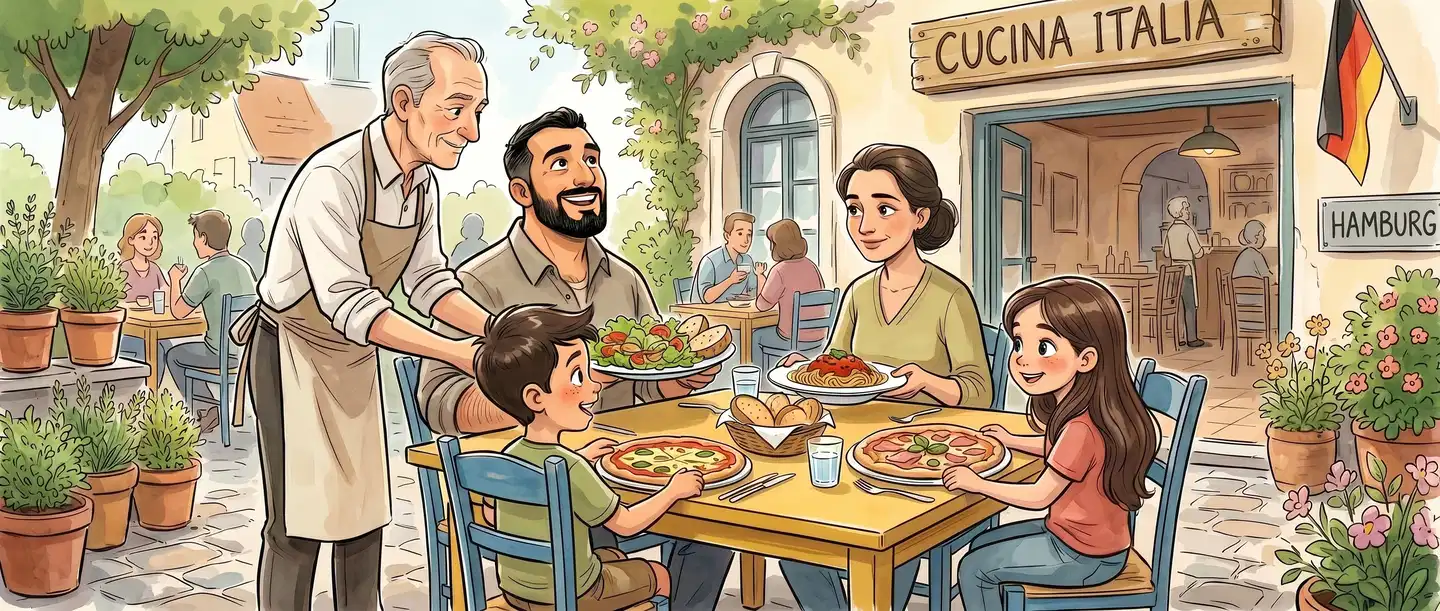
Es gibt einen Park in der Nähe. With „esgibt“ + accusative you say what exists or is available — useful for describing places, offers, and possibilities.
'es gibt' + accusative
Grammar → „es gibt“
„es gibt“
With es gibt you say that something is there or exists. The verb always stays gibt. After it comes the accusative.
Singular — einen (m), eine (f), or ein (n): Es gibt einen Supermarkt.Es gibt eine Bank.Es gibt ein Problem.
Plural — no article, often with viele or a number: Es gibt viele Cafés.Es gibt zwölf Monate.
More
The verb gibt is always in position 2. If the sentence starts with something else (e.g. a place), es moves behind gibt:In der Stadt gibt es ein Kino. In a yes/no question,Gibt comes first: Gibt es hier eine Bank? In a wh-question, the question word comes first, then gibt es:Wo gibt es einen Supermarkt?Wie viele Cafés gibt es?
Form
Example
Singular
Es gibt einen Supermarkt.
plural
Es gibt viele Cafés.
Negation
Es gibt keinen Park.
position 1 different
In der Stadt gibt es einen Park.
yes/no question
Gibt es eine Apotheke?
W-question
Wo gibt es hier Eis?
Find words
Click es and gibt in each sentence.
0/0
.
.
.
.
?
?
?
Statement or question?
Read each sentence and decide whether it is a statement or a question.
0/0
Es gibt einen Park.
Es gibt viele Restaurants.
In der Stadt gibt es ein Kino.
Hier gibt es eine Apotheke.
Gibt es einen Supermarkt?
Gibt es hier eine Bank?
Wo gibt es einen Bäcker?
Warum gibt es keinen Park?
Wie viele Cafés gibt es hier?
Which article fits?
Choose the correct accusative article after es gibt.
0/0
Es gibt Supermarkt in der Straße.
In der Stadt gibt es Apotheke.
Es gibt Schwimmbad in der Stadt.
Gibt es hier Bäcker?
Neben dem Park gibt es Bäckerei.
Gibt es Museum in der Stadt?
Hier gibt es Cafés.
Warum gibt es Park?
Put sentences in order
Put the words in the correct order.
0/0
.
es
gibt
einen
Park
.
es
gibt
viele
Cafés
.
in
der
Stadt
gibt
es
ein
Kino
?
gibt
es
hier
einen
Supermarkt
?
wo
gibt
es
eine
Apotheke
.
es
gibt
keinen
Bahnhof
Fill in the blanks
Fill in each gap with the matching article.
0/0
Anna zieht in eine neue Stadt.
Am ersten Tag macht sie einen langen Spaziergang.
In ihrer Straße gibt es Supermarkt.
Direkt daneben gibt es Bäckerei.
Das findet Anna sehr praktisch.
Am Marktplatz gibt es Brunnen.
Dort gibt es auch kleines Café.
Sie trinkt einen Kaffee und ruht sich aus.
Leider gibt es Kino in der Nähe.
Und es gibt auch Bibliothek im Zentrum.
Trotzdem gefällt Anna ihre neue Stadt sehr.
Grammar in context
Read these texts to consolidate what you learned. They fit this grammar lesson especially well.