The perfect tense is the past form you need most in conversation: Ich habe gegessen.,Ich bin gefahren.. You learn when to use haben or sein and how the past participle goes to the end of the sentence.
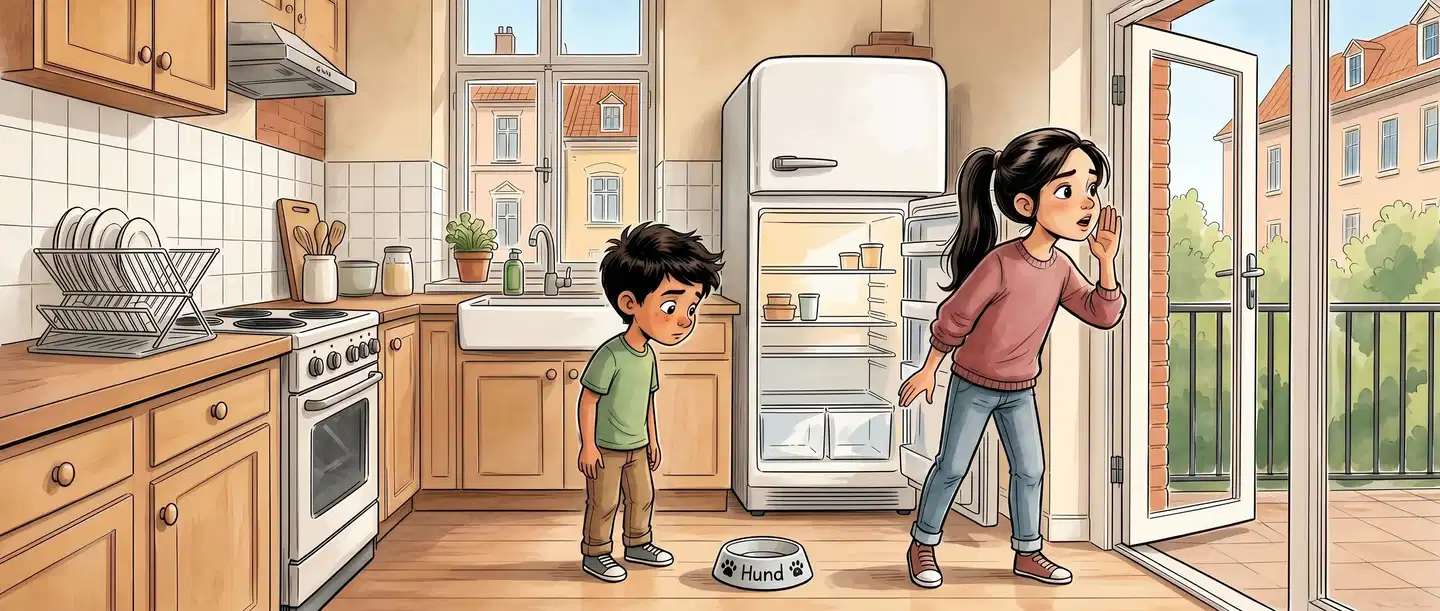
Present perfect with 'haben'
Present perfect with 'sein'
Verb bracket in the present perfect
Grammar → Perfect tense
Explanation
The perfect tense is the most common past tense in spoken German.
It forms a verb bracket from two parts:
The auxiliary verbhaben or sein is in position 2.
The past participle is at the end of the sentence.
Look at the bracket: Ich habe gestern viel gelernt.Wir sind nach Hause gegangen.
Most verbs take haben. Verbs of movement (gehen,fahren,kommen) and of change of state (aufwachen) take sein:Sie ist nach Spanien geflogen.
Auxiliary
Past participle
Verb-bracket example
haben
gelernt
Ich habe gestern viel gelernt.
haben
gegessen
Er hat eine Pizza gegessen.
sein
gegangen
Wir sind nach Hause gegangen.
sein
geflogen
Sie ist nach Spanien geflogen.
Find words
Click the auxiliary verb and the past participle at the end of the sentence in each sentence.
0/0
.
.
.
.
.
.
Which auxiliary fits?
Choose the correct auxiliary — haben or sein — for the perfect tense.
0/0
Ich gestern viel gelernt.
Wir nach Hause gegangen.
Er eine Pizza gegessen.
Sie nach Spanien geflogen.
Du den Film gesehen.
Ihr früh aufgewacht.
Which past participle fits?
Choose the correct form of the past participle.
0/0
Wir haben Fußball .
Er hat den Brief .
Sie hat heute viel .
Ich bin nach Hause .
Du hast Brot .
Wir haben zusammen Pizza .
Put sentences in order
Put the words in the correct order. There are several solutions — what matters is: the auxiliary in position 2, the past participle at the end of the sentence.
0/0
.
ich
habe
gestern
viel
gelernt
.
wir
sind
nach
Hause
gegangen
.
er
hat
eine
Pizza
gegessen
.
sie
ist
nach
Spanien
geflogen
Fill in the blanks
Fill in each gap with the matching word — sometimes an auxiliary verb, sometimes a past participle.
0/0
Am Samstag ich lange geschlafen.
Dann bin ich in die Stadt .
Dort ich eine Freundin getroffen.
Wir haben zusammen einen Kaffee .
Danach wir ins Kino gegangen.
Der Film hat uns gut .
Am Abend bin ich müde nach Hause gekommen.
Es war ein richtig schöner Tag.
Grammar in context
Read these texts to consolidate what you learned. They fit this grammar lesson especially well.