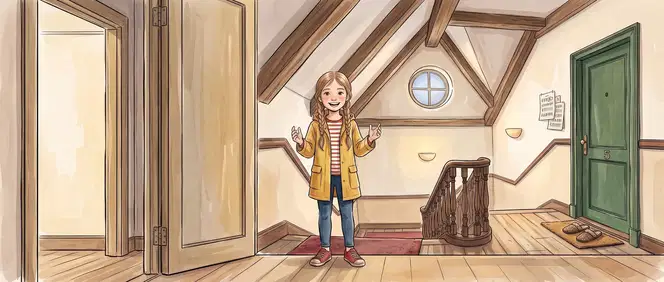
Whose things and when they went missing
Ownership still agrees with the thing: , , . A plural feminine noun keeps ; is not a universal plural possessive ending.
states that the key had gone missing before the current past point. Treat as a common result expression, with placing that result in the past.
A simple relative idea can often be recast: . It expresses what he loves without requiring a full relative construction at A1. refers back to the subject and agrees with the owned thing.
ये उसकी चीज़ें हैं।These are his/her things.
चाबी खो गई थी।The key had gone missing.
वह अपनी चाबी लेता है।He takes his own key.
Practice 1/5 · Finding words
Notice the useful form
Tap the form explained in this unit.
।
These are his/her things.
।
The key had gone missing.
।
He takes his own key.
Practice 2/5 · The right form
Choose the form
Use the meaning and the Hindi pattern.
ये चीज़ें हैं।
These are his/her things.
चाबी खो गई ।
The key had gone missing.
वह चाबी लेता है।
He takes his own key.
Practice 3/5 · Fill the gaps
Complete the messages
Fill the gaps with the words from the box.
ये चीज़ें हैं।
These are his/her things.
चाबी खो गई ।
The key had gone missing.
वह चाबी लेता है।
He takes his own key.
Practice 4/5 · Building sentences
Build a sentence
Put the words in order.
These are his/her things.
The key had gone missing.
He takes his own key.
Practice 5/5 · Matching
Connect form and meaning
Match the pairs.
Unit complete