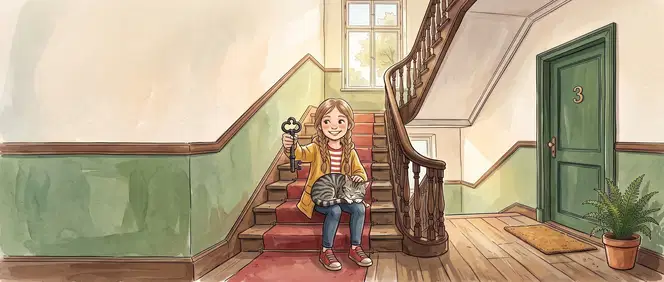
Introduce yourself and ask a yes/no question
A pronoun stands in for a person or thing: means I and means polite you. Singular means one person or thing; plural means more than one. Respectful speech can use plural-style for just one person.
Hindi usually puts the verb last. Say (I am Kamala), (this is my house). takes , takes , and polite takes even for one person.
Use with a new adult acquaintance. Starting a statement with makes a yes/no question: The answer can simply be or . Learn as a greeting for now.
itself works for a man or woman, but a describing word changes: for a man addressed politely, for a woman. Hindi noun gender belongs to each noun; it is not always the person’s sex.
| Person | Be |
|---|---|
| (I) | |
| (polite you) | |
| (this/he/she) |
मैं कमला हूँ।I am Kamala.
यह मेरा मकान है।This is my house.
क्या आप नए पड़ोसी हैं?Are you the new neighbour? (male)
Hindi nouns have gender: they belong to a masculine or feminine class. Masculine (house) takes (my); feminine (key) takes . This noun class need not match a person’s sex. An article is a word like English a or the; Hindi does not need one in these simple introductions.
Practice 1/5 · Finding words
Notice the useful form
Tap the form explained in this unit.
।
I am Kamala.
।
This is my house.
?
Are you the new neighbour? (male)
Practice 2/5 · The right form
Choose the form
Use the meaning and the Hindi pattern.
मैं कमला ।
I am Kamala.
यह मेरा मकान ।
This is my house.
आप नए पड़ोसी हैं?
Are you the new neighbour? (male)
Practice 3/5 · Fill the gaps
Complete the messages
Fill the gaps with the words from the box.
मैं कमला ।
I am Kamala.
यह मेरा मकान ।
This is my house.
आप नए पड़ोसी हैं?
Are you the new neighbour? (male)
Practice 4/5 · Building sentences
Build a sentence
Put the words in order.
I am Kamala.
This is my house.
Are you the new neighbour? (male)
Practice 5/5 · Matching
Connect form and meaning
Match the pairs.

Unit complete