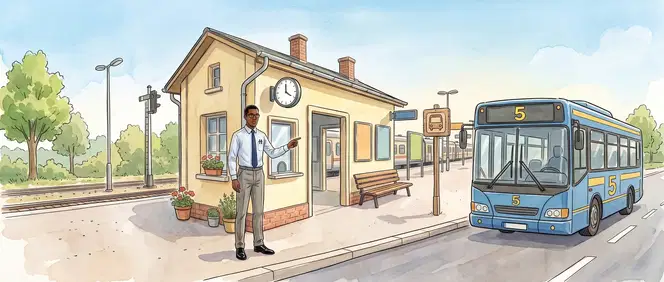
The complete irregular go set is . The last two present forms are not past tense. means we go by train.
Transport and timetable times
Transport uses -val/-vel: . The initial assimilates after a consonant. Walking is . Being inside a train uses , a conventional surface ending.
is a return ticket; is one way. A timetable can use twenty-four-hour times. means the service is not running; this is a natural announcement for a cancelled train.
| Form | Example | Meaning |
|---|---|---|
| I go by train. | ||
| I go by train. | ||
| I go by bus. | ||
| I go by bus. | ||
| I go by car. | ||
| I go by car. | ||
| I go by bicycle. | ||
| I go by bicycle. | ||
| I go on foot. | ||
| I go on foot. | ||
| I am on the train. | ||
| I am on the train. | ||
Vonattal megyek.I go by train.
Busszal megyek.I go by bus.
Autóval megyek.I go by car.
Biciklivel megyek.I go by bicycle.
Gyalog megyek.I go on foot.
A vonaton vagyok.I am on the train.
| Person | Meaning | |
|---|---|---|
| I — go | ||
| I — go | ||
| You (familiar singular) — go | ||
| You (familiar singular) — go | ||
| He/she/you polite — go | ||
| He/she/you polite — go | ||
| We — go | ||
| We — go | ||
| You (familiar plural) — go | ||
| You (familiar plural) — go | ||
| They/you polite plural — go | ||
| They/you polite plural — go | ||
Practice 1/6 · Finding words
Notice the useful pattern
Tap the form practised in this unit.
.
I go by train.
.
I go by bus.
.
I go by car.
.
I go by bicycle.
Practice 2/6 · The right form
Choose the form 1
Choose the right word for the gap.
Én Budapestre.
I go to Budapest.
Te Budapestre.
You (familiar singular) go to Budapest.
Ő Budapestre.
He/she goes to Budapest.
Mi Budapestre.
We go to Budapest.
Ti Budapestre.
You (familiar plural) go to Budapest.
Ők Budapestre.
They go to Budapest.
megyek.
I go by train.
Choose the form 2
Choose the right word for the gap.
megyek.
I go by bus.
megyek.
I go by car.
megyek.
I go by bicycle.
megyek.
I go on foot.
A vagyok.
I am on the train.
Practice 3/6 · Fill the gaps
Recall the form 1
Fill the gaps with the words from the box.
Én Budapestre.
I go to Budapest.
Te Budapestre.
You (familiar singular) go to Budapest.
Ő Budapestre.
He/she goes to Budapest.
Mi Budapestre.
We go to Budapest.
Ti Budapestre.
You (familiar plural) go to Budapest.
Ők Budapestre.
They go to Budapest.
megyek.
I go by train.
Recall the form 2
Fill the gaps with the words from the box.
megyek.
I go by bus.
megyek.
I go by car.
megyek.
I go by bicycle.
megyek.
I go on foot.
A vagyok.
I am on the train.
Practice 4/6 · Building sentences
Build a sentence
Put the words in order.
I go by train today.
I go by bus today.
I go by car today.
I go by bicycle today.
Practice 5/6 · In situations
What would you say?
Choose the right words for the situation.
I go by train.
You say:
Use the meaning and Hungarian pattern explained in this unit.
I go by train.
You say:
Use the meaning and Hungarian pattern explained in this unit.
I go by bus.
You say:
Use the meaning and Hungarian pattern explained in this unit.
I go by bus.
You say:
Use the meaning and Hungarian pattern explained in this unit.
I go by car.
You say:
Use the meaning and Hungarian pattern explained in this unit.
I go by car.
You say:
Use the meaning and Hungarian pattern explained in this unit.
I go by bicycle.
You say:
Use the meaning and Hungarian pattern explained in this unit.
I go by bicycle.
You say:
Use the meaning and Hungarian pattern explained in this unit.
Practice 6/6 · Matching
Connect messages and meanings
Match the pairs.

Unit complete