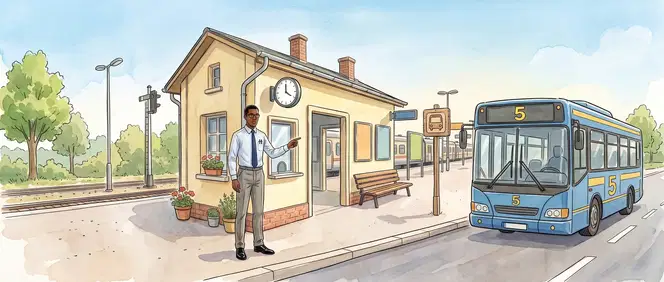
The complete irregular go set is . The last two present forms are not past tense. means we go by train.
Transport and timetable times
Transport uses -val/-vel: . The initial assimilates after a consonant. Walking is . Being inside a train uses , a conventional surface ending.
is a return ticket; is one way. A timetable can use twenty-four-hour times. means the service is not running; this is a natural announcement for a cancelled train.
| Form | Example | Meaning |
|---|---|---|
| I go by train. | ||
| I go by train. | ||
| I go by bus. | ||
| I go by bus. | ||
| I go by car. | ||
| I go by car. | ||
| I go by bicycle. | ||
| I go by bicycle. | ||
| I go on foot. | ||
| I go on foot. | ||
| I am on the train. | ||
| I am on the train. | ||
Vonattal megyek.I go by train.
Busszal megyek.I go by bus.
Autóval megyek.I go by car.
Biciklivel megyek.I go by bicycle.
Gyalog megyek.I go on foot.
A vonaton vagyok.I am on the train.
| Person | Meaning | |
|---|---|---|
| I — go | ||
| I — go | ||
| You (familiar singular) — go | ||
| You (familiar singular) — go | ||
| He/she/you polite — go | ||
| He/she/you polite — go | ||
| We — go | ||
| We — go | ||
| You (familiar plural) — go | ||
| You (familiar plural) — go | ||
| They/you polite plural — go | ||
| They/you polite plural — go | ||
Practice 1/6 · Finding words
Notice the useful pattern
Tap the form practised in this unit.
.
I go by train.
.
I go by bus.
.
I go by car.
.
I go by bicycle.
Practice 2/6 · The right form
Choose the form 1
Choose the right word for the gap.
Én Budapestre.
I go to Budapest.
Te Budapestre.
You (familiar singular) go to Budapest.
Ő Budapestre.
He/she goes to Budapest.
Mi Budapestre.
We go to Budapest.
Ti Budapestre.
You (familiar plural) go to Budapest.
Ők Budapestre.
They go to Budapest.
megyek.
I go by train.
Choose the form 2
Choose the right word for the gap.
megyek.
I go by bus.
megyek.
I go by car.
megyek.
I go by bicycle.
megyek.
I go on foot.
A vagyok.
I am on the train.
Practice 3/6 · Fill the gaps
Recall the form 1
Fill the gaps with the words from the box.
Én Budapestre.
I go to Budapest.
Én Budapestre.
I go to Budapest.
Te Budapestre.
You (familiar singular) go to Budapest.
Te Budapestre.
You (familiar singular) go to Budapest.
Ő Budapestre.
He/she goes to Budapest.
Ő Budapestre.
He/she goes to Budapest.
Mi Budapestre.
We go to Budapest.
Mi Budapestre.
We go to Budapest.
Ti Budapestre.
You (familiar plural) go to Budapest.
Ti Budapestre.
You (familiar plural) go to Budapest.
Ők Budapestre.
They go to Budapest.
Ők Budapestre.
They go to Budapest.
megyek.
I go by train.
megyek.
I go by train.
Recall the form 2
Fill the gaps with the words from the box.
megyek.
I go by bus.
megyek.
I go by bus.
megyek.
I go by car.
megyek.
I go by car.
megyek.
I go by bicycle.
megyek.
I go by bicycle.
megyek.
I go on foot.
megyek.
I go on foot.
A vagyok.
I am on the train.
A vagyok.
I am on the train.
Practice 4/6 · Building sentences
Build a sentence
Put the words in order.
Too hard? Listen to the sentence first.
I go by train today.
I go by bus today.
I go by car today.
I go by bicycle today.
Practice 5/6 · In situations
What would you say?
Choose the right words for the situation.
I go by train.
You say:
Use the meaning and Hungarian pattern explained in this unit.
I go by train.
You say:
Use the meaning and Hungarian pattern explained in this unit.
I go by bus.
You say:
Use the meaning and Hungarian pattern explained in this unit.
I go by bus.
You say:
Use the meaning and Hungarian pattern explained in this unit.
I go by car.
You say:
Use the meaning and Hungarian pattern explained in this unit.
I go by car.
You say:
Use the meaning and Hungarian pattern explained in this unit.
I go by bicycle.
You say:
Use the meaning and Hungarian pattern explained in this unit.
I go by bicycle.
You say:
Use the meaning and Hungarian pattern explained in this unit.
Practice 6/6 · Matching
Connect messages and meanings
Match the pairs.

Unit complete