In, on, at and direct objects
Use place prepositions in common expressions: , , . Learn the whole expression when English uses a different preposition.
A preposition can join a definite article: with becomes , with becomes , and with becomes . Examples are , , .
The direct object pronouns replace a noun: . They normally go before the present verb. Detailed practice returns with medicine and shopping later.
Polite object can mean you for a man or woman: . Learn the polite instruction as a useful chunk: put it in the bag.
| Form | Example | Meaning |
|---|---|---|
| in, inside | ||
| in, inside | ||
| on | ||
| on | ||
| at, to | ||
| at, to | ||
| in the | ||
| in the | ||
| on the | ||
| on the | ||
| at the | ||
| at the | ||
| him/it | ||
| him/it | ||
| her/it/you (polite, either sex) | ||
| her/it/you (polite, either sex) | ||
Tommaso è in ufficio.Tommaso is in the office.
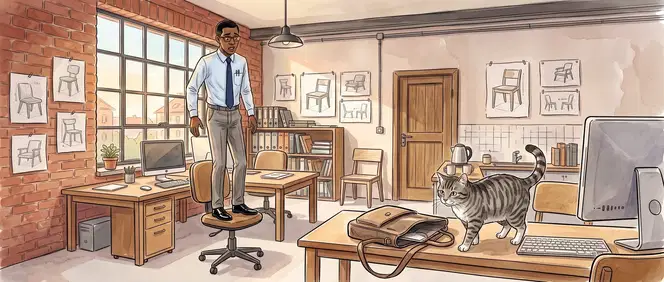
Milo dorme sulla stampante.Milo sleeps on the printer.
Marco dorme a casa.Marco sleeps at home.
Nel fine settimana Tommaso mangia uova.At the weekend Tommaso eats eggs.
Le regole sono sul muro della cucina.The rules are on the kitchen wall.
Conosco il nuovo collega. Lo vedo al bar.I know the new colleague. I see him/her at the café.
Conosco la nuova collega. La vedo al bar.I know the new colleague. I see him/her at the café.
Lei vede il gatto? Sì, lo vedo.Do you see the cat? Yes, I see it.
Chiara è al bancone.Chiara is at the counter.
Practice 1/6 · Finding words
Notice the useful pattern
Tap the form practised in this unit.
.
Tommaso is in the office.
.
Milo sleeps on the printer.
.
Marco sleeps at home.
.
At the weekend Tommaso eats eggs.
Practice 2/6 · The right form
Choose the form
Use the English meaning and the pattern in this unit.
Tommaso è ufficio.
Tommaso is in the office.
Milo dorme stampante.
Milo sleeps on the printer.
Marco dorme casa.
Marco sleeps at home.
Nel Tommaso mangia uova.
At the weekend Tommaso eats eggs.
Le regole sono muro della cucina.
The rules are on the kitchen wall.
Conosco il nuovo collega. vedo al bar.
I know the new colleague. I see him/her at the café.
Conosco la nuova collega. vedo al bar.
I know the new colleague. I see him/her at the café.
Lei vede il gatto? Sì, vedo.
Do you see the cat? Yes, I see it.
Chiara è bancone.
Chiara is at the counter.
Practice 3/6 · Fill the gaps
Complete the messages
Fill the gaps with the words from the box.
Marco dorme casa.
Marco sleeps at home.
Nel Tommaso mangia uova.
At the weekend Tommaso eats eggs.
Le regole sono muro della cucina.
The rules are on the kitchen wall.
Conosco il nuovo collega. vedo al bar.
I know the new colleague. I see him/her at the café.
Conosco la nuova collega. vedo al bar.
I know the new colleague. I see him/her at the café.
Lei vede il gatto? Sì, vedo.
Do you see the cat? Yes, I see it.
Chiara è bancone.
Chiara is at the counter.
Practice 4/6 · Building sentences
Build a sentence
Put the words in order.
Tommaso is in the office.
Milo sleeps on the printer.
Marco sleeps at home.
At the weekend Tommaso eats eggs.
The rules are on the kitchen wall.
I know the new colleague. I see him/her at the café.
I know the new colleague. I see him/her at the café.
Practice 5/6 · In situations
What would you say?
Choose the right words for the situation.
Tommaso is in the office.
You say:
Use the meaning and Italian pattern explained in this unit.
Tommaso is in the office.
You say:
Use the meaning and Italian pattern explained in this unit.
Milo sleeps on the printer.
You say:
Use the meaning and Italian pattern explained in this unit.
Milo sleeps on the printer.
You say:
Use the meaning and Italian pattern explained in this unit.
Marco sleeps at home.
You say:
Use the meaning and Italian pattern explained in this unit.
Marco sleeps at home.
You say:
Use the meaning and Italian pattern explained in this unit.
At the weekend Tommaso eats eggs.
You say:
Use the meaning and Italian pattern explained in this unit.
At the weekend Tommaso eats eggs.
You say:
Use the meaning and Italian pattern explained in this unit.
Practice 6/6 · Matching
Connect messages and meanings
Match the pairs.
Unit complete
