Bonus storyPremium
Il ragazzo con la tromba
The boy with the trumpet
Module 9 · The festivalGet to know the neighbours and practise what you've learned in a new story.
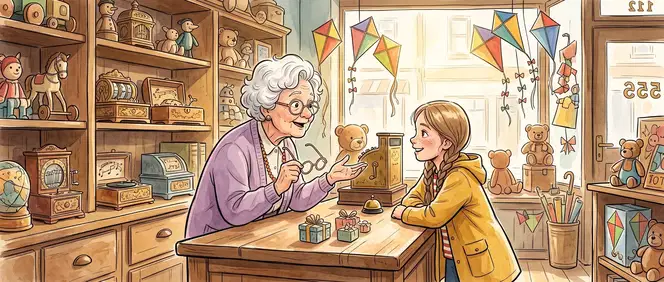
The storySaturday morning, the day of the festival. On the way to the market square, you and Sofia stop at the old toy and gift shop, and Mrs Giulia tells you about a boy of ten, his first trumpet and his first festival, eighteen years ago.
New words in the story
- gradini steps
- orchestra orchestra
- canzone song
- triste sad
- contento happy; pleased
- stessa same, feminine
- rimanere to remain; to stay
- rimasta / rimasti remained; stayed — agreeing past forms
Tap a word to see what it means.
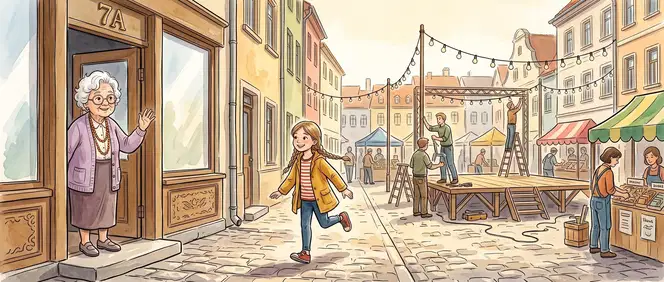
Saturday morning, the day of the festival. The sun is out. On the way to the market square, you and Sofia pass the old toy and gift shop. Giulia is standing in the doorway.
 Giulia
Buongiorno! Andate al festival?
Good morning! Off to the festival?
 Sofia
SofiaBuongiorno, signora Giulia! Sì. Stasera Marco suona per primo!
Good morning, Mrs Giulia! Yes. Tonight Marco is playing first!
- Giulia
Il piccolo Marco? Stasera? Entrate, entrate!
Little Marco? Tonight? Come in, come in!
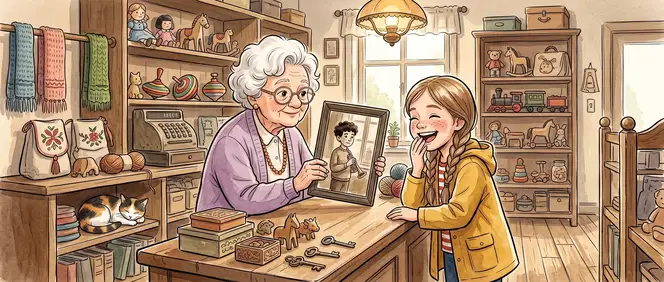
Inside, the shop smells of wood and old paper. Giulia sits down behind her counter and takes off her glasses. - Giulia
Conosco il piccolo Marco da molto tempo. Allora aveva dieci anni.
I've known little Marco for a very long time. Back then he was ten.
- Giulia
Sofia, hai visto la sua foto? Con la tromba, alla finestra?
Sofia, have you seen his photo? With the trumpet, at the window?
- Sofia
Sì! E con un taglio di capelli terribile!
I have! And with a terrible haircut!
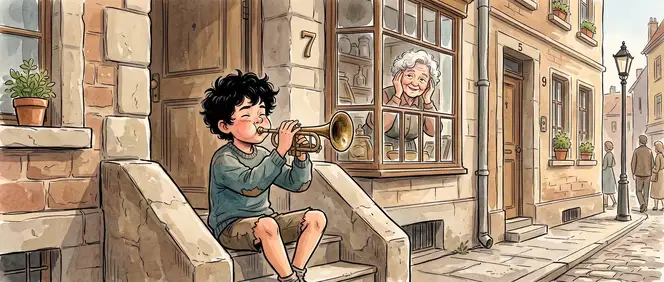
Lui abitava al numero 7 allora, vero?
He lived at number 7 then, didn't he?
Lui abitava al numero 7 allora, vero?
He lived at number 7 then, didn't he?
- Giulia
Sì. Con sua madre e suo padre, al secondo piano. Nel Suo appartamento.
Yes. With his mum and dad, on the second floor. In your flat.
Lo so. Marco me l’ha detto.
I know. Marco told me.
Lo so. Marco me l’ha detto.
I know. Marco told me.
- Giulia
Sua madre e suo padre lavoravano molto. Tutto il giorno, ogni giorno.
His mum and dad worked a lot. All day, every day.
 Giulia
E dopo la scuola il piccolo Marco era da solo. Da solo con una tromba.
And after school little Marco was on his own. On his own with a trumpet.
- Sofia
Con una tromba? Dove ha preso una tromba?
With a trumpet? Where did he get a trumpet?
- Giulia
La tromba era della signora Rossi. Una tromba piccola e vecchia. La signora Rossi gliel’ha data.
The trumpet was Maria's. A small, old trumpet. Maria gave it to him.
- Sofia
Della nonna? E dove ha preso una tromba la nonna?
Grandma's? And where did Grandma get a trumpet?
- Giulia
Non lo so. La signora Rossi sa tutto, e io no.
I don't know. Maria knows everything, and I don't.
- Giulia
Ogni giorno lui si sedeva sui gradini sotto la mia finestra e suonava.
Every day he sat on the steps under my window and played.
- Giulia
All’inizio suonava molto male. Molto forte e molto male!
At first he played very badly. Very loudly and very badly!
E Lei ascoltava? Ogni giorno?
And you listened? Every day?
E Lei ascoltava? Ogni giorno?
And you listened? Every day?
 Giulia
Ascoltavo. Che cosa potevo fare? Lavoravo qui.
I listened. What could I do? I worked here.
- Giulia
Dopo un po’ lui suonava meglio. E poi è arrivato il festival della città.
After a while he played better. And then came the town festival.
- Sofia
E ha suonato al festival?
And he played at the festival?
- Giulia
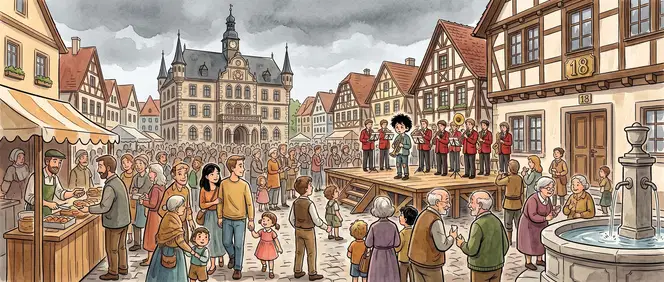
Sì. Sulla piazza, con l’orchestra. Per la prima volta.
He did. On the square, with the orchestra. For the first time.
- Giulia
All’inizio è stato molto brutto. Lui aveva molta paura. C’era tanta gente sulla piazza.
At first it was very bad. He was very frightened. There were lots of people on the square.
- Giulia
L’orchestra suonava una canzone, e il piccolo Marco un’altra. Quella sbagliata!
The orchestra played one song, and little Marco another. The wrong one!
- Giulia
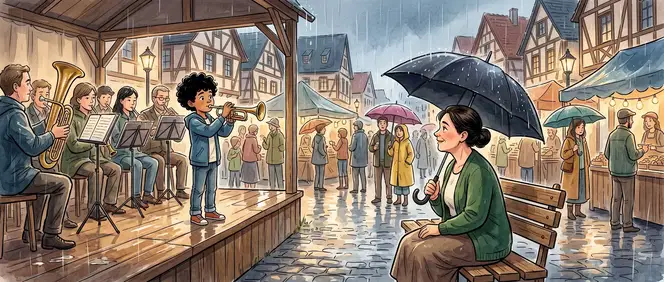
Poi ha piovuto. Ha piovuto forte! E tante persone sono andate a casa.
Then it rained. It poured! And lots of people went home.
- Giulia
Il piccolo Marco era bagnato e molto triste. Anche lui voleva andare a casa.
Little Marco was wet and very sad. He wanted to go home too.
- Sofia
E la nonna? Dov’era la nonna?
And Grandma? Where was Grandma?
 Giulia
La signora Rossi era seduta sulla panchina davanti al palco. Con un ombrello.
Maria was sitting on the bench in front of the stage. With an umbrella.
- Giulia
Ha detto: "Marco, non vai a casa! Suona!"
She said: 'Marco, you're not going home! Play!'
E lui ha suonato?
And he played?
E lui ha suonato?
And he played?
- Giulia
Sì. Sotto la pioggia. La stessa canzone dell’orchestra. E molto bene.
He did. In the rain. The same song as the orchestra. And very beautifully.
- Giulia
Alla fine la pioggia si è fermata, e la gente è tornata.
At last the rain stopped, and the people came back.
- Giulia
Noi tutti ascoltavamo. E poi tutta la piazza ha cantato.
We all listened. And then the whole square sang.
- Sofia
E Lei ha cantato, signora Giulia?
And did you sing, Mrs Giulia?
- Giulia
Certo! Io ho cantato, la signora Rossi ha cantato, tutti hanno cantato.
Of course! I sang, Maria sang, we all sang.
E sua madre e suo padre? Erano lì?
And his mum and dad? Were they there?
E sua madre e suo padre? Erano lì?
And his mum and dad? Were they there?
- Giulia
Sono arrivati dopo il lavoro, tardi. Ma hanno sentito l’ultima canzone.
They came after work, late. But they heard the last song.
- Giulia
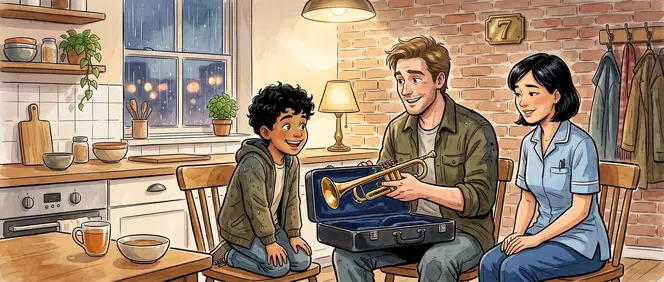
Suo padre era molto contento. Dopo, i suoi genitori hanno comprato al piccolo Marco una tromba nuova, grande.
His dad was very happy. Afterwards his parents bought little Marco a new, big trumpet.
- Sofia
E la tromba piccola?
And the little trumpet?
- Giulia
La piccola è rimasta con la signora Rossi. Forse è ancora lì. Chi lo sa?
The little one stayed with Maria. Maybe it's still there. Who knows?
- Sofia
La nonna lo sa. La nonna sa tutto!
Grandma knows. Grandma knows everything!
Giulia puts her glasses back on and looks out at the sunny street.
- Giulia
E oggi lui suona di nuovo sulla piazza. Come diciotto anni fa.
And today he'll play on the square again. Like eighteen years ago.
Viene anche Lei, signora Giulia?
Will you come, Mrs Giulia?
Viene anche Lei, signora Giulia?
Will you come, Mrs Giulia?
- Giulia
Vengo. Mi siedo vicino alla signora Rossi. E se piove, ho un ombrello!
I'll come. I'll sit next to Maria. And if it rains, I've got an umbrella!
- Sofia
E noi tutti cantiamo!
And we'll all sing!
Practice 1/4 · Who says it
Who said it?
Who says it?
Buongiorno! Andate al festival?
Buongiorno! Andate al festival?
Buongiorno, signora Giulia! Sì. Stasera Marco suona per primo!
Buongiorno, signora Giulia! Sì. Stasera Marco suona per primo!
Lui abitava al numero 7 allora, vero?
Lui abitava al numero 7 allora, vero?
Practice 2/4 · True or false
Right or wrong?
True or false?
Giulia conosce Marco da molto tempo.
Giulia has known Marco for a long time.
Marco abitava al numero 9.
Marco lived at number 9.
La tromba piccola era della signora Rossi.
The little trumpet belonged to Mrs Rossi.
Quando ha piovuto, tutti sono rimasti sulla piazza.
When it rained, everyone stayed on the square.
I genitori di Marco hanno comprato una tromba nuova.
Marco's parents bought a new trumpet.
Practice 3/4 · What happens
What happened first?
Put what happens in order.
Practice 4/4 · Questions
Understand the story
Answer the questions.
Chi ha dato la tromba piccola a Marco?
Who gave the little trumpet to Marco?
Giulia says the small old trumpet belonged to Mrs Rossi, and Mrs Rossi gave it to him.
Dov’era seduta la signora Rossi?
Where was Mrs Rossi sitting?
In the story, Giulia says Mrs Rossi was sitting on the bench in front of the stage.
Che cosa hanno sentito i genitori di Marco?
What did Marco's parents hear?
They arrived late after work, but they heard the last song.
Unit complete
