Module 1Word reviewPremium
Words of module 1: Arrival
Reviews practise both sides: wherever Lukas and Lena would say something differently, you do it once as each.
In this module you learned to
- greet an older neighbour politely and say my name
- say hello to a child, ask her name, get my key back and ask where something is
- introduce myself in a café, choose coffee or tea, and say if I like something
- knock on a neighbour's door, say that I want to sleep, and ask someone to do something tomorrow
- ask how someone is, and ask where people live
From this module's scenes

안녕하세요
hello (in the evening)
안녕하세요 is natural in the evening too; Korean greetings need not translate the English time-of-day words.
안녕하세요


할머니
grandmother
저는 지우예요. 최 선생님은 우리 할머니예요. 새 이웃이에요?I am Jiwoo. Ms Choi is my grandmother. Are you the new neighbour?
제 열쇠예요!
있다
have / there is
Korean commonly uses 있다 with the item as the subject: 열쇠가 있어요.
네, 저는 루카스예요. 제 열쇠가 있어요?Yes, I am Lukas. Do you have my key?
네, 저는 레나예요. 제 열쇠가 있어요?Yes, I am Lena. Do you have my key?
제 열쇠예요!


가다
go (on foot)
좋아요. 카페에 가요.Good. I am going to the café.
좋아요. 카페에 가요.Good. I am going to the café.
제 열쇠예요!

좋은 아침이에요
good morning (friendly)
좋은 아침이에요 is a friendly greeting. 안녕하세요 is also normal in the morning.
좋은 아침이에요! 새 이웃이에요?Good morning! Are you the new neighbour?
맛있게 드세요


주세요
please give…
Use N 주세요 for a request. 제발 is a strong plea, not a routine equivalent of every English please.
맛있게 드세요
벌써
already
이제 손님 것이에요. 배고파요? 최 선생님은 벌써 알아요.Now it is yours. Are you hungry? Ms Choi already knows.
맛있게 드세요

좋아하다
like
좋아하다 takes an object. 좋다 describes something as good and has a different construction.
정말 맛있어요. 케이크를 좋아해요. 고마워요!It is really delicious. I like cake. Thank you!
정말 맛있어요. 케이크를 좋아해요. 고마워요!It is really delicious. I like cake. Thank you!
맛있게 드세요


살다
live
반가워요. 저는 루카스예요. 아래층에 살아요.Nice to meet you. I am Lukas. I live downstairs.
반가워요. 저는 레나예요. 아래층에 살아요.Nice to meet you. I am Lena. I live downstairs.
지금은 밤이에요


싶다
want to (bound pattern)
Use a verb stem + 고 싶어요 for your own desire or a question about another person’s desire. Third-person reports need a different pattern; the beginner dialogues normally use direct speech.
지금은 밤이에요


선생님은요
and you?
잘 지내요. 고마워요. 선생님은요?I am doing well. Thank you. And you?
잘 지내요. 고마워요. 선생님은요?I am doing well. Thank you. And you?
누가 어디에 살아요?


씨
respectful name suffix (not gendered)
씨 follows a name. For the retired teacher use 최 선생님; shop owners are commonly 사장님.
밤에도요? 지훈 씨!At night too? Jihun!
누가 어디에 살아요?
주인
master of the house, the one in charge
여기요. 저기요. 위층에도, 아래층에도 있어요. 나비가 주인이에요!Here and there. Upstairs and downstairs. Nabi is the boss!
누가 어디에 살아요?


안녕하세요
hello (during the day)
Korean normally uses 안녕하세요 rather than a separate literal good-day formula.
안녕하세요.Hello.
안녕하세요.Hello.
누가 어디에 살아요?
Additional words


빵
bread
십일 번 테이블은 커피와 케이크요! 십이 번은 차와 빵이요!Table eleven: coffee and cake! Table twelve: tea and bread!
차만 주세요


Practice 1/7 · Pictures
Pictures and words
Match the words to the pictures.
Pictures and words
Match the words to the pictures.
Pictures and words
Match the words to the pictures.
Pictures and words
Match the words to the pictures.
Pictures and words
Match the words to the pictures.
Pictures and words
Match the words to the pictures.
Pictures and words
Match the words to the pictures.
Pictures and words
Match the words to the pictures.
Pictures and words
Match the words to the pictures.
Pictures and words
Match the words to the pictures.
Pictures and words
Match the words to the pictures.
Pictures and words
Match the words to the pictures.
Practice 2/7 · Listening
Listen and choose
Listen and choose the word you hear.
만나서 반가워요: nice to meet you
누구: who
열쇠: key
이름: name
여기요: here is
Practice 3/7 · Meanings
What does it mean?
감사합니다
새
누구
이거
집
만나서 반가워요
Practice 4/7 · Matching
Messages from the module
Match the pairs.
Practice 5/7 · Fill the gaps
Recall the conversations
Fill the gaps with the words from the box.
As Lukas
저는 루카스예요. .
I am Lukas. Hello.
As Lena
저는 레나예요. .
I am Lena. Hello.
As Lukas
저는 루카스예요. . 이름이 뭐예요?
I am Lukas. Hello. What is your name?
As Lena
저는 레나예요. . 이름이 뭐예요?
I am Lena. Hello. What is your name?
! 어떻게 알아요?
Yes! How do you know?
! 어떻게 알아요?
Yes! How do you know?
! 지금은 안 돼요!
Oh! Not now!
! 지금은 안 돼요!
Oh! Not now!
지내요. 고마워요. 선생님은요?
I am doing well. Thank you. And you?
지내요. 고마워요. 선생님은요?
I am doing well. Thank you. And you?
Practice 6/7 · In situations
Use the messages
Choose the right words for the situation.
Hello.
You say:
Hello.
You say:
Hello. What is your name?
You say:
Hello. What is your name?
You say:
Yes! How do you know?
You say:
Yes! How do you know?
You say:
Oh! Not now!
You say:
Oh! Not now!
You say:
I am doing well. Thank you. And you?
You say:
I am doing well. Thank you. And you?
You say:
Practice 7/7 · Comic strip
최 선생님, 안녕하세요! 잘 지내세요?
Fill the speech bubbles.
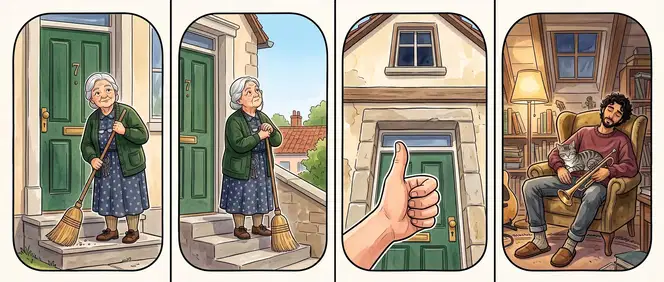 1 Lukas
최 선생님, ! 잘 지내세요?
Hello, Ms Choi! Are you well?
2 최정숙네, 좋아요. 은요?
Yes, fine. And the night?
3 Lukas정말 좋아요! 지훈 씨가 불어요.
Very good! Jihun is not playing.
4 최정숙지훈 씨는 . 나비도 자요.
Jihun sleeps. Nabi sleeps too.
1 Lena최 선생님, ! 잘 지내세요?
Hello, Ms Choi! Are you well?
2 최정숙네, 좋아요. 은요?
Yes, fine. And the night?
3 Lena정말 좋아요! 지훈 씨가 불어요.
Very good! Jihun is not playing.
4 최정숙지훈 씨는 . 나비도 자요.
Jihun sleeps. Nabi sleeps too.

Unit complete
