People, gender and being
A pronoun is a word for a person: , I; , familiar you; , he/she; , we; , polite or plural you; , they. Singular means one; plural means more than one. The subject is the person or thing the sentence talks about.
The present tense of , to be, is . Third-person singular and plural share . Negation means saying no: .
Gender is the masculine or feminine class of a noun. An adjective describes a noun and agrees with it: , masculine, and , feminine. The nominative is the subject or basic form; a case is a form showing a noun’s role. Possessives agree with the owned noun: , . To call someone, use the vocative: Muris → Muri!. Polite uses a plural verb, but a single learner’s describing word stays singular and matches that learner’s gender.
| Person | With | Meaning | |
|---|---|---|---|
| I am · I am not | |||
| I am · I am not | |||
| You are · You are not, familiar | |||
| You are · You are not, familiar | |||
| · | He/she is · He/she is not | ||
| He/she is · He/she is not | |||
| We are · We are not | |||
| We are · We are not | |||
| You are · You are not, polite/plural | |||
| You are · You are not, polite/plural | |||
| · | They are · They are not | ||
| They are · They are not | |||
Es esmu kaimiņš.I am a neighbour.
Es esmu kaimiņiene.I am a neighbour.
Tu esi kaimiņš.You are a neighbour, familiar.
Tu esi kaimiņiene.You are a neighbour, familiar.
Viņš ir kaimiņš.He is a neighbour.
Mēs esam kaimiņi.We are neighbours.
Jūs esat kaimiņš.You are a neighbour, polite.
Jūs esat kaimiņiene.You are a neighbour, polite.
Viņi ir kaimiņi.They are neighbours.
Es neesmu kaimiņš.I am not a neighbour.
Es neesmu kaimiņiene.I am not a neighbour.
Jūs neesat kaimiņš.You are not a neighbour, polite.
Jūs neesat kaimiņiene.You are not a neighbour, polite.
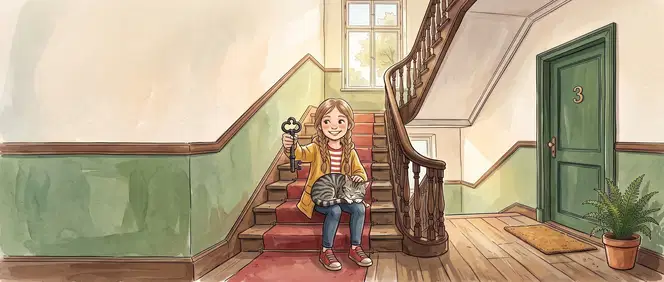
The scene asks about the expected newcomer with or . These particular-person forms are useful whole expressions now; definite describing endings are taught fully in module seven.
Practice 1/6 · Finding words
Notice the useful pattern
Tap the form practised in this unit.
.
I am a neighbour.
.
I am a neighbour.
.
You are a neighbour, familiar.
.
You are a neighbour, familiar.
.
He is a neighbour.
.
We are neighbours.
Practice 2/6 · The right form
Choose the form
Use the English meaning and the pattern in this unit.
Es kaimiņš.
I am a neighbour.
Es kaimiņiene.
I am a neighbour.
Tu kaimiņš.
You are a neighbour, familiar.
Tu kaimiņiene.
You are a neighbour, familiar.
Viņš kaimiņš.
He is a neighbour.
Mēs kaimiņi.
We are neighbours.
Jūs kaimiņš.
You are a neighbour, polite.
Jūs kaimiņiene.
You are a neighbour, polite.
Viņi kaimiņi.
They are neighbours.
Es kaimiņš.
I am not a neighbour.
Es kaimiņiene.
I am not a neighbour.
Jūs kaimiņš.
You are not a neighbour, polite.
Jūs kaimiņiene.
You are not a neighbour, polite.
The complete negative paradigm
Choose the right word for the gap.
Tu jauns.
You are not new, familiar.
Tu jauna.
You are not new, familiar.
Viņš kaķis.
He is not a cat.
Mēs te.
We are not here.
Viņi te.
They are not here.
Practice 3/6 · Fill the gaps
Complete the messages
Fill the gaps with the words from the box.
Viņš kaimiņš.
He is a neighbour.
Mēs kaimiņi.
We are neighbours.
Jūs kaimiņš.
You are a neighbour, polite.
Jūs kaimiņiene.
You are a neighbour, polite.
Viņi kaimiņi.
They are neighbours.
Es kaimiņš.
I am not a neighbour.
Es kaimiņiene.
I am not a neighbour.
Jūs kaimiņš.
You are not a neighbour, polite.
Jūs kaimiņiene.
You are not a neighbour, polite.
Negative messages
Fill the gaps with the words from the box.
Tu jauns.
You are not new, familiar.
Tu jauna.
You are not new, familiar.
Viņš kaķis.
He is not a cat.
Mēs te.
We are not here.
Viņi te.
They are not here.
Practice 4/6 · Building sentences
Build a sentence
Put the words in order.
I am a neighbour.
I am a neighbour.
You are a neighbour, familiar.
You are a neighbour, familiar.
He is a neighbour.
We are neighbours.
You are a neighbour, polite.
You are a neighbour, polite.
They are neighbours.
Practice 5/6 · In situations
What would you say?
Choose the right words for the situation.
I am a neighbour.
You say:
Use the meaning and Latvian pattern explained in this unit.
I am a neighbour.
You say:
Use the meaning and Latvian pattern explained in this unit.
You are a neighbour, familiar.
You say:
Use the meaning and Latvian pattern explained in this unit.
You are a neighbour, familiar.
You say:
Use the meaning and Latvian pattern explained in this unit.
He is a neighbour.
You say:
Use the meaning and Latvian pattern explained in this unit.
He is a neighbour.
You say:
Use the meaning and Latvian pattern explained in this unit.
We are neighbours.
You say:
Use the meaning and Latvian pattern explained in this unit.
We are neighbours.
You say:
Use the meaning and Latvian pattern explained in this unit.
Practice 6/6 · Matching
Connect messages and meanings
Match the pairs.
Unit complete