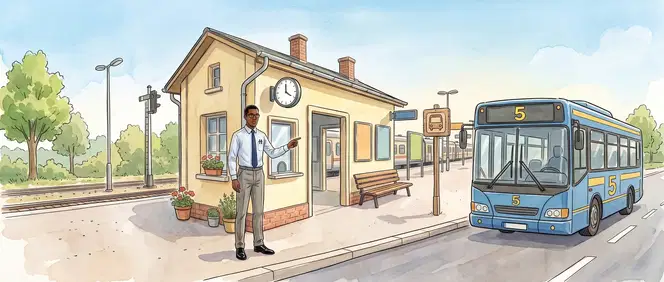
A Lithuanian sentence often starts with when: it sets the scene. Then come who and what, and where usually goes at the end: Tomorrow Tomas and I are going to the lake by train. The order is free, though, and what comes last is what is new or important.
When? Who? Does what? Where?
| Meaning | ||||
|---|---|---|---|---|
| tomorrow · we · are going · to the lake | ||||
| tomorrow · we · are going · to the lake | ||||
| at 9:12 · the train · leaves · from platform 2 | ||||
| at 9:12 · the train · leaves · from platform 2 | ||||
| on Saturday · Rūta · buys apples · at the market | ||||
| on Saturday · Rūta · buys apples · at the market | ||||
| every morning · Micius · sits · in the café window | ||||
| every morning · Micius · sits · in the café window | ||||
| at weekends · Jonas · plays · at the Old Station | ||||
| at weekends · Jonas · plays · at the Old Station | ||||
Words for when
| Words | Meaning | |
|---|---|---|
| The day | · · · | today · tomorrow · on Saturday · at weekends |
| today · tomorrow · on Saturday · at weekends | ||
| The time of day | · · · | in the morning · in the daytime · in the evening · at night |
| in the morning · in the daytime · in the evening · at night | ||
| The clock | · · · | at nine · at 9:12 · at 8:57 · at 12:30 |
| at nine · at 9:12 · at 8:57 · at 12:30 | ||
| How often | · · · | every day · sometimes · always · never |
| every day · sometimes · always · never | ||
Words for where
| Question | Case | Examples | Meaning |
|---|---|---|---|
| Locative | · · | where? · at the station · at the market · in the café | |
| where? · at the station · at the market · in the café | |||
| + accusative | · | where to? · to the station · to the market | |
| where to? · to the station · to the market | |||
| or + genitive | · | where from? · from platform 2 · from the station | |
| where from? · from platform 2 · from the station | |||
| · + genitive | · | where? · by the lake · on the table | |
| where? · by the lake · on the table | |||
Aš ateinu į stotį be trijų devintą.I'm coming to the station at three minutes to nine.
Devintą dvylika traukinys išvažiuoja nuo antro perono.At 9:12 the train leaves from platform two.
Šiandien jūs nevėluojate.Today you're not late.
Savaitgaliais Jonas groja Senojoje stotyje.At weekends Jonas plays at the Old Station.
Traukinys atvyksta septynioliktą keturiasdešimt.The train arrives at 17:40.
Practice 1/5 · Finding words
Find the words
Tap the words that say when.
.
Tomorrow we're going to the lake.
.
The train leaves at 9:12.
.
On Saturday Rūta buys apples at the market.
.
Every morning Micius sits in the café window.
.
Tomas always has a plan B.
Practice 2/5 · The right form
The right form for when and where
Choose the right word for the gap.
Traukinys išvažiuoja .
The train leaves at nine.
Aš ateinu į be trijų devintą.
I'm coming to the station at three minutes to nine.
Šeštadienį Rūta perka obuolius .
On Saturday Rūta buys apples at the market.
Micius rytą sėdi kavinės lange.
Micius sits in the café window every morning.
turgus veikia nuo septynių.
On Saturday the market is open from seven.
Jonas groja Senojoje .
Jonas plays at the Old Station.
Kada or kur?
Choose the question word.
išvažiuoja traukinys? – Devintą dvylika.
When does the train leave? – At 9:12.
išvažiuoja traukinys? – Devintą dvylika.
When does the train leave? – At 9:12.
groja Jonas? – Senojoje stotyje.
Where does Jonas play? – At the Old Station.
groja Jonas? – Senojoje stotyje.
Where does Jonas play? – At the Old Station.
traukinys grįžta? – Septynioliktą keturiasdešimt.
When does the train come back? – At 17:40.
traukinys grįžta? – Septynioliktą keturiasdešimt.
When does the train come back? – At 17:40.
Nuo perono? – Nuo antro.
From which platform? – From platform two.
Nuo perono? – Nuo antro.
From which platform? – From platform two.
kainuoja du bilietai? – Dvidešimt keturi eurai.
How much are two tickets? – Twenty-four euros.
kainuoja du bilietai? – Dvidešimt keturi eurai.
How much are two tickets? – Twenty-four euros.
Practice 3/5 · Building sentences
Put the words in order
Put the words in order.
Tomorrow we're going to the lake.
At 9:12 the train leaves from platform two.
On Saturday Rūta buys apples at the market.
When does the train leave?
When does the train leave?
I'm coming to the station at three minutes to nine.
Practice 4/5 · In situations
The right words
Choose the right words for the situation.
Ask the ticket clerk when the train leaves.
You say:
Ask the ticket clerk when the train leaves.
You say:
On the phone, Tomas tells you exactly when he'll be at the station.
Tomas says:
Going to a place: į stotį. And at what time: devintą.
Ask which platform the train leaves from.
You say:
Ask which platform the train leaves from.
You say:
Tell Tomas that on Saturday you're going to the market.
You say:
Tell Tomas that on Saturday you're going to the market.
You say:
Practice 5/5 · Matching
Question and answer
Match each question to its answer.

Unit complete