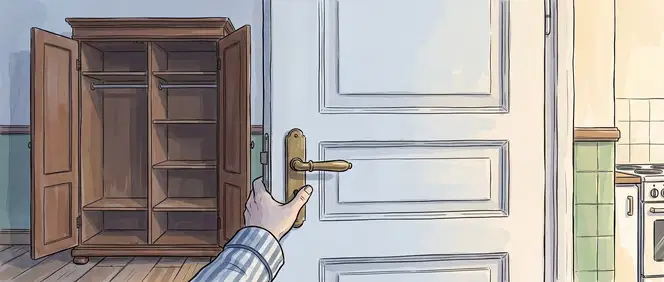
When something isn't there, or you don't have it, the noun goes into the genitive, the form you know from . I have a table. I don't have a table. There is a sofa. There is no sofa.
The genitive singular
| Nominative | Accusative | Genitive | Meaning |
|---|---|---|---|
| -as → -o | |||
| a table | |||
| a table | |||
| -is → -io | |||
| a grandfather | |||
| a grandfather | |||
| -ys → -io | |||
| a room | |||
| a room | |||
| -a → -os | |||
| a sofa | |||
| a sofa | |||
| -ė → -ės | |||
| a chair | |||
| a chair | |||
| -is → -ies (feminine) | |||
| a night | |||
| a night | |||
Masculine nouns in -us take -aus: , a son → . The genitive after no is the same form as after : , .
Use it after a verb with in front, where the yes-sentence has an object, and after : there isn't, or it isn't here. , nothing, is a genitive itself: There's nothing here.
Yes and no
| Yes | No | Meaning |
|---|---|---|
| I have a suitcase. · I don't have a suitcase. | ||
| I have a suitcase. · I don't have a suitcase. | ||
| There's a bed here. · There's no bed here. | ||
| There's a bed here. · There's no bed here. | ||
| I know his name. · I don't know his name. | ||
| I know his name. · I don't know his name. | ||
| Here's the key. · The key isn't here! | ||
| Here's the key. · The key isn't here! | ||
Stalo nėra.There isn't a table.
Stalo nėra.There isn't a table.
Aš neturiu sofos.I don't have a sofa.
Aš neturiu sofos.I don't have a sofa.
Kodėl čia nėra kėdės?Why isn't there a chair here?
Čia nieko nėra!There's nothing here!
Practice 1/6 · Finding words
Find the words
Tap the nouns in the genitive, the form after no.
, .
There's no table, and there's no sofa.
, .
There's no table, and there's no sofa.
.
Micius doesn't have a surname.
!
There's nothing here!
.
There's no chair in the room.
, .
Sorry, I don't have a key.
, .
Sorry, I don't have a key.
.
Grandad isn't here.
.
There's no bathroom there.
.
There's no bathroom there.
, !
Good night, Elzė!
.
I don't have a suitcase.
.
I don't know his name.
.
I don't know his name.
Practice 2/6 · The right form
After no
Choose the right word for the gap.
Aš neturiu .
I don't have a sofa.
Aš neturiu .
I don't have a sofa.
Čia nėra .
There's no table here.
Aš turiu .
I have a suitcase.
Aš turiu .
I have a suitcase.
Kambaryje nėra .
There's no chair in the room.
Elzė neturi .
Elzė doesn't have a key.
Ar jūs turite ?
Do you have a lamp?
Čia yra .
There's a sofa here.
Štai !
Here's a chair!
Yra tik , lempa ir lagaminas.
There's only a bed, a lamp and a suitcase.
Yra tik , lempa ir lagaminas.
There's only a bed, a lamp and a suitcase.
Aš žinau jo .
I know his name.
Aš žinau jo .
I know his name.
Yes, there is; no, there isn't
Choose the right word for the gap.
Kur ?
Where's the table?
Rūta turi , o aš neturiu.
Rūta has a table, and I don't.
Čia mano .
This is my grandad.
Aš turiu .
I have a grandad.
čia nėra.
Grandad isn't here.
Čia mano .
This is my room.
Aš turiu mažą .
I have a small room.
Ten nėra vonios .
There's no bathroom there.
Ten nėra vonios .
There's no bathroom there.
Ar jūs turite ?
Do you have a sofa?
Rūta turi ir stalą.
Rūta has a chair and a table.
Night, bed, name, key
Choose the right word for the gap.
. Viršuje groja trimitas.
Night. Upstairs, a trumpet is playing.
Jonas groja .
Jonas plays at night.
Labos , Elze!
Good night, Elzė!
Aš neturiu .
I don't have a suitcase.
Vonios kambaryje nėra .
There's no bed in the bathroom.
Aš nežinau jo .
I don't know his name.
Aš nežinau jo .
I don't know his name.
Kas čia? ?
What's this? A key?
Practice 3/6 · Fill the gaps
In the empty flat
Fill the gaps with the words from the box.
Bute yra lova, bet nėra.
There's a bed in the flat, but no table.
Aš turiu , bet neturiu .
I have a suitcase, but I don't have a wardrobe.
Aš turiu , bet neturiu .
I have a suitcase, but I don't have a wardrobe.
Ar čia yra ? – Ne, nėra.
Is there coffee here? – No, there's no coffee.
Micius neturi , bet turi .
Micius has no surname, but he has a name.
Kur ? – nėra.
Where's the table? – There isn't one.
Čia mano . Aš turiu ir močiutę.
This is my grandad. I have a grandad and a grandma.
Jonas turi viršuje. Jo mažas.
Jonas has a room upstairs. His room is small.
Ar jūs turite ir ? – Ne.
Do you have a sofa and a chair? – No.
. Jonas groja .
Night. Jonas is playing at night.
Bute yra , o vonios kambaryje nėra.
There's a bed in the flat, but there's no bed in the bathroom.
Practice 4/6 · Building sentences
Put the words in order
Put the words in order.
There's no table, but there's a bed.
There's no table, but there's a bed.
I don't have a sofa.
I don't have a sofa.
Why is there nothing here?
Everything is in my suitcase.
Everything is in my suitcase.
Where's the key? The key isn't here.
Good night, Elzė!
Grandad isn't here.
I don't know his name.
I don't know his name.
I don't have a suitcase.
Practice 5/6 · In situations
The right words
Choose the right words for the situation.
Elzė asks where your table is. You don't have one.
You say:
After neturiu, stalas becomes stalo.
Elzė asks where your table is. You don't have one.
You say:
After neturiu, stalas becomes stalo.
Elzė looks for a sofa. There isn't one.
You say:
Elzė looks for a sofa. There isn't one.
You say:
You open the kitchen cupboard. There's no coffee!
You say:
You open the kitchen cupboard. There's no coffee!
You say:
Elzė quickly shuts the wardrobe and leans against it.
Elzė says:
Practice 6/6 · Matching
Yes and no
Match each sentence to its no.
Unit complete