The person who gets something, or who something is for, goes into the dative, the same form you use for age. A present for Elzė. This is for you!
To whom? Nouns and names in the dative
| Nominative | Dative | Meaning |
|---|---|---|
| -as → -ui | ||
| · · | · · | Jonas · a friend · a neighbour |
| Jonas · a friend · a neighbour | ||
| -us → -ui | ||
| a son | ||
| a son | ||
| -is · -ius → -iui | ||
| · | · | a brother · Micius |
| a brother · Micius | ||
| -a → -ai | ||
| · · | · · | Ona · mum · Rūta |
| Ona · mum · Rūta | ||
| -ė → -ei | ||
| · · | · · | Elzė · a friend · a neighbour |
| Elzė · a friend · a neighbour | ||
In the plural: -ams, -oms, -ėms. , to the neighbours · , to the mothers · , to the friends.
To whom? The pronouns in the dative
| Person | Dative | Example | Meaning |
|---|---|---|---|
| Singular | |||
| · | · | to me · to you · This is for you! | |
| to me · to you · This is for you! | |||
| · | · | to him · to her · The fish is for him. | |
| to him · to her · The fish is for him. | |||
| Plural | |||
| · | · | to us · to you · Jonas plays for us. | |
| to us · to you · Jonas plays for us. | |||
| · | · | to them · The cake is for them. | |
| to them · The cake is for them. | |||
You have met the dative in three places already: Elzė likes yellow; word for word, yellow pleases Elzė. You need a table. How old is Micius?
Čia tau, Elze!This is for you, Elzė!
Čia tau, Elze!This is for you, Elzė!
Elzei patinka geltona.Elzė likes yellow.
Mes ieškome dovanos draugei.We're looking for a present for a friend.
Jonas groja mums naktį.Jonas plays for us at night.
Jonas groja mums naktį.Jonas plays for us at night.
Practice 1/5 · Finding words
Find the words
Tap the words in the dative: who gets it, who it's for, who likes or needs it.
, !
This is for you, Elzė!
, !
This is for you, Elzė!
.
Elzė likes yellow.
.
We're looking for a present for a friend.
, .
The fish isn't for me, it's for Micius.
.
You need a table.
– , – .
The cake is for my son, and the coffee is for the neighbour.
.
This is a present for my brother.
.
This is a present for my brother.
, – .
Mum likes blue, and Grandma likes silence.
– , – .
The present is for the neighbour, and the fish is for Micius.
.
Micius has a present for Ona.
Practice 2/5 · The right form
Man, tau, jai, mums
Choose the right word for the gap.
Čia , Elze!
This is for you, Elzė!
Čia , Elze!
This is for you, Elzė!
Ponia Ona, čia .
Mrs Ona, this is for you.
Ponia Ona, čia .
Mrs Ona, this is for you.
Jonas groja naktį.
Jonas plays for us at night.
Jonas groja naktį.
Jonas plays for us at night.
Elzei patinka geltona. Geltonas albumas – !
Elzė likes yellow. The yellow sketchbook is for her!
Micius alkanas. Žuvis – .
Micius is hungry. The fish is for him.
To Elzė, to Jonas
Choose the right word for the gap.
patinka geltona.
Elzė likes yellow.
patinka žuvis.
Micius likes fish.
reikia kavos.
Jonas needs coffee.
patinka stipri arbata.
Ona likes strong tea.
Mūsų reikia stalo.
Our neighbour needs a table.
Kam dovana? ?
Who's the present for? A friend?
Dovana mano .
A present for my son.
Dovana mano .
A present for my brother.
Dovana mano .
A present for my brother.
Mes ieškome dovanos .
We're looking for a present for a friend.
Pyragas – !
The cake is for the neighbour!
Who, or to whom?
Who has or does something is in the nominative; who gets it, in the dative.
groja mums naktį.
Jonas plays for us at night.
Jonas – mano .
Jonas is my friend.
Jonas – mano .
Jonas is my friend.
Mano groja naktį.
My neighbour plays at night.
Mano groja naktį.
My neighbour plays at night.
Mano visada alkanas.
My son is always hungry.
Mano gyvena Hamburge.
My brother lives in Hamburg.
Mano gyvena Hamburge.
My brother lives in Hamburg.
turi dovaną Elzei.
Ona has a present for Elzė.
, čia tau!
Mum, this is for you!
turi dovaną Elzei.
Rūta has a present for Elzė.
Mano turi daug dažų.
My friend has lots of paints.
Mano – ponia Ona.
My neighbour is Mrs Ona.
Mano – ponia Ona.
My neighbour is Mrs Ona.
Practice 3/5 · Fill the gaps
Presents for everyone
Fill the gaps with the words from the box.
Geltonas albumas – , o žuvis – .
The yellow sketchbook is for Elzė, and the fish is for Micius.
patinka kava, o – arbata.
Rūta likes coffee, and Jonas likes tea.
Pusę moku aš, o pusę – . Dovana – !
I pay half, and you pay half. The present is for her!
Practice 4/5 · Building sentences
Put the words in order
Put the words in order.
This is for you, Elzė!
This is for you, Elzė!
Elzė likes yellow.
We're looking for a present for a friend.
Jonas plays for us at night.
Jonas plays for us at night.
Jonas is my friend and neighbour.
Jonas is my friend and neighbour.
My brother lives in Hamburg.
My brother lives in Hamburg.
My son is always hungry.
Mum, this is for you!
Ona and Rūta are looking for a present for Elzė.
Elzė is my friend and neighbour.
Elzė is my friend and neighbour.
Practice 5/5 · In situations
The right words
Choose the right words for the situation.
Give Elzė her birthday present.
You say:
Elzė is a child, so tu; she gets it, so tau.
Give Elzė her birthday present.
You say:
Elzė is a child, so tu; she gets it, so tau.
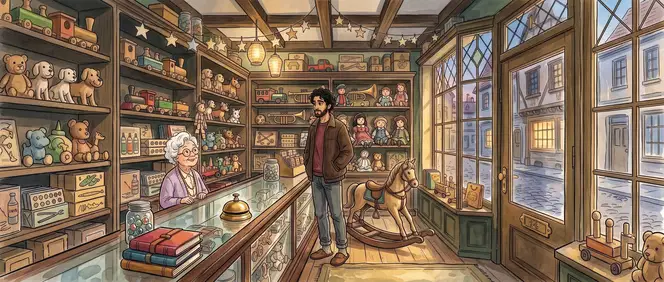
The shop assistant asks: Kam dovana? It's for a friend (a girl).
You say:
The shop assistant asks: Kam dovana? It's for a friend (a girl).
You say:
Another day, another present. The shop assistant asks: Kam dovana? This time it's for a friend who is a man.
You say:
Another day, another present. The shop assistant asks: Kam dovana? This time it's for a friend who is a man.
You say:
In the gift shop, Jonas picks the yellow sketchbook and tells the seller why.
Jonas says:
Elzė runs in to tell Ona that Micius has a present for her.
Elzė says:
Unit complete
