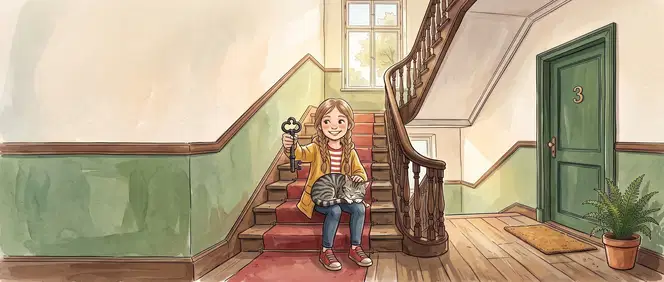
Every Lithuanian noun is masculine or feminine, and the ending almost always tells you which. Masculine nouns end in -as, -is, -ys or -us; feminine nouns end in -a or -ė. Names work the same way: and are masculine, , and feminine. Tap a word in the tables to hear it.
Masculine and feminine
| Masculine | Feminine | Meaning |
|---|---|---|
| a neighbour (a man) · a neighbour (a woman) | ||
| a neighbour (a man) · a neighbour (a woman) | ||
| · · | a house · a key · a name | |
| a house · a key · a name | ||
| · | · · | |
People come in pairs: is a man, a woman. Words that describe them, the adjectives, take the same gender: , . That is why Ona asks Lukas and Lena two different questions.
Ar jūs naujas kaimynas?Are you the new neighbour? (to Lukas)
Ar jūs nauja kaimynė?Are you the new neighbour? (to Lena)
Verbs change their ending for the person. The 1st person is the speaker (I, we), the 2nd person the one you speak to (you), and the 3rd person everyone and everything else (he, she, it, they). Each comes in the singular (one) and the plural (more than one). Here is , to be, the most important verb of all.
, to be: the present tense
| Person | With | Meaning | |
|---|---|---|---|
| Singular | |||
| I am · I am not | |||
| I am · I am not | |||
| you are · you are not | |||
| you are · you are not | |||
| · | he, she, it is · is not | ||
| he, she, it is · is not | |||
| Plural | |||
| we are · we are not | |||
| we are · we are not | |||
| you are · you are not | |||
| you are · you are not | |||
| · | they are · they are not | ||
| they are · they are not | |||
is you to a friend or a child, to an adult or to several people. is they for men or a mixed group, for women. There is no separate word for it: a thing is or , like its noun. Here's the key. It's new.
Aš esu Ona.I am Ona.
Jūs esate naujas kaimynas.You are the new neighbour.
Jūs esate nauja kaimynė.You are the new neighbour.
Čia Micius. Jis nėra mano.This is Micius. He isn't mine.
Mes esame kaimynai.We are neighbours.
or ? Both mean you. Say to a friend, a child, your family or a cat. Say to an adult you don't know well, to older people, and to more than one person. The verb changes with it: , . Ona says to you, and you say to her; to Micius you say .
or ?
| To whom | a friend, a child, family, an animal | an adult you don't know well, older people, several people |
| You are | ||
| Example | ||
| Meaning | You're Micius! | Are you the new neighbour? |
Tu esi Micius!You're Micius! (to the cat)
Tu esi Micius!You're Micius! (to the cat)
Ar jūs naujas kaimynas?Are you the new neighbour? (Ona to you, politely)
Ar jūs nauja kaimynė?Are you the new neighbour? (Ona to you, politely)
Practice 1/5 · Finding words
Find the words
Tap every form of būti, to be.
, .
I'm Ona, and you are the new neighbour.
, .
I'm Ona, and you are the new neighbour.
.
Micius isn't mine.
? !
Who are you? You're Micius!
? !
Who are you? You're Micius!
, .
We are neighbours, and they are neighbours.
, . .
No, I'm not Elzė. I'm Ona.
, !
Micius, you aren't mine!
? !
Micius and me? We aren't new neighbours!
, ?
You aren't new neighbours, are you?
, ?
You aren't new neighbours, are you?
Practice 2/5 · The right form
The right form of būti
Choose the right word for the gap.
Aš Lukas.
I am Lukas.
Aš Lena.
I am Lena.
Ar jūs naujas kaimynas?
Are you the new neighbour?
Ar jūs nauja kaimynė?
Are you the new neighbour?
Ona čia.
Ona is here.
Mes kaimynai.
We are neighbours.
Tu Micius!
You're Micius!
Tu Micius!
You're Micius!
Micius mano.
Micius isn't mine.
Ne, aš Elzė. Aš esu Ona.
No, I'm not Elzė. I'm Ona.
Miciau, tu mano!
Micius, you aren't mine!
Mes nauji kaimynai.
We aren't new neighbours.
Jūs nauji kaimynai, taip?
You aren't new neighbours, are you?
Jūs nauji kaimynai, taip?
You aren't new neighbours, are you?
Masculine or feminine?
Choose the form that fits the noun.
Jūs kaimynas?
Are you the new neighbour (a man)?
Jūs kaimynė?
Are you the new neighbour (a woman)?
Čia namas.
This is a new house.
Štai raktas.
Here is a new key.
Jis yra mano .
He is my neighbour.
Ona yra mano .
Ona is my neighbour.
Ona yra mano .
Ona is my neighbour.
Čia mano naujas .
This is my new house.
Štai jūsų naujas .
Here is your new key.
He or she?
Choose the name or word that fits.
Jis yra .
He is Lukas.
Ji yra .
She is Lena.
Kas ji? Ji – .
Who is she? She's Ona.
Čia . Jis ne mano.
This is Micius. He's not mine.
Ji yra .
She is Elzė.
Mano Ona.
My name is Ona.
Practice 3/5 · Matching
Who is who?
Match the pairs.
Practice 4/5 · Building sentences
Put the words in order
Put the words in order.
I am Ona.
Are you the new neighbour?
Are you the new neighbour?
This is my house and my key.
We are neighbours.
My name is Lukas.
My name is Lena.
No, I'm not Elzė.
This is Micius. He isn't mine.
Practice 5/5 · In situations
The right words
Choose the right words for the situation.
Someone at the door thinks Ona is the new neighbour. She tells them she isn't.
Ona says:
An old woman at the door asks if you are the new neighbour. Say yes, and give your name.
You say:
An old woman at the door asks if you are the new neighbour. Say yes, and give your name.
You say:
The landlady hands you your key.
You say:
The landlady hands you your key.
You say:
A grey cat walks in. Ask who this is.
You say:
A grey cat walks in. Ask who this is.
You say:
Unit complete