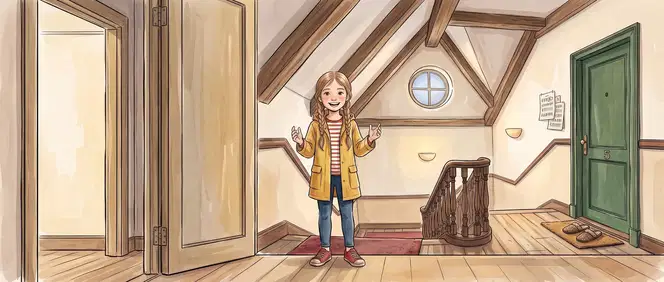
In the attic every thing has an owner and a day it went missing. To say when something happened, Lithuanian has a handful of patterns. You know most of them already.
When in the past?
| Word | Example | Meaning |
|---|---|---|
| With the accusative | ||
| · · | ago · a week ago · a month ago · a year ago | |
| ago · a week ago · a month ago · a year ago | ||
| · · | ago · two days ago · three months ago · ten minutes ago | |
| ago · two days ago · three months ago · ten minutes ago | ||
| · | during · during the festival · during the concert | |
| during · during the festival · during the concert | ||
| · · | on Saturday · in April · on the 28th of March | |
| on Saturday · in April · on the 28th of March | ||
| With the genitive | ||
| since · since the festival | ||
| since · since the festival | ||
| With the past tense | ||
| · | when · when you were ill · when Jonas was little | |
| when · when you were ill · when Jonas was little | ||
| On its own | ||
| last year · Last year Micius slept on the drum. | ||
| last year · Last year Micius slept on the drum. | ||
With 10 to 20 and multiples of ten the noun goes into the genitive plural, -ų, as always: , ten minutes ago · , twenty years ago.
And whose is it? The owner goes into the genitive, in front of the thing: , Tomas's pen.
Whose? The owner in the genitive
| Nominative | Genitive | Meaning |
|---|---|---|
| -as → -o | ||
| · | · | Tomas's pen · Jonas's mouthpiece |
| Tomas's pen · Jonas's mouthpiece | ||
| -ius → -iaus | ||
| Micius's flat | ||
| Micius's flat | ||
| -a → -os | ||
| · | · | Ona's key · Rūta's cake |
| Ona's key · Rūta's cake | ||
| -ė → -ės | ||
| Elzė's thermometer | ||
| Elzė's thermometer | ||
Tomo rašiklis dingo prieš tris mėnesius.Tomas's pen went missing three months ago.
Elzės žvakė dingo per gimtadienį.Elzė's candle went missing at her birthday party.
Termometras dingo, kai jūs sirgote.The thermometer went missing when you were ill.
Jono kandiklis dingo per šventę.Jonas's mouthpiece went missing during the festival.
Jūsų raktas dingo pirmą dieną.Your key went missing on the first day.
Practice 1/6 · Finding words
Find the words
Tap the owners: the names in the genitive (whose?).
.
Here's Tomas's pen and Jonas's mouthpiece.
.
It was Micius's flat.
, .
Elzė's thermometer went missing when you were ill.
? , .
Is that Ona's key? No, it's Rūta's key.
? , .
Is that Ona's key? No, it's Rūta's key.
Practice 2/6 · The right form
When?
Choose the right word for the gap.
Tomo rašiklis dingo tris mėnesius.
Tomas's pen went missing three months ago.
Prieš Micius miegojo lagamine.
A week ago Micius slept in the suitcase.
Termometras dingo, jūs sirgote.
The thermometer went missing when you were ill.
Kandiklis dingo per .
The mouthpiece went missing during the festival.
Jonas jo ieško nuo .
Jonas has been looking for it since the festival.
Jonas jo ieško nuo .
Jonas has been looking for it since the festival.
Micius miegojo ant būgno.
Last year Micius slept on the drum.
Elzės žvakė dingo prieš .
Elzė's candle went missing a month ago.
Onos raktas dingo prieš .
Ona's key went missing a year ago.
Tomo rašiklis dingo prieš tris .
Tomas's pen went missing three months ago.
Mano blynas dingo prieš dešimt !
My pancake went missing ten minutes ago!
Whose is it?
Choose the right word for the gap.
Čia rašiklis.
Here's Tomas's pen.
O čia kandiklis.
And here's Jonas's mouthpiece.
O čia kandiklis.
And here's Jonas's mouthpiece.
Tai buvo butas.
It was Micius's flat.
Mano termometras! termometras!
My thermometer! Elzė's thermometer!
Ar tai raktas?
Is that Ona's key?
Ar tai raktas?
Is that Ona's key?
O čia pyragas.
And here's Rūta's cake.
Who, and when?
Choose the right word for the gap.
ieško rašiklio.
Tomas is looking for his pen.
ieško kandiklio.
Jonas is looking for his mouthpiece.
ima tik tuos daiktus, kuriuos myli.
Micius only takes the things he loves.
ieško rakto.
Ona is looking for her key.
ieško pyrago.
Rūta is looking for her cake.
ieško pyrago.
Rūta is looking for her cake.
rado savo termometrą!
Elzė has found her thermometer!
rado savo termometrą!
Elzė has found her thermometer!
Rūtos pyragas dingo prieš dvi .
Rūta's cake went missing two days ago.
Jono kandiklis dingo per .
Jonas's mouthpiece went missing during the concert.
Mano lagaminas dingo .
My suitcase went missing on Saturday.
Mano lagaminas dingo .
My suitcase went missing on Saturday.
Mano termometras dingo .
My thermometer went missing in April.
Practice 3/6 · Fill the gaps
Elzė's list
Fill the gaps with the words from the box.
Elzės žvakė dingo prieš .
Elzė's candle went missing a month ago.
Rūtos pyragas dingo prieš dvi .
Rūta's cake went missing two days ago.
Mano blynas dingo prieš dešimt !
My pancake went missing ten minutes ago!
Jono kandiklis dingo per .
Jonas's mouthpiece went missing during the concert.
Mano lagaminas dingo .
My suitcase went missing on Saturday.
Mano lagaminas dingo .
My suitcase went missing on Saturday.
Mano termometras dingo .
My thermometer went missing in April.
Koncertas prasidėjo .
The concert started at eight.
ieško rašiklio, o ieško kandiklio.
Tomas is looking for his pen, and Jonas for his mouthpiece.
ieško rakto, o ieško pyrago.
Ona is looking for her key, and Rūta for her cake.
rado savo termometrą!
Elzė has found her thermometer!
rado savo termometrą!
Elzė has found her thermometer!
Practice 4/6 · Building sentences
Put the words in order
Put the words in order.
Tomas's pen went missing three months ago.
The thermometer went missing when you were ill.
Last year Micius slept on the drum.
It was Micius's flat.
Ona's key went missing a year ago.
Jonas's mouthpiece went missing during the concert.
Practice 5/6 · In situations
The right words
Choose the right words for the situation.
Elzė holds up a pen and asks whose it is. It's Tomas's.
You say:
Elzė holds up a pen and asks whose it is. It's Tomas's.
You say:
Ask Elzė when the key went missing.
You say:
Ask Elzė when the key went missing.
You say:
Elzė reads from her list in the attic and tells you when Jonas's mouthpiece went missing.
Elzė says:
Say that your key went missing a week ago.
You say:
Ago is prieš with the object form: prieš savaitę. Po savaitės means in a week's time.
Say that your key went missing a week ago.
You say:
Ago is prieš with the object form: prieš savaitę. Po savaitės means in a week's time.
Practice 6/6 · Matching
When was it?
Match the pairs.
Unit complete