Three questions, three cases. Where to? + the accusative: , to the park. Where? The locative, with no little word: , in the park. Where from? + the genitive: , from the park. Going to a lake or a river, you say : , to the lake.
Where to, where, where from
| Nominative | + accusative | Locative | + genitive | Meaning |
|---|---|---|---|---|
| a park | ||||
| a park | ||||
| a town | ||||
| a town | ||||
| a market | ||||
| a market | ||||
| a café | ||||
| a café | ||||
| a station | ||||
| a station | ||||
| Germany | ||||
| Germany | ||||
Home is special: , home, to home · , at home · , from home.
How do you get there? The means of transport takes the instrumental, but without : I go by bus. On foot is simply .
By what? The instrumental
| Nominative | Instrumental | Meaning |
|---|---|---|
| a bus · by bus | ||
| a bus · by bus | ||
| a train · by train | ||
| a train · by train | ||
| a bicycle · by bike | ||
| a bicycle · by bike | ||
| a car · by car | ||
| a car · by car | ||
| – | on foot | |
| on foot | ||
looks the same in both cases. is to go on foot; is to go by bus, train, car or bike. So: , I walk, but , I go by bus.
Going, coming and coming back
| Infinitive | · | · | Meaning | ||||
|---|---|---|---|---|---|---|---|
| to go (by) | |||||||
| to go (by) | |||||||
| to come (by) | |||||||
| to come (by) | |||||||
| to come back | |||||||
| to come back | |||||||
Aš iš Vokietijos, bet dabar gyvenu čia.I'm from Germany, but I live here now.
Aš iš Vokietijos, bet dabar gyvenu čia.I'm from Germany, but I live here now.
Kaip nuvažiuoti į stotį? Autobusu?How do I get to the station? By bus?
Tik ne autobusu! Pėsčiomis – dvidešimt minučių.Anything but the bus! On foot it's twenty minutes.
Parke žmonės žaidžia futbolą.In the park people are playing football.
Micius eina iš parko prie ežero.Micius walks from the park to the lake.
Practice 1/5 · Finding words
Find the words
Tap the places and the ways of travelling.
.
Micius walks from the park to the lake.
, .
I'm from Germany, but I live here now.
, .
I'm from Germany, but I live here now.
.
People are playing football in the park.
.
Tomas comes to the station at three minutes to nine.
, .
We're going by bus, not by train.
, – .
Rūta is going to the market, and Jonas to the café.
.
There are lots of people at the market and in the café.
.
I'm walking from the café into town.
.
I'm walking from the café into town.
, – .
Tomas is waiting at the station, and we're in town.
, – .
Jonas comes back from town by bike, and Ona by car.
Practice 2/5 · The right form
Where to, where, where from?
Choose the right word for the gap.
Aš einu į .
I'm going to the park.
Vaikai žaidžia futbolą .
Children are playing football in the park.
Micius ateina iš .
Micius is coming from the park.
Rūta yra .
Rūta is in the café.
Tomas eina į .
Tomas is going to the station.
Aš iš .
I'm from Germany.
Aš iš .
I'm from Germany.
Rytoj aš važiuoju į .
Tomorrow I'm going into town.
Mes gyvename .
We live in a town.
Jonas grįžta iš .
Jonas is coming back from town.
Rūta perka obuolius .
Rūta buys apples at the market.
By bus, on foot
Choose the right word for the gap.
Mes važiuojame .
We're going by bus.
Rytoj važiuojame prie ežero.
Tomorrow we're going to the lake by train.
Jonas važiuoja .
Jonas goes by bike.
Į stotį mes autobusu.
We're going to the station by bus.
Į parką mes pėsčiomis.
We're walking to the park on foot.
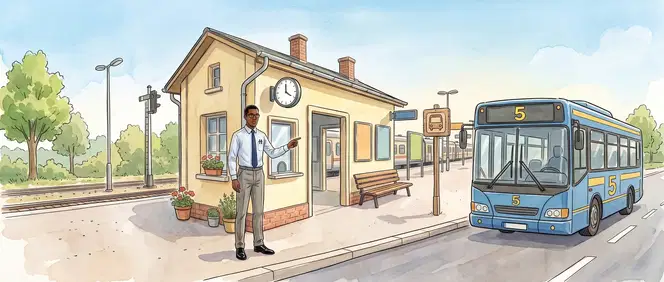
Štai numeris penki!
Here's the number 5 bus!
išvažiuoja devintą.
The train leaves at nine.
Mano prie namo.
My bike is by the house.
Mes važiuojame .
We're going by car.
Mes važiuojame .
We're going by car.
Jūs autobusu ar traukiniu?
Are you going by bus or by train?
Jūs autobusu ar traukiniu?
Are you going by bus or by train?
Going, coming, coming back
važiuoti, atvažiuoti, grįžti: choose the person.
Aš į parką autobusu.
I'm going to the park by bus.
Aš į parką autobusu.
I'm going to the park by bus.
Tu dviračiu?
Are you going by bike?
Elzė į parką dviračiu.
Elzė is cycling to the park.
Aš devintą.
I'm coming at nine.
Aš devintą.
I'm coming at nine.
Kada tu ?
When are you coming?
Mano draugė rytoj.
My friend is coming tomorrow.
Mes traukiniu.
We're coming by train.
Mes traukiniu.
We're coming by train.
Kada jūs ?
When are you coming?
Aš namo vakare.
I come back home in the evening.
Aš namo vakare.
I come back home in the evening.
Močiute, kada tu ?
Grandma, when are you coming back?
Back home
Choose the right word for the gap.
Micius namo naktį.
Micius comes back home at night.
Mes autobusu.
We're coming back by bus.
Mes autobusu.
We're coming back by bus.
Kada jūs į Vokietiją?
When are you going back to Germany?
Tomas laukia .
Tomas is waiting at the station.
Traukinys išvažiuoja iš .
The train leaves the station.
Einu į .
I'm going to the café.
Einu į .
I'm going to the café.
Jonas ateina iš .
Jonas is coming from the café.
Šeštadienį Rūta eina į .
On Saturday Rūta goes to the market.
Rūta grįžta iš .
Rūta is coming back from the market.
Rytoj važiuoju į .
Tomorrow I'm going to Germany.
Rytoj važiuoju į .
Tomorrow I'm going to Germany.
Practice 3/5 · Fill the gaps
A Sunday out
Fill the gaps with the words from the box.
Iš mes važiuojame .
From the station we go by bus.
Parke žmonės futbolą.
In the park people are playing football.
Marta yra iš , bet ji irgi mokosi lietuviškai.
Marta is from Canada, but she's learning Lithuanian too.
Micius eina iš prie .
Micius walks from the park to the lake.
didelis, o mažas.
The park is big, and the town is small.
veikia šeštadienį, o – kiekvieną dieną.
The market is open on Saturday, and the café every day.
toli, bet autobusas tiesiai.
The station is far, but the bus goes straight there.
ir – prie stoties.
The bus and the train are by the station.
Mano šeima gyvena .
My family lives in Germany.
Mano šeima gyvena .
My family lives in Germany.
– mano šalis.
Germany is my country.
– mano šalis.
Germany is my country.
Practice 4/5 · Building sentences
Put the words in order
Put the words in order.
I'm from Germany, but I live here now.
I'm from Germany, but I live here now.
How do I get to the station by bus?
They're playing football in the park.
Micius walks from the park to the lake.
I'm going by bus, and you?
I'm going by bus, and you?
Are you going by train or by bus?
We're cycling to the park.
We're cycling to the park.
We're coming at nine, and you?
We're coming at nine, and you?
When are you coming back home?
My friend is coming tomorrow by train.
Practice 5/5 · In situations
The right words
Choose the right words for the situation.
The tourist asks where you're from.
You say:
The tourist asks where you're from.
You say:
Tomas wants to take the bus again. Tell him: not by bus, on foot!
You say:
Tomas wants to take the bus again. Tell him: not by bus, on foot!
You say:
A neighbour asks: Kur einate? You're going to the park.
You say:
A neighbour asks: Kur einate? You're going to the park.
You say:
Ask the tourist where she is from.
You say:
She's an adult you don't know, so jūs; and iš kur asks where from.
Ask the tourist where she is from.
You say:
She's an adult you don't know, so jūs; and iš kur asks where from.
Tomas asks when you're coming back from the market. Say: at twelve, by bus.
You say:
Tomas asks when you're coming back from the market. Say: at twelve, by bus.
You say:
Elzė asks her grandmother when she's coming back.
Elzė says:
Tell Tomas that you and Anna are coming back on Sunday.
You say:
Tell Tomas that you and Anna are coming back on Sunday.
You say:
The tourist asks when the train comes back. It's at 17:40.
You say:
The tourist asks when the train comes back. It's at 17:40.
You say:
Ask Tomas when he's coming, and if it's by train.
You say:
Ask Tomas when he's coming, and if it's by train.
You say:
Tell Jonas you're coming at nine, by bike.
You say:
Tell Jonas you're coming at nine, by bike.
You say:
Unit complete
