After (a lot), (how many?) and the numbers 10 to 20 and multiples of ten (10 to 20, 30, 40...), a noun you can count goes into the genitive plural. Its ending is always -ų, often -ių.
One, a few, a lot
| Singular | Plural | Genitive plural | Meaning |
|---|---|---|---|
| an egg · six eggs · a lot of eggs | |||
| an egg · six eggs · a lot of eggs | |||
| an apple · six apples · nineteen apples | |||
| an apple · six apples · nineteen apples | |||
| a key · two keys · ten keys | |||
| a key · two keys · ten keys | |||
| a euro · two euros · twenty euros | |||
| a euro · two euros · twenty euros | |||
| a pancake · three pancakes · how many pancakes? | |||
| a pancake · three pancakes · how many pancakes? | |||
| a chair · two chairs · a lot of chairs | |||
| a chair · two chairs · a lot of chairs | |||
| a cat · two cats · a lot of cats | |||
| a cat · two cats · a lot of cats | |||
| a person · four people · a lot of people | |||
| a person · four people · a lot of people | |||
From the plural to -ų
| Plural | Genitive plural | Meaning |
|---|---|---|
| -ai → -ų | ||
| · · | · · | keys · euros · pancakes |
| keys · euros · pancakes | ||
| -iai → -ių | ||
| · · | · · | eggs · apples · cups |
| eggs · apples · cups | ||
| -os → -ų | ||
| · | · | lamps · forms |
| lamps · forms | ||
| -ės → -ių | ||
| · · | · · | shops · chairs · cats |
| shops · chairs · cats | ||
Before -ių, some consonants change: → , → . , people, is the plural of : , a lot of people.
Things you don't count, like milk, fish or bread, stay singular after : , , . That is the genitive singular you know from
Micius valgo labai daug žuvies.Micius eats a lot of fish.
O kiek obuolių?And how many apples?
Šeši obuoliai, ne aštuoniolika!Six apples, not eighteen!
Šeši obuoliai, ne aštuoniolika!Six apples, not eighteen!
Aš turiu tik dvidešimt eurų.I only have twenty euros.
Aš turiu tik dvidešimt eurų.I only have twenty euros.
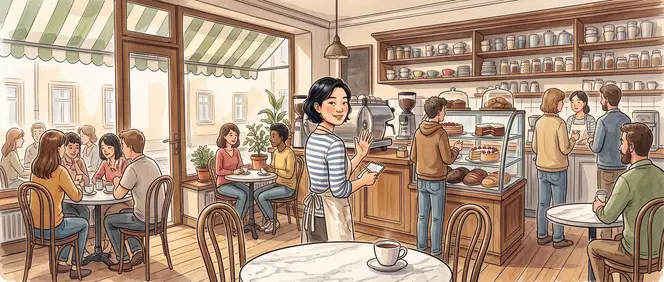
Kavinėje labai daug žmonių.There are a lot of people in the café.
Practice 1/6 · Finding words
Find the words
Tap the nouns in the genitive plural: they end in -ų or -ių.
?
And how many apples?
.
I only have twenty euros.
.
I only have twenty euros.
!
So many people!
!
So many people!
.
Micius has ten keys and a lot of spoons.
!
I want lots of pancakes!
, .
There are lots of lamps in the flat, but no chairs.
.
Here are ten forms.
.
There are lots of shops and cafés here.
Practice 2/6 · The right form
One, a few or a lot?
Choose the right word for the gap.
Šaldytuve yra šeši .
There are six eggs in the fridge.
Elzė nori daug .
Elzė wants a lot of apples.
Iš viso dvidešimt du .
Twenty-two euros altogether.
Micius turi dešimt .
Micius has ten keys.
Kiek tu nori?
How many pancakes do you want?
Kiek tu nori?
How many pancakes do you want?
Kavinėje labai daug .
There are a lot of people in the café.
Šaldytuve yra daug .
There are a lot of eggs in the fridge.
Ant stalo yra trys .
There are three apples on the table.
Iš viso trisdešimt .
Thirty euros altogether.
Ant stalo yra du .
There are two keys on the table.
One or more?
Choose the right word for the gap.
Šaldytuve yra tik vienas .
There's only one egg in the fridge.
Ant stalo yra tik vienas .
There's only one apple on the table.
Ant stalo yra tik vienas .
There's only one key on the table.
Obuolys – vienas .
An apple is one euro.
Ant stalo yra vienas .
There's one pancake on the table.
Ant stalo yra trys .
There are three pancakes on the table.
Virtuvėje yra viena .
There's one chair in the kitchen.
Virtuvėje yra dvi .
There are two chairs in the kitchen.
Kavinėje yra tik vienas .
There's only one person in the café.
Čia yra dvi .
There are two shops here.
A lot of them
Choose the right word for the gap.
Parduotuvėje yra keturi .
There are four people in the shop.
Kavinėje daug .
There are a lot of chairs in the café.
Parduotuvėje yra dvi .
There are two cats in the shop.
Parduotuvėje labai daug .
There are a lot of cats in the shop.
Ant stalo yra šeši .
There are six cups on the table.
Virtuvėje labai daug .
There are a lot of cups in the kitchen.
Bute yra dvi .
There are two lamps in the flat.
Kavinėje yra dešimt .
There are ten lamps in the café.
Štai trys .
Here are three forms.
Kiek daug !
So many forms!
Kiek daug !
So many forms!
Practice 3/6 · Fill the gaps
Elzė's list
Fill the gaps with the words from the box.
Šeši , duona ir devyniolika .
Six eggs, bread and nineteen apples.
Micius valgo labai daug .
Micius eats a lot of fish.
Iš viso dvidešimt du , bet aš turiu tik dvidešimt .
Twenty-two euros altogether, but I only have twenty euros.
Ant stalo yra vienas ir vienas .
There's one egg and one pancake on the table.
Ant stalo yra vienas ir šeši .
There's one apple and six cups on the table.
Ant stalo yra du , bet Micius turi dešimt .
There are two keys on the table, but Micius has ten keys.
Obuolys – vienas .
An apple is one euro.
Bute yra viena , o kavinėje – daug .
There's one chair in the flat, and lots of chairs in the café.
Kavinėje yra viena , o parduotuvėje – dvi .
There's one cat in the café, and two cats in the shop.
Kavinėje yra vienas , o parduotuvėje – keturi .
There's one person in the café, and four people in the shop.
Practice 4/6 · Matching
How many?
Match each question to its answer.
Practice 5/6 · Building sentences
Put the words in order
Put the words in order.
How many apples would you like?
Micius eats a lot of fish.
I only have twenty euros.
I only have twenty euros.
Six apples, not eighteen!
Six apples, not eighteen!
There are a lot of people in the café.
There are only two chairs in the kitchen.
That gentleman is very afraid of cats.
There's one apple and three pancakes on the table.
There are a lot of cups in the shop.
There are a lot of shops here.
Practice 6/6 · In situations
The right words
Choose the right words for the situation.
You want to know how many apples are in the bag.
You say:
You want to know how many apples are in the bag.
You say:
Tell the shopkeeper you only have twenty euros.
You say:
Tell the shopkeeper you only have twenty euros.
You say:
The café is packed. Say how many people there are!
You say:
The café is packed. Say how many people there are!
You say:
After the shopping, Elzė is very hungry and wants lots of pancakes.
Elzė says:
Elzė asks how many keys you have. Just one.
You say:
Elzė asks how many keys you have. Just one.
You say:
Tell Elzė there are only two lamps in your flat.
You say:
From two to nine, the noun takes the plural: lempos.
Tell Elzė there are only two lamps in your flat.
You say:
From two to nine, the noun takes the plural: lempos.
Ona gives you three more forms. Groan!
You say:
Ona gives you three more forms. Groan!
You say:
Elzė asks if there's a shop near here. There are two.
You say:
Elzė asks if there's a shop near here. There are two.
You say:
Unit complete