Module 1Word reviewPremium
Words of module 1: Arrival
Reviews practise both sides: wherever Lukas and Lena would say something differently, you do it once as each.
In this module you learned to
- greet an older neighbour politely and say my name
- say hello to a child, ask her name, get my key back and ask where something is
- introduce myself in a café, choose coffee or tea, and say if I like something
- knock on a neighbour's door, say that I want to sleep, and ask someone to do something tomorrow
- ask how someone is, and ask where people live
From this module's scenes

għandi pjaċir
nice to meet you
Literally: I have pleasure.
Għandi pjaċir. Jien Marija. Din id-dar tiegħi.Nice to meet you. I'm Marija. This is my house.
Bonswa!
jieħu
take (take hold of)
Ħudha: take it (for a feminine word, like ċavetta).
Ċikku jieħu ċ-ċavetta.Ċikku takes the key.
Bonswa!kollox
everything
Mingħand Marija. Marija taf kollox.From Marija. Marija knows everything.
L-ikla t-tajba!
l-ikla t-tajba!
enjoy your meal
Literally: the good meal.
L-ikla t-tajba!Enjoy your meal!
L-ikla t-tajba!
trumbettafem.
trumpet
Lejl. Fuq qed tindaqq trumbetta.Night. Upstairs, a trumpet is playing.
Il-lejl it-tajjeb

u int?
and you?
Tajjeb, grazzi. U int?Fine, thanks. And you?
Tajba, grazzi. U int?Fine, thanks. And you?
Min joqgħod fejn?
mhux tajjeb wisq
not great
Literally: not too good.
Mhux tajjeb wisq. Ġorġ idoqq bil-lejl.Not great. Ġorġ plays at night.
Mhux tajjeb wisq. Ġorġ idoqq bil-lejl.Not great. Ġorġ plays at night.
Min joqgħod fejn?kull
every
It never changes: kull ġurnata, every day.
Le. Imma tkun hawn kull ġurnata. In-neputija tiegħi!No. But she's here every day. My granddaughter!
Min joqgħod fejn?
neputijafem.
granddaughter
Also a niece. A grandson or a nephew: neputi.
Le. Imma tkun hawn kull ġurnata. In-neputija tiegħi!No. But she's here every day. My granddaughter!
Min joqgħod fejn?
sidmasc.
master of the house, the one in charge
The owner, the one in charge: sid id-dar, the owner of the house. A woman: sidt (sidt id-dar). In an office people often just say il-boss.
Ċikku? Hawn. U hemm. U hemm. Ċikku hu s-sid hawn.Ċikku? Here. And there. And there. Ċikku is the boss here.
Min joqgħod fejn?

ġdid
new
ġdid (m) · ġdida (f)
Bonswa! Int il-ġar il-ġdid?Good evening! Are you the new neighbour?
Bonswa! Int il-ġara l-ġdida?Good evening! Are you the new neighbour?
Bonswa!
ġarmasc.
neighbour
Several neighbours: ġirien.
Bonswa! Int il-ġar il-ġdid?Good evening! Are you the new neighbour?
Bonswa! Int il-ġara l-ġdida?Good evening! Are you the new neighbour?
Bonswa!isemmasc.
name
Jisimni: my name is. X'jismek? What's your name?
Iva. Jisimni Lukas.Yes. My name is Lukas.
Iva. Jisimni Lena.Yes. My name is Lena.
Bonswa!
darfem.
house / building
A house, a home or a building. Id-dar: the house, and also home.
Għandi pjaċir. Jien Marija. Din id-dar tiegħi.Nice to meet you. I'm Marija. This is my house.
Bonswa!
hawn hu / hawn hi
here is
hu for a masculine word, hi for a feminine one: hawn hu l-kafè, hawn hi ċ-ċavetta.
Hawn hi ċ-ċavetta tiegħek.Here is your key.
Bonswa!

dan / din
this
dan for a masculine word, din for a feminine one: dan il-kejk, din id-dar.
U dan min hu?And who is this?
U dan min hu?And who is this?
Bonswa!le
no
Le is the answer no. Not, before a word that is not a verb: mhux (mhux tiegħi, not mine). Before a verb: ma … -x.
Ċikku! Le!Ċikku! No!
Bonswa!
saħħa
goodbye
Literally: health. Also: cheers! Many people just say ċaw or bye.
Iċ-ċavetta tiegħi! Saħħa, ċavetta...My key! Goodbye, key...
Iċ-ċavetta tiegħi! Saħħa, ċavetta...My key! Goodbye, key...
Bonswa!

nannafem.
grandmother
Ella. Marija n-nanna tiegħi. Int il-ġar il-ġdid, hux?Ella. Marija is my grandmother. You're the new neighbour, right?
Ella. Marija n-nanna tiegħi. Int il-ġara l-ġdida, hux?Ella. Marija is my grandmother. You're the new neighbour, right?
Għandek iċ-ċavetta tiegħi!
għandu
have
Maltese has no verb for have: għand (at someone's) takes the owner. Għandi: I have. Għandek: you have.
Iva, jien Lukas. Ara! Għandek iċ-ċavetta tiegħi!Yes, I'm Lukas. Look! You have my key!
Iva, jien Lena. Ara! Għandek iċ-ċavetta tiegħi!Yes, I'm Lena. Look! You have my key!
Għandek iċ-ċavetta tiegħi!
m'hemmx imniex
you're welcome
Literally: there is nothing of it.
M'hemmx imniex!You're welcome!
Għandek iċ-ċavetta tiegħi!ħafna
very
After the word: tajba ħafna, very good. Also a lot: grazzi ħafna. Really, before a verb: verament irrid, I really want.
Grazzi ħafna, Ella!Thank you very much, Ella!
Grazzi ħafna, Ella!Thank you very much, Ella!
Għandek iċ-ċavetta tiegħi!
qattusmasc.
cat
A tomcat, or a cat in general. Several: qtates.
Qattusa ħażina!Bad cat!
Qattusa ħażina!Bad cat!
Għandek iċ-ċavetta tiegħi!
ħażin
bad
ħażin (m) · ħażina (f). Of a child or a cat: naughty.
Qattusa ħażina!Bad cat!
Qattusa ħażina!Bad cat!
Għandek iċ-ċavetta tiegħi!biss
just / simply
After what it limits: hu bil-ġuħ biss, he is just hungry.
Qattus, mhux qattusa! U mhux ħażin. Hu bil-ġuħ biss.A tomcat, not a she-cat! And he isn't bad. He's just hungry.
Għandek iċ-ċavetta tiegħi!
bil-ġuħ
hungry
Literally: with hunger. The same for a man and a woman.
Bil-ġuħ? Jien ukoll bil-ġuħ.Hungry? I'm hungry too.
Bil-ġuħ? Jien ukoll bil-ġuħ.Hungry? I'm hungry too.
Għandek iċ-ċavetta tiegħi!ukoll
too / also
After the word: jien ukoll, me too. After a vowel it becomes wkoll: hu wkoll.
Bil-ġuħ? Jien ukoll bil-ġuħ.Hungry? I'm hungry too.
Bil-ġuħ? Jien ukoll bil-ġuħ.Hungry? I'm hungry too.
Għandek iċ-ċavetta tiegħi!
tajjeb
good
tajjeb (m) · tajba (f)
Hawn kafetterija tajba ħafna.There's a very good café here.
Għandek iċ-ċavetta tiegħi!
hawn
here
Also: there is (here). Hawn kafetterija: there is a café here. In general, there is: hemm.
Hawn kafetterija tajba ħafna.There's a very good café here.
Għandek iċ-ċavetta tiegħi!
kafetterijafem.
café
Sejjer għall-kafetterija!I'm going to the café!
Sejra għall-kafetterija!I'm going to the café!
Għandek iċ-ċavetta tiegħi!

imur
go (on foot)
Sejjer (m) · sejra (f): on the way, going now.
Sejjer għall-kafetterija!I'm going to the café!
Sejra għall-kafetterija!I'm going to the café!
Għandek iċ-ċavetta tiegħi!
għal
to (where you are going)
Where you are going: sejjer għall-kafetterija, I'm going to the café. With the article it becomes għall-.
Sejjer għall-kafetterija!I'm going to the café!
Sejra għall-kafetterija!I'm going to the café!
Għandek iċ-ċavetta tiegħi!
bonġu
good morning
Until the early afternoon. Also good day, as a hello.
Bonġu! Iva. Kif taf?Good morning! Yes. How do you know?
Bonġu! Iva. Kif taf?Good morning! Yes. How do you know?
L-ikla t-tajba!
jaf
know (a fact)
Naf: I know. Taf: you know, she knows.
Bonġu! Iva. Kif taf?Good morning! Yes. How do you know?
Bonġu! Iva. Kif taf?Good morning! Yes. How do you know?
L-ikla t-tajba!


jekk jogħġbok
please
Literally: if it pleases you. To several people: jekk jogħġobkom.
Kafè, jekk jogħġbok.Coffee, please.
Kafè, jekk jogħġbok.Coffee, please.
L-ikla t-tajba!
imma
but
Grazzi! Imma dan mhux il-kejk tiegħi.Thank you! But this isn't my cake.
Grazzi! Imma dan mhux il-kejk tiegħi.Thank you! But this isn't my cake.
L-ikla t-tajba!issa
now
Issa tiegħek. Int bil-ġuħ ħafna. Marija diġà taf.Now it's yours. You're very hungry. Marija already knows.
L-ikla t-tajba!diġà
already
Issa tiegħek. Int bil-ġuħ ħafna. Marija diġà taf.Now it's yours. You're very hungry. Marija already knows.
L-ikla t-tajba!kif
how
Bonġu! Iva. Kif taf?Good morning! Yes. How do you know?
Bonġu! Iva. Kif taf?Good morning! Yes. How do you know?
L-ikla t-tajba!
jogħġob
like
The thing you like does the pleasing: jogħġobni, it pleases me. Jekk jogħġbok (please) is the same word: if it pleases you.
Mela, kif inhu? Jogħġbok?So, how is it? Do you like it?
L-ikla t-tajba!

idoqq
play (an instrument)
For music: idoqq it-trumbetta, he plays the trumpet. Tindaqq: is being played.
Lejl. Fuq qed tindaqq trumbetta.Night. Upstairs, a trumpet is playing.
Il-lejl it-tajjeb
fuq
upstairs
Also: on, above. Fuq il-kafetterija: above the café.
Lejl. Fuq qed tindaqq trumbetta.Night. Upstairs, a trumpet is playing.
Il-lejl it-tajjeb
joqgħod
live
To live somewhere, and also to stay or to sit. Noqgħod isfel: I live downstairs.
Ħello. Jien Lukas. Noqgħod isfel.Hi. I'm Lukas. I live downstairs.
Ħello. Jien Lena. Noqgħod isfel.Hi. I'm Lena. I live downstairs.
Il-lejl it-tajjeb
mużiċistmasc.
musician
Għandi pjaċir! Jien mużiċist.Nice to meet you! I'm a musician.
Il-lejl it-tajjeb
skużani
sorry
Also: excuse me. Skużani, Sinjura: excuse me, madam.
Lejl? Ajma, skużani!Night? Oh no, sorry!
Il-lejl it-tajjeb
irid
want
Irrid: I want. Trid: you want, she wants.
Verament irrid norqod. Tista' ddoqq għada?I really want to sleep. Could you play tomorrow?
Verament irrid norqod. Tista' ddoqq għada?I really want to sleep. Could you play tomorrow?
Il-lejl it-tajjeb
jorqod
sleep
Iva. Ċikku ħabib tiegħi. Jorqod hawn.Yes. Ċikku is my friend. He sleeps here.
Il-lejl it-tajjeb
jista'
can (be able to)
Tista' ...? Can you ...? The apostrophe stands for a dropped għ.
Verament irrid norqod. Tista' ddoqq għada?I really want to sleep. Could you play tomorrow?
Verament irrid norqod. Tista' ddoqq għada?I really want to sleep. Could you play tomorrow?
Il-lejl it-tajjebtajjeb
well / fine
Tajjeb: fine, OK. A woman says it of herself as tajba: tajba, grazzi. It is also the word for good.
Għada? Tajjeb, tajjeb. Għada.Tomorrow? OK, OK. Tomorrow.
Il-lejl it-tajjeb
ħabibmasc.
friend
Iva. Ċikku ħabib tiegħi. Jorqod hawn.Yes. Ċikku is my friend. He sleeps here.
Il-lejl it-tajjeb
il-lejl it-tajjeb
good night
Literally: the good night.
Hu jorqod, u jien le. Il-lejl it-tajjeb, Ġorġ. Il-lejl it-tajjeb, Ċikku.He sleeps, and I don't. Good night, Ġorġ. Good night, Ċikku.
Hu jorqod, u jien le. Il-lejl it-tajjeb, Ġorġ. Il-lejl it-tajjeb, Ċikku.He sleeps, and I don't. Good night, Ġorġ. Good night, Ċikku.
Il-lejl it-tajjeb
kif int?
how are you?
The same to a man and a woman. To several people: kif intom?
Bonġu! Kif int?Good morning! How are you?
Min joqgħod fejn?

ġurnatafem.
day
Also jum: kuljum, every day.
Le. Imma tkun hawn kull ġurnata. In-neputija tiegħi!No. But she's here every day. My granddaughter!
Min joqgħod fejn?
Sinjurafem.
Mrs (polite, before a woman's name)
Polite, before a woman's name: Sinjura Marija. For a man: Sur (Sur Vella).
Skużani, Sinjura Marija! Skużani!Sorry, Mrs Marija! Sorry!
Min joqgħod fejn?


il-ġurnata t-tajba
good day / hello
Have a good day, when you leave; also a formal hello, on the radio or in a speech. The everyday hello: bonġu, later bonswa.
Min joqgħod fejn?
Additional words


għoli
loud
għoli (m) · għolja (f). It means high, and of music or a voice: loud. Il-mużika għolja: the music is loud.
Il-lejl it-tajjeb (P)


Practice 1/7 · Pictures
Pictures and words
Match the words to the pictures.
Pictures and words
Match the words to the pictures.
Pictures and words
Match the words to the pictures.
Pictures and words
Match the words to the pictures.
Pictures and words
Match the words to the pictures.
Pictures and words
Match the words to the pictures.
Pictures and words
Match the words to the pictures.
Pictures and words
Match the words to the pictures.
Pictures and words
Match the words to the pictures.
Pictures and words
Match the words to the pictures.
Pictures and words
Match the words to the pictures.
Pictures and words
Match the words to the pictures.
Practice 2/7 · Listening
Listen and choose
Listen and choose the word you hear.
għada: tomorrow
bonswa: good evening
kull: every
trumbetta: trumpet
mhux tajjeb wisq: not great
Practice 3/7 · Meanings
What does it mean?
neputija
jieħu
bonswa
sid
u int?
għada
Practice 4/7 · Matching
A greeting for every time of day
Match the pairs.
Practice 5/7 · In situations
The right words
Choose the right words for the situation.
You meet the landlady on the stairs at nine in the morning.
You say:
You meet the landlady on the stairs at nine in the morning.
You say:
Lina puts a cake in front of a guest.
Lina says:
You step on Ġorġ's foot.
You say:
You step on Ġorġ's foot.
You say:
Someone thanks you for the key.
You say:
M'hemmx imniex answers a thank you; jekk jogħġbok asks for something.
Someone thanks you for the key.
You say:
M'hemmx imniex answers a thank you; jekk jogħġbok asks for something.
As Lukas
A neighbour on the stairs asks who you are. You have just moved in.
You say:
A man is il-ġar il-ġdid, a woman il-ġara l-ġdida.
As Lena
A neighbour on the stairs asks who you are. You have just moved in.
You say:
A man is il-ġar il-ġdid, a woman il-ġara l-ġdida.
Practice 6/7 · Fill the gaps
The house at number 7
Fill the gaps with the words from the box.
As Lukas
Jien il-ġar il-.
I'm the new neighbour.
As Lena
Jien il-ġara l-.
I'm the new neighbour.
Din id- tiegħi. Jien isfel.
This is my house. I live downstairs.
Ġorġ . Hu joqgħod .
Ġorġ is a musician. He lives upstairs.
Lina għandha . Hemm il- tajjeb ħafna.
Lina has a café. The cake there is very good.
Ella n- ta' Marija, u Marija n- tagħha.
Ella is Marija's granddaughter, and Marija is her grandmother.
Practice 7/7 · Comic strip
U l-lejl?
Fill the speech bubbles.
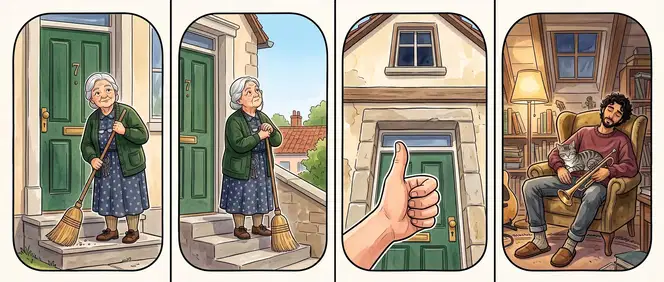 1 Lukas
Bonġu, Sinjura Marija! Kif ?
Good morning, Mrs Marija! How are you?
2 MarijaTajba, grazzi. U l-?
Fine, thanks. And the night?
3 LukasTajjeb ! Ġorġ mhux qed idoqq.
Very good! Ġorġ isn't playing.
4 MarijaĠorġ . U Ċikku wkoll.
Ġorġ is asleep. And so is Ċikku.
1 LenaBonġu, Sinjura Marija! Kif ?
Good morning, Mrs Marija! How are you?
2 MarijaTajba, grazzi. U l-?
Fine, thanks. And the night?
3 LenaTajjeb ! Ġorġ mhux qed idoqq.
Very good! Ġorġ isn't playing.
4 MarijaĠorġ . U Ċikku wkoll.
Ġorġ is asleep. And so is Ċikku.

Unit complete
