Module 2Word reviewPremium
Words of module 2: The empty flat
Reviews practise both sides: wherever Lukas and Lena would say something differently, you do it once as each.
In this module you learned to
- spell my name, say where I'm from, which languages I speak and what I do, and ask someone to speak slowly
- say what is in a flat and what is not, and ask what something is
- say what colour and size things are, and where they are in a room
- ask what happened, say what is in my kitchen and whose things are, and say what I need
- ask who is there, say what is in my flat now, and thank people for their help
From this module's scenes

jimla
fill in (a form)
Imla l-formola: fill in the form. It is the verb for fill, too.
Kull ġar ġdid jimla formola.Every new neighbour fills in a form.
Formola oħra!
mgħarfafem.
spoon
Several spoons: mgħaref. A teaspoon: kuċċarina.
Ċikku! U x'hemm hawn? Mgħarfa... ċavetta...Ċikku! And what's in here? A spoon... a key...
Ċikku! U x'hemm hawn? Mgħarfa... ċavetta...Ċikku! And what's in here? A spoon... a key...
M'hemm xejn hawn!ta' min
whose
Literally: of whom. Ta' min hu? Whose is it? Ta' min hi? for a feminine word.
Mela ta' min hi?Then whose is it?
Mela ta' min hi?Then whose is it?
Is-sufan l-isfar
pultrunafem.
armchair
Araw! Ċikku diġà fil-pultruna. Il-qtates jafu!Look! Ċikku is already in the armchair. Cats know!
Min qed jgħin?
kantinafem.
cellar
Il-pultruna mill-kantina tan-nanna. Qadima, imma tajba ħafna.The armchair is from Grandma's cellar. It's old, but very good.
Min qed jgħin?
jiġi
come (on foot)
Ejja: come! To several: ejjew. Ġejt: I came.
Bonġu! Nista' nidħol?Good morning! May I come in?
Formola oħra!
formolafem.
form
Imla l-formola: fill in the form.
Kull ġar ġdid jimla formola.Every new neighbour fills in a form.
Formola oħra!
malajr
fast
Quickly, soon: malajr, which does not change. Faster: iktar malajr. Hurry up: għaġġel! In a hurry: mgħaġġel (m) · mgħaġġla (f).
Iva, issa. Ħaġa ta' malajr!Yes, now. It's quick!
Formola oħra!
kunjommasc.
surname
Isem u kunjom: first name and surname.
Il-kunjom tiegħi Becker.My surname is Becker.
Il-kunjom tiegħi Becker.My surname is Becker.
Formola oħra!
minn
from
With the article: mill-Belt, mit-Tnejn. From me: minni, minnek, minnu, minnha. From someone's place: mingħand: mingħand Ġorġ.
U minn fejn int?And where are you from?
Formola oħra!
lingwafem.
language
Several: lingwi. Also ilsien, the tongue: l-ilsien Malti.
Mill-Ġermanja, tajjeb. U x'lingwi titkellem?From Germany, good. And what languages do you speak?
Formola oħra!
jitkellem
speak
Titkellem bil-Malti? Do you speak Maltese? The language takes bil-: bl-Ingliż, in English.
Malti? Titkellem bil-Malti! Tajjeb ħafna!Maltese? You speak Maltese! Very good!
Formola oħra!
jaħdem
work
Work, the noun: xogħol. Immur ix-xogħol: I go to work.
Tajjeb, tajjeb. U x'taħdem?All right, all right. And what do you do?
Formola oħra!
jifhem
understand
Ma nifhimx: I don't understand (the e turns to i before -x). Fhimt? Did you understand?
Skużani, ma nifhimx. Tista' titkellem bil-mod?Sorry, I don't understand. Could you speak slowly?
Skużani, ma nifhimx. Tista' titkellem bil-mod?Sorry, I don't understand. Could you speak slowly?
Formola oħra!bil-mod
slowly
Bil-mod, jekk jogħġbok: slowly, please. Slower: iktar bil-mod.
Mill-ġdid, bil-mod, jekk jogħġbok.Again, slowly, please.
Formola oħra!
jgħid ittra b'ittra
spell
Maltese says it letter by letter: għidli ittra b'ittra, spell it for me. Kif jinkiteb? How is it spelled?
Ittra b'ittra, jekk jogħġbok.Letter by letter, please.
Formola oħra!mill-ġdid
again
Literally: from new. Before a verb Maltese often uses reġa': reġa' ġie, he came again; reġgħet bdiet ix-xita, it started raining again.
Mill-ġdid, bil-mod, jekk jogħġbok.Again, slowly, please.
Formola oħra!ftit
a little
Before a noun with no article: ftit ħalib. Also a few: ftit nies. A little bit: daqsxejn.
Ftit biss! Bil-mod, jekk jogħġbok!Only a little! Slowly, please!
Ftit biss! Bil-mod, jekk jogħġbok!Only a little! Slowly, please!
Formola oħra!
Maltimasc.
the language you are learning
In Maltese: bil-Malti; nitkellem bil-Malti, I speak Maltese. A Maltese man: Malti; a woman: Maltija; the people: il-Maltin.
Il-Ġermaniż u l-Ingliż. U ftit Malti.German and English. And a little Maltese.
Il-Ġermaniż u l-Ingliż. U ftit Malti.German and English. And a little Maltese.
Formola oħra!biss
only
After what it limits: kafè wieħed biss, only one coffee.
Ftit biss! Bil-mod, jekk jogħġbok!Only a little! Slowly, please!
Ftit biss! Bil-mod, jekk jogħġbok!Only a little! Slowly, please!
Formola oħra!
jgħid
say
Its past is another word: qal (he said), qalet (she said), għedt (I said). Għidli: tell me.
Jien... ma nafx. Kif ngħid "engineer" bil-Malti?I'm... I don't know. How do I say "engineer" in Maltese?
Jien... ma nafx. Kif ngħid "engineer" bil-Malti?I'm... I don't know. How do I say "engineer" in Maltese?
Formola oħra!dak / dik
that
dak for a masculine word, dik for a feminine one: dak il-qattus, dik iċ-ċavetta. Those: dawk. That, joining two sentences: li (naf li ..., I know that ...).
Mela dik il-formola għal xiex?So what's that form for?
Mela dik il-formola għal xiex?So what's that form for?
Formola oħra!
appartamentmasc.
flat
Many people just say flat.
Mela dan l-appartament il-ġdid tiegħek?So this is your new flat?
M'hemm xejn hawn!
żgħir
small
żgħir (m) · żgħira (f) · żgħar (pl). Smaller: iżgħar. Also little, young: meta kien żgħir, when he was little.
Iva. Żgħir, imma tiegħi.Yes. Small, but mine.
Iva. Żgħir, imma tiegħi.Yes. Small, but mine.
M'hemm xejn hawn!xiex
what
Before a word it is x': x'inhu? what is it? x'qed tagħmel? what are you doing? On its own: xiex?
U x'hemm hemm?And what's in there?
M'hemm xejn hawn!
kamra tal-banjufem.
bathroom
Literally: the room of the bath. Often just il-banju.
Hemm il-kamra tal-banju.The bathroom's in there.
Hemm il-kamra tal-banju.The bathroom's in there.
M'hemm xejn hawn!
vojt
empty
vojt (m) · vojta (f): il-friġġ vojt, the fridge is empty. A house or flat nobody lives in: battal (battala).
Il-kamra vojta ħafna! Fejn hi l-mejda?The room is very empty! Where's the table?
M'hemm xejn hawn!
mejdafem.
table
Several tables: mwejjed.
M'hemmx mejda.There isn't a table.
M'hemmx mejda.There isn't a table.
M'hemm xejn hawn!
siġġumasc.
chair
Several chairs: siġġijiet.
Hemm xi siġġu? Xi sufan?Is there a chair? A sofa?
M'hemm xejn hawn!

soddafem.
bed
Several beds: sodod. Fis-sodda: in bed.
Le. M'għandix siġġu u m'għandix sufan. Hemm sodda, lampa u bagalja biss.No. I don't have a chair and I don't have a sofa. There's only a bed, a lamp and a suitcase.
Le. M'għandix siġġu u m'għandix sufan. Hemm sodda, lampa u bagalja biss.No. I don't have a chair and I don't have a sofa. There's only a bed, a lamp and a suitcase.
M'hemm xejn hawn!
lampafem.
lamp
Le. M'għandix siġġu u m'għandix sufan. Hemm sodda, lampa u bagalja biss.No. I don't have a chair and I don't have a sofa. There's only a bed, a lamp and a suitcase.
Le. M'għandix siġġu u m'għandix sufan. Hemm sodda, lampa u bagalja biss.No. I don't have a chair and I don't have a sofa. There's only a bed, a lamp and a suitcase.
M'hemm xejn hawn!
għaliex
why
Also għala and għalfejn. The answer starts with għax: because.
Għaliex?Why?
M'hemm xejn hawn!
wieħed
one
wieħed (m) · waħda (f). It comes after the noun: kafè wieħed, tazza waħda. First: l-ewwel.
Kollox? F'bagalja waħda?Everything? In one suitcase?
M'hemm xejn hawn!
gwardarobbafem.
wardrobe
U dik il-gwardarobba l-kbira? Tiegħek?And that big wardrobe? Is it yours?
M'hemm xejn hawn!
kbir
big
kbir (m) · kbira (f) · kbar (pl). Bigger: akbar.
U dik il-gwardarobba l-kbira? Tiegħek?And that big wardrobe? Is it yours?
M'hemm xejn hawn!
qadim
old (of things)
qadim (m) · qadima (f) · qodma (pl). Older: eqdem (eqdem minnek, older than you). L-Istazzjon il-Qadim: the Old Station.
Le, mhux tiegħi. Qadima ħafna.No, it isn't mine. It's very old.
Le, mhux tiegħi. Qadima ħafna.No, it isn't mine. It's very old.
M'hemm xejn hawn!
iħares
look / watch
Ħares lejn: look at. Ara! (look!) comes from jara, see, and so does watching TV: nara t-televiżjoni.
Nista' nħares?Can I have a look?
M'hemm xejn hawn!xejn
nothing
With ma: ma rajt xejn, I saw nothing. As an answer, alone: xejn.
Xejn! M'hemm xejn hawn!Nothing! There's nothing here!
M'hemm xejn hawn!
kamrafem.
room
Several rooms: kmamar.
Il-kamra vojta ħafna! Fejn hi l-mejda?The room is very empty! Where's the table?
M'hemm xejn hawn!
isfar
yellow
isfar (m) · safra (f) · sofor (pl)
Għandek sufan isfar?Do you have a yellow sofa?
Għandek sufan isfar?Do you have a yellow sofa?
Is-sufan l-isfar
aħmar
red
aħmar (m) · ħamra (f) · ħomor (pl)
U l-lampa l-ħamra? Tiegħek ukoll?And the red lamp? Is it yours too?
U l-lampa l-ħamra? Tiegħek ukoll?And the red lamp? Is it yours too?
Is-sufan l-isfar
aħdar
green
aħdar (m) · ħadra (f) · ħodor (pl)
Le. Il-lampa tiegħi żgħira u ħadra.No. My lamp is small and green.
Is-sufan l-isfar
fuq
on
Also above and upstairs. On me: fuqi; on it: fuqu (m), fuqha (f).
Fil-kamra tal-banju hemm sufan isfar kbir. Fuq is-sufan hemm lampa ħamra.In the bathroom there's a big yellow sofa. On the sofa there's a red lamp.
Is-sufan l-isfar
tieqafem.
window
Several windows: twieqi.
U t-tieqa żgħira wkoll.And the window is small too.
U t-tieqa żgħira wkoll.And the window is small too.
Is-sufan l-isfar
biebmasc.
door
Several doors: bibien.
Imma kif? Is-sufan kbir, u l-bieb żgħir.But how? The sofa is big, and the door is small.
Is-sufan l-isfar
taħt
under
Under it: taħtu (m), taħtha (f): taħt il-mejda, taħtha.
Ara! Ċikku taħt is-sufan.Look! Ċikku is under the sofa.
Is-sufan l-isfar
kċinafem.
kitchen
Several kitchens: kċejjen.
Fil-kċina tiegħek?! U s-siġġijiet?In your kitchen?! And the chairs?
Il-mejda tal-kafetterija
abjad
white
abjad (m) · bajda (f) · bojod (pl). Bajda is also an egg.
Mejda żgħira, bajda? Hemm waħda fil-kċina tiegħi. Ma nafx ta' min hi!A small, white table? There's one in my kitchen. I don't know whose it is!
Mejda żgħira, bajda? Hemm waħda fil-kċina tiegħi. Ma nafx ta' min hi!A small, white table? There's one in my kitchen. I don't know whose it is!
Il-mejda tal-kafetterija
jistenna
wait
Stenna! Wait! To several: stennew. No word for for: nistenna l-karozza tal-linja, I wait for the bus.
Stenna ftit... Sejra nara!Wait a moment... I'm going to have a look!
Il-mejda tal-kafetterija
tazzafem.
cup
Tazza te: a cup of tea.
Għandi tazza waħda biss.I only have one cup.
Għandi tazza waħda biss.I only have one cup.
Il-mejda tal-kafetterija
kolazzjonmasc.
breakfast
Għall-kolazzjon: for breakfast.
U kolazzjon ukoll! Fejn huma t-tazzi?And breakfast too! Where are the cups?
Il-mejda tal-kafetterija
għandu bżonn
need
Literally: has need. Għandi bżonn ġakketta: I need a jacket. M'hemmx bżonn: there's no need.
Għandi tazza waħda biss.I only have one cup.
Għandi tazza waħda biss.I only have one cup.
Il-mejda tal-kafetterija
jiftaħ
open
Open, the adjective: miftuħ (m), miftuħa (f): il-ħanut miftuħ, the shop is open.
Imma min jiftaħ il-bieb tiegħi bil-lejl?But who opens my door at night?
Imma min jiftaħ il-bieb tiegħi bil-lejl?But who opens my door at night?
Il-mejda tal-kafetterijakollha
all (all the doors)
After the noun: il-bibien kollha, all the doors. All of them: kollha, or kollhom for people. The whole: il-lejl kollu, all night.
Kollha?All of them?
Kollha?All of them?
Il-mejda tal-kafetterijagħad
yet / not yet
Not yet: għadu le. With an ending it means still: għadni hawn, I am still here.
Fil-kafetterija għad hemm mwejjed. U int għandek bżonn mejda.There are still tables in the café. And you need a table.
Il-mejda tal-kafetterija
bilqiegħda
sit (be sitting)
Sitting is bilqiegħda after the person: hi bilqiegħda fuq il-bank, she is sitting on the bench. Toqgħod ħdejn it-tieqa: she sits (stays) by the window.
Jien bilqiegħda u nistenna. Min jiġi bil-lejl? U għaliex?I'm sitting here, waiting. Who comes at night? And why?
Jien bilqiegħda u nistenna. Min jiġi bil-lejl? U għaliex?I'm sitting here, waiting. Who comes at night? And why?
Min qed jgħin?
jgħin
help
Tista' tgħinni? Can you help me? Help, the noun: għajnuna.
Bonswa! Qed ngħinu biss.Good evening! We're just helping.
Min qed jgħin?
nofsillejlmasc.
midnight
Literally half the night. At midnight: f'nofsillejl. Noon is nofsinhar.
Nofsillejl. Xi ħadd jiftaħ il-bieb.Midnight. Somebody opens the door.
Min qed jgħin?xi ħadd
somebody / someone
Without xi, ħadd is nobody, with ma: ħadd ma jaf, nobody knows.
Nofsillejl. Xi ħadd jiftaħ il-bieb.Midnight. Somebody opens the door.
Min qed jgħin?
ħinmasc.
time
Time on the clock, and time to do something: m'għandix ħin, I have no time. A longer time, an age, is żmien.
Bi nhar? Bi nhar m'għandix ħin.In the daytime? In the daytime I have no time.
Min qed jgħin?
Additional words


qasir
short
qasir (m) · qasira (f) · qosra (pl), of people, hair and a visit alike. Shorter: iqsar.
Is-sufan l-isfar (P)
Practice 1/8 · Pictures
Pictures and words
Match the words to the pictures.
Pictures and words
Match the words to the pictures.
Pictures and words
Match the words to the pictures.
Pictures and words
Match the words to the pictures.
Pictures and words
Match the words to the pictures.
Pictures and words
Match the words to the pictures.
Pictures and words
Match the words to the pictures.
Pictures and words
Match the words to the pictures.
Pictures and words
Match the words to the pictures.
Practice 2/8 · Listening
Listen and choose
Listen and choose the word you hear.
minn: from
lingwa: language
malajr: fast
pultruna: armchair
kunjom: surname
Practice 3/8 · Meanings
What does it mean?
jitkellem
formola
kantina
jimla
kunjom
jiġi
Practice 4/8 · Matching
Around the flat
Match the pairs.
Practice 5/8 · In situations
The right words
Choose the right words for the situation.
Marija hands you a form. Ask her what it's for.
You say:
Marija hands you a form. Ask her what it's for.
You say:
There's a spoon on your bed, and you don't know whose it is.
You say:
There's a spoon on your bed, and you don't know whose it is.
You say:
Marija promises that the form won't take long.
Marija says:
You don't understand a surname. Ask for it letter by letter.
You say:
You don't understand a surname. Ask for it letter by letter.
You say:
As Lukas
Marija asks what you do. Tell her your job.
You say:
As Lena
Marija asks what you do. Tell her your job.
You say:
As Lukas
Ella wonders why the flat is so empty. Tell her you're new here, and everything is in your suitcase.
You say:
As Lena
Ella wonders why the flat is so empty. Tell her you're new here, and everything is in your suitcase.
You say:
Lina hears her table is in your kitchen. She's going to go and see.
Lina says:
Practice 6/8 · Fill the gaps
My flat now
Fill the gaps with the words from the box.
Kull ġar ġdid formola.
Every new neighbour fills in a form.
Issa fil-kamra tiegħi hemm sodda, mejda u qadima.
Now in my room there's a bed, a table and an old armchair.
Il-pultruna mill- tan-nanna.
The armchair is from Grandma's cellar.
Fil-kċina hemm tazzi u .
In the kitchen there are cups and spoons.
Ta' hi l-lampa l-ħamra? Ma nafx.
Whose is the red lamp? I don't know.
As Lukas
Jien , u l- tiegħi Becker.
I'm an engineer, and my surname is Becker.
As Lena
Jien , u l- tiegħi Becker.
I'm an engineer, and my surname is Becker.
Practice 7/8 · Comic strip
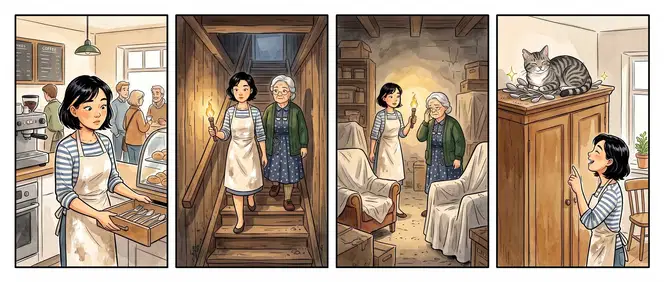
Fejn huma l-mgħaref tiegħi?
Fill the speech bubbles.
 1 Lina
Fejn huma l- tiegħi? M'hemm xejn hawn!
Where are my spoons? There's nothing here!
2 LukasForsi fil-?
Maybe in the cellar?
3 MarijaLe. Fil-kantina hemm biss.
No. There are only armchairs in the cellar.
4 LinaĊikku! Dawk il-mgħaref !
Ċikku! Those are my spoons!
1 LinaFejn huma l- tiegħi? M'hemm xejn hawn!
Where are my spoons? There's nothing here!
2 LenaForsi fil-?
Maybe in the cellar?
3 MarijaLe. Fil-kantina hemm biss.
No. There are only armchairs in the cellar.
4 LinaĊikku! Dawk il-mgħaref !
Ċikku! Those are my spoons!
Practice 8/8 · Questions
What happened?
Answer the questions.
Il-lampa ta' Ġorġ ħamra?
Is Ġorġ's lamp red?
Fejn hu s-sufan ta' Ġorġ?
Where is Ġorġ's sofa?
Il-mejda fil-kċina: minn fejn hi?
The table in the kitchen: where is it from?
X'jiftaħ il-bibien kollha?
What opens all the doors?
Il-pultruna l-ħadra: minn fejn hi?
The green armchair: where is it from?

Unit complete
