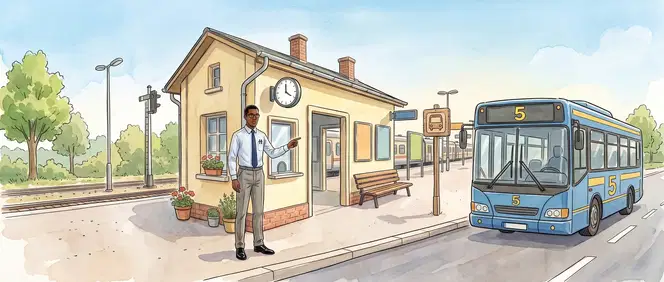
Transport and travel times
Use for common transport methods: . Walking uses . describes being inside a particular train, not the transport method in general.
A ticket can be or . Present verbs express scheduled departures: . A cancelled service is . Learn the complete announcement phrase here.
| Form | Example | Meaning |
|---|---|---|
| I go by train. | ||
| I go by train. | ||
| I go on foot. | ||
| I go on foot. | ||
| I am on the train. | ||
| I am on the train. | ||
| The train leaves at nine. | ||
| The train leaves at nine. | ||
| Two return tickets. | ||
| Two return tickets. | ||
| The train is cancelled. | ||
| The train is cancelled. | ||
Vou de comboio.I go by train.
Vou a pé.I go on foot.
Estou no comboio.I am on the train.
O comboio parte às nove.The train leaves at nine.
Dois bilhetes de ida e volta.Two return tickets.
O comboio está suprimido.The train is cancelled.
Sou novo aqui. Dois bilhetes de ida e volta.I am new here. Two return tickets.
Sou nova aqui. Dois bilhetes de ida e volta.I am new here. Two return tickets.
Sou novo aqui. O comboio está suprimido.I am new here. The train is cancelled.
Sou nova aqui. O comboio está suprimido.I am new here. The train is cancelled.
Practice 1/6 · Finding words
Notice the useful pattern
Tap the form practised in this unit.
.
I go by train.
.
I go on foot.
.
I am on the train.
.
The train leaves at nine.
Practice 2/6 · The right form
Choose the form 1
Choose the right word for the gap.
Vou comboio.
I go by train.
Vou pé.
I go on foot.
Estou comboio.
I am on the train.
O comboio às nove.
The train leaves at nine.
Dois bilhetes de ida e .
Two return tickets.
O comboio está .
The train is cancelled.
Sou novo aqui. Dois bilhetes de ida e .
I am new here. Two return tickets.
Sou nova aqui. Dois bilhetes de ida e .
I am new here. Two return tickets.
Sou novo aqui. O comboio está .
I am new here. The train is cancelled.
Sou nova aqui. O comboio está .
I am new here. The train is cancelled.
Practice 3/6 · Fill the gaps
Use the form 1
Fill the gaps with the words from the box.
Vou comboio.
I go by train.
Vou pé.
I go on foot.
Estou comboio.
I am on the train.
O comboio às nove.
The train leaves at nine.
Dois bilhetes de ida e .
Two return tickets.
O comboio está .
The train is cancelled.
Sou novo aqui. Dois bilhetes de ida e .
I am new here. Two return tickets.
Sou nova aqui. Dois bilhetes de ida e .
I am new here. Two return tickets.
Sou novo aqui. O comboio está .
I am new here. The train is cancelled.
Sou nova aqui. O comboio está .
I am new here. The train is cancelled.
Practice 4/6 · Building sentences
Build a sentence
Put the words in order.
I go by train.
I go on foot.
I am on the train.
The train leaves at nine.
Two return tickets.
The train is cancelled.
Practice 5/6 · In situations
What would you say?
Choose the right words for the situation.
I go by train.
You say:
Use the meaning and Portuguese pattern explained in this unit.
I go by train.
You say:
Use the meaning and Portuguese pattern explained in this unit.
I go on foot.
You say:
Use the meaning and Portuguese pattern explained in this unit.
I go on foot.
You say:
Use the meaning and Portuguese pattern explained in this unit.
I am on the train.
You say:
Use the meaning and Portuguese pattern explained in this unit.
I am on the train.
You say:
Use the meaning and Portuguese pattern explained in this unit.
The train leaves at nine.
You say:
Use the meaning and Portuguese pattern explained in this unit.
The train leaves at nine.
You say:
Use the meaning and Portuguese pattern explained in this unit.
Practice 6/6 · Matching
Connect messages and meanings
Match the pairs.

Unit complete