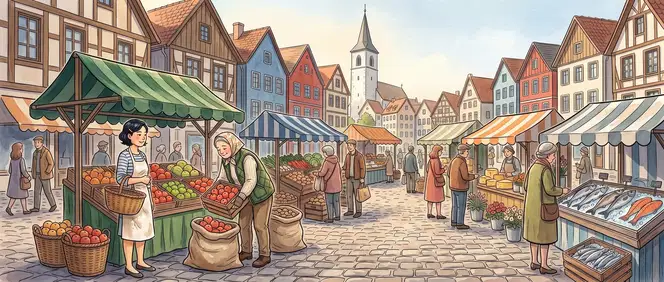
Scene 26 of 50
Três estações
Left, right, straight on
Your goalI can ask the way and understand simple directions.


Prepare the wordsPremium
Meet the 15 words of this scene before you read. You can also go straight to the story.
Bom dia, dona Maria! Desculpe, onde fica a estação?
Good morning, Mrs Silva! Excuse me, where is the station?
Bom dia, dona Maria! Desculpe, onde fica a estação?
Good morning, Mrs Silva! Excuse me, where is the station?
 Maria
MariaA estação? E para que precisa da estação?
The station? And why do you need the station?
Amanhã vou com o Tomás ao lago de comboio.
Tomorrow Tomás and I are going to the lake by train.
Amanhã vou com o Tomás ao lago de comboio.
Tomorrow Tomás and I are going to the lake by train.
- Maria
Eu sei, eu sei. Sei tudo.
I know, I know. I know everything.
- Maria
A estação fica longe. Primeira rua à esquerda, depois em frente e depois a segunda rua à direita.
The station is far. First street on the left, then straight on, then the second street on the right.
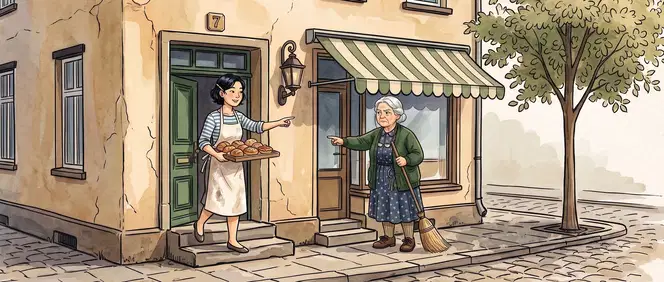
Rita comes out of the café with a tray.  Rita
RitaNão, não! A estação fica perto. À direita e depois à esquerda, na esquina.
No, no! The station is close. Right, then left at the corner.
Perto? A dona Maria diz que fica longe.
Close? Mrs Silva says it's far.
Perto? A dona Maria diz que fica longe.
Close? Mrs Silva says it's far.
- Rita
Para a dona Maria, tudo fica longe.
For Maria, everything is far.
- Maria
Estou a ouvir tudo!
I can hear everything!
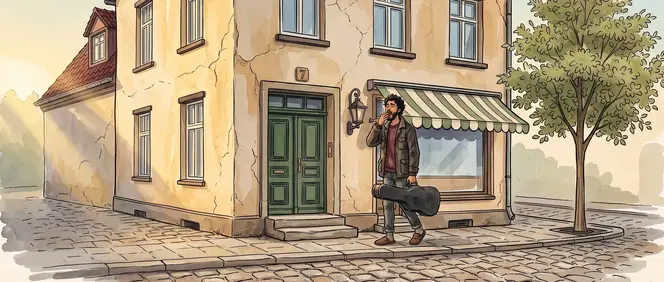
João comes home with his trumpet case, after a night of jazz.  João
JoãoBoa noite... Não, bom dia.
Good night... No, good morning.
João, onde fica a estação?
João, where is the station?
João, onde fica a estação?
João, where is the station?
- João
A estação? Em frente, junto ao rio. Cinco minutos a pé.
The station? Straight on, by the river. Five minutes on foot.
Três vizinhos, três caminhos!
Three neighbours, three ways!
Três vizinhos, três caminhos!
Three neighbours, three ways!
- Maria
A minha estação é a de comboios. Fica longe.
My station is the train station. It's far.
- Rita
E a minha é a de autocarros. Fica perto.
And mine is the bus station. It's close.
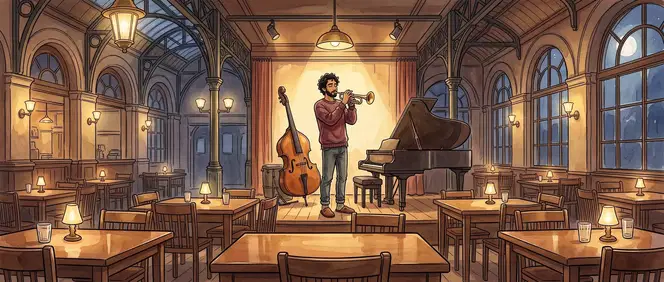 João
JoãoE a minha é a Estação Velha. Toco lá ao fim de semana.
And mine is the Old Station. I play there at weekends.
Preciso da estação de comboios. Então, à esquerda?
I need the train station. So, left?
Preciso da estação de comboios. Então, à esquerda?
I need the train station. So, left?
- Maria
À esquerda. E amanhã não chegue tarde!
Left. And don't be late tomorrow!
Who says this?
A estação? E para que precisa da estação?
A estação? E para que precisa da estação?
What does it mean?
Amanhã vou com o Tomás ao lago de comboio.
Amanhã vou com o Tomás ao lago de comboio.
Which line do you hear?
Close? Mrs Silva says it's far.
Close? Mrs Silva says it's far.
Put the words in order.
For Maria, everything is far.
Who says this?
Boa noite... Não, bom dia.
Boa noite... Não, bom dia.
What does it mean?
Três vizinhos, três caminhos!
Três vizinhos, três caminhos!
Which line do you hear?
I need the train station. So, left?
I need the train station. So, left?
Put the words in order.
Left. And don't be late tomorrow!
What happens first?
Put the lines in the order they come in the scene.
Scene complete
Três estações
Goal reachedI can ask the way and understand simple directions.