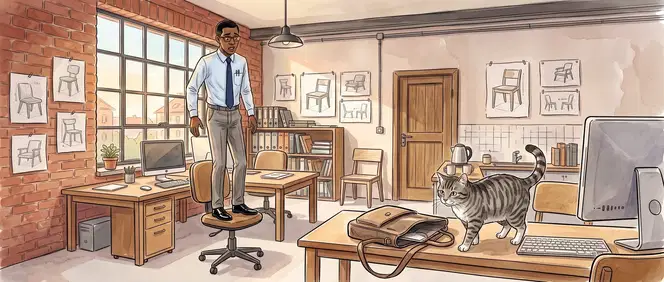
The action comes back to the person
The dictionary form means get up. In , refers to the person doing the action. It comes before the conjugated verb. Learn the small word with each person: , , , , , . These are reflexive verbs.
| Person | Routine |
|---|---|
Two everyday patterns
follows the same regular endings: , , , , , . changes its stem in some forms: learn as I go to bed. The full pattern comes later with other stem changes.
Practice 1/5 · The right form
Choose the form for the message
Choose the right word for the gap.
Yo levanto temprano.
I get up early.
Vosotros ducháis.
You shower.
Marta a las siete.
Marta gets up at seven.
Nosotras nos .
We shower.
Practice 2/5 · Fill the gaps
Complete a useful exchange
Fill the gaps with the words from the box.
¿A qué hora levantas?
What time do you get up?
Ellos levantan tarde.
They get up late.
Yo ducho y nosotros levantamos.
I shower and we get up.
Practice 3/5 · Building sentences
Put the message together
Put the words in order.
I get up at half past six.
You shower in the morning.
They get up late.
Practice 4/5 · Matching
Connect the message and its meaning
Match the pairs.
Practice 5/5 · Fill the gaps
Check the contrast in a new context
Fill the gaps with the words from the box.
Tú duchas. Nosotros duchamos.
You shower. We shower.
Unit complete