Bonus storyPremium
La tienda de la esquina
The corner shop
Module 6 · Around townGet to know the neighbours and practise what you've learned in a new story.
The storyA Saturday at the little shop on the corner by number 7: Karim, who came here from far away many years ago, his wife Aldona, and the cat, who comes every evening at six.
New words in the story
- el matrimonio marriage
- abro I open
- puntual on time
- las patas paws
- cuéntame tell me
- el avión plane
Tap a word to see what it means.
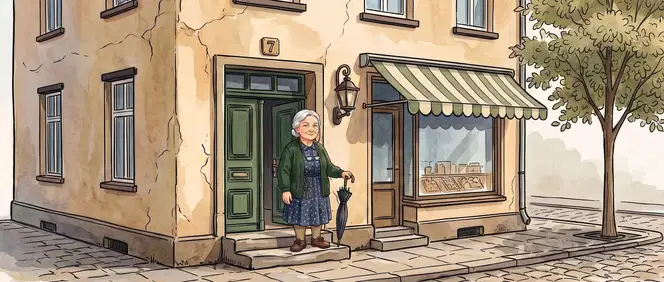
Saturday, six in the morning. The street is still dark. On the corner by number 7, a light goes on in a small shop.
Sábado, seis de la mañana. Hay luz en la tienda de Diego.
Saturday, six in the morning. There is a light in Diego’s shop.
La tienda está en la esquina, junto al número siete. Diego trabaja aquí desde hace treinta años.
The shop is on the corner, beside number seven. Diego has worked here for thirty years.
 Diego
DiegoLos sábados me levanto a las cinco. Para ir al mercado.
On Saturdays I get up at five. To go to the market.
 Diego
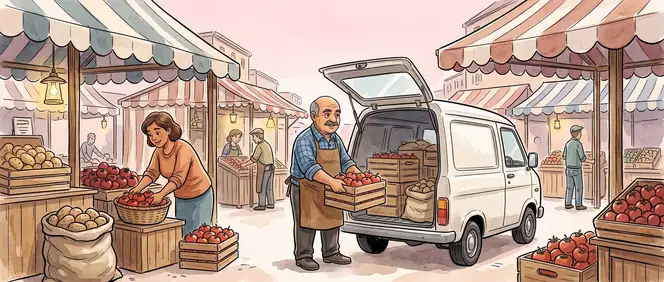
DiegoA las siete voy en coche. Necesito manzanas, tomates y patatas.
At seven I go by car. I need apples, tomatoes and potatoes.
- Rosa
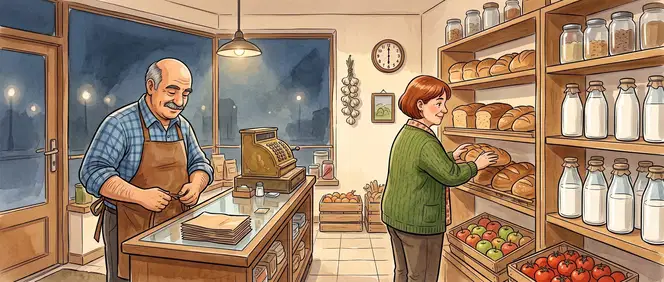
Y yo abro la tienda. ¡Alguien tiene que estar aquí!
And I open the shop. Someone has to be here!
Es Rosa, su mujer. Es de Valdemora.
It is Rosa, his wife. She is from Valdemora.
Diego es de Argentina. Ahora Valdemora también es su casa.
Diego is from Argentina. Now Valdemora is his home too.
- Diego
¡Rosa! ¡Ya estoy aquí! ¡Diez kilos de manzanas!
Rosa! I am back! Ten kilos of apples!
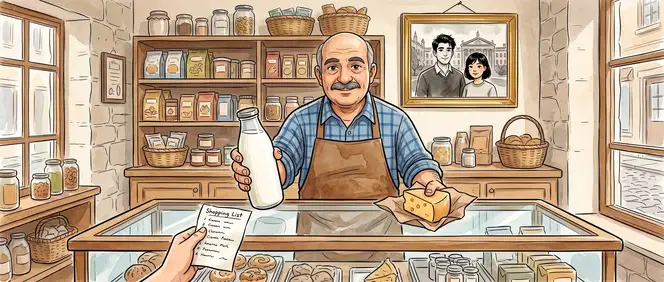
At ten, you come in with a shopping list.
Buenos días, Diego. Una botella de leche y medio kilo de queso, por favor.
Good morning, Diego. A bottle of milk and half a kilo of cheese, please.
Buenos días, Diego. Una botella de leche y medio kilo de queso, por favor.
Good morning, Diego. A bottle of milk and half a kilo of cheese, please.
 Diego
DiegoClaro. Aquí tienes la leche y el queso.
Of course. Here are the milk and cheese.
Gracias. ¿Eres de Valdemora?
Thank you. Are you from Valdemora?
Gracias. ¿Eres de Valdemora?
Thank you. Are you from Valdemora?
- Diego
No, de Argentina. Pero vivo aquí desde hace mucho tiempo.
No, from Argentina. But I have lived here for a long time.
¿Y por qué aquí?
And why here?
¿Y por qué aquí?
And why here?
- Diego
Por Rosa. Mira esa foto. Los dos, en Hamburgo, de estudiantes.
Because of Rosa. Look at that photo. Both of us, in Hamburg, as students.
- Diego
Ahora estamos casados. Y me gusta vivir aquí.
Now we are married. And I like living here.
- Rosa
La tienda tiene treinta años. ¡Casi como nuestro matrimonio!
The shop is thirty years old. Nearly as old as our marriage!
¿Tenéis hijos?
Do you have children?
¿Tenéis hijos?
Do you have children?
- Diego
Sí. Un hijo y una hija. Ya son mayores.
Yes. A son and a daughter. They are adults now.
- Rosa
Nuestra hija vive en Madrid. Nuestro hijo, cerca de la estación.
Our daughter lives in Madrid. Our son, near the station.
- Diego
Mañana vienen a comer. Ella en tren y él en bicicleta.
Tomorrow they come for lunch. She by train and he by bicycle.
Una pregunta más. ¿Cómo voy a Correos?
One more question. How do I get to the post office?
Una pregunta más. ¿Cómo voy a Correos?
One more question. How do I get to the post office?
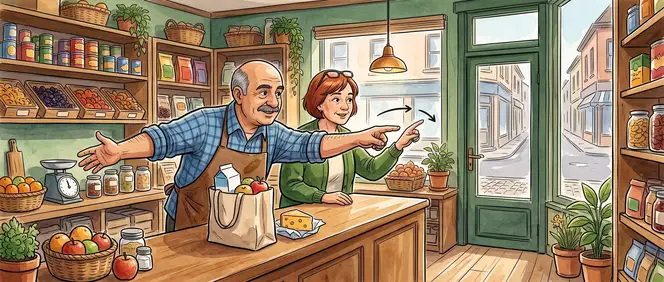 Diego
DiegoA la derecha. Y la segunda calle a la izquierda.
Right. And the second street on the left.
Gracias. ¿Y conoces a Michi?
Thank you. And do you know Michi?
Gracias. ¿Y conoces a Michi?
Thank you. And do you know Michi?
- Diego
Claro. Desde hace muchos años.
Of course. For many years.
- Diego
¿Cuántos años tiene? Nadie lo sabe.
How old is he? Nobody knows.
Evening. The street lamps come on. The grey tomcat sits in front of the shop door.
A las seis de la tarde, Michi está en la puerta de Diego.
At six in the evening, Michi is at Diego’s door.
Por la mañana, cafetería; los sábados, mercado; por la tarde, tienda. Tiene mucho que hacer.
In the morning, café; Saturdays, market; in the evening, shop. He has a lot to do.
- Diego
¡Hola, Michi! ¡Siempre puntual!
Hello, Michi! Always on time!
- Diego
¿Tienes hambre? Claro que sí.
Are you hungry? Of course you are.
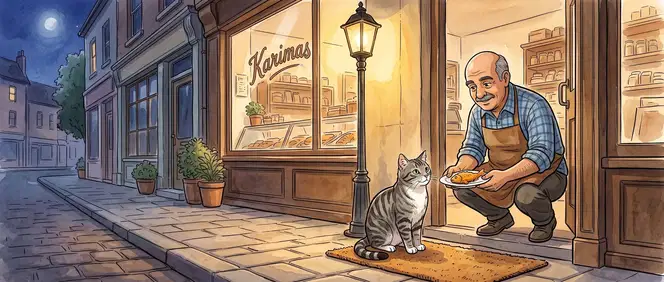 Diego
DiegoUn poco de pescado. Hoy, nada más.
A little fish. Nothing else today.
- Rosa
Eso dices todas las tardes, Diego.
You say that every evening, Diego.
- Diego
Es mi amigo. Los amigos tienen que cenar.
He is my friend. Friends have to eat dinner.
Lucía comes in on her way home from her grandmother's.
 Lucía
Lucía¡Hola, Diego! Cuéntame algo de Michi. ¿De dónde lo conoces?
Hello, Diego! Tell me something about Michi. How do you know him?
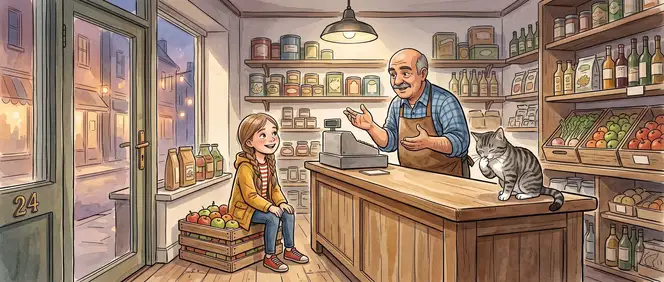 Diego
DiegoDe aquí mismo. Siempre está en nuestra puerta.
From right here. He is always at our door.
- Diego
Grande, gris y con hambre. Siempre igual.
Big, grey and hungry. Always the same.
- Rosa
Sobre todo, con hambre.
Especially hungry.
- Lucía
¿Es tuyo?
Is he yours?
- Diego
No. Vive en el número siete. Aquí viene a comer.
No. He lives at number seven. He comes here to eat.
- Lucía
¡Aquí, en el mercado y en la cafetería! ¡Tiene tres cocinas!
Here, at the market and at the café! He has three kitchens!
- Rosa
Sí. Y necesita las tres.
Yes. And he needs all three.
Michi finishes the fish and walks off towards number 7. Lucía picks up her bag.
- Diego
Adiós, Michi. ¡A casa!
Goodbye, Michi. Home!
- Rosa
Tú también, Lucía. Todo recto y la segunda calle a la izquierda.
You too, Lucía. Straight on and the second street on the left.
La tienda está cerrada. Diego y Rosa toman té.
The shop is closed. Diego and Rosa drink tea.
- Diego
Mañana vienen los niños. ¡Qué bien!
The children come tomorrow. How nice!
- Rosa
Y a las seis viene otro. Con cuatro patas.
And at six another one comes. With four paws.
Practice 1/3 · Who says it
Who says it?
A las siete voy en coche. Necesito manzanas, tomates y patatas.
A las siete voy en coche. Necesito manzanas, tomates y patatas.
La tienda tiene treinta años. ¡Casi como nuestro matrimonio!
¡Aquí, en el mercado y en la cafetería! ¡Tiene tres cocinas!
¡Aquí, en el mercado y en la cafetería! ¡Tiene tres cocinas!
Practice 2/3 · True or false
The shop and the family
True or false?
Diego es de Argentina.
Diego is from Argentina.
Su hija vive en Valdemora.
His daughter lives in Valdemora.
Michi come en tres sitios.
Michi eats at three places.
Practice 3/3 · Questions
The daily visit
Answer the questions.
¿Cuándo viene Michi?
When does Michi come?
¿Cómo viene el hijo?
How does the son come?
Unit complete