Módulo 1Repaso de vocabularioPremium
Palabras del módulo 1: La llegada
Los repasos practican ambos papeles: cuando Lukas y Lena dirían algo de forma distinta, lo haces una vez con cada personaje.
En este módulo has aprendido a
- greet an older neighbour politely and say my name
- say hello to a child, ask her name, get my key back and ask where something is
- introduce myself in a café, choose coffee or tea, and say if I like something
- knock on a neighbour's door, say that I want to sleep, and ask someone to do something tomorrow
- ask how someone is, and ask where people live
De las escenas de este módulo


new
nuevo / nueva
Good evening! Are you the new neighbour?¡Buenas noches! ¿Es usted el nuevo vecino?
Good evening! Are you the new neighbour?¡Buenas noches! ¿Es usted la nueva vecina?
Good evening
neighbour
vecino / vecina
Good evening! Are you the new neighbour?¡Buenas noches! ¿Es usted el nuevo vecino?
Good evening! Are you the new neighbour?¡Buenas noches! ¿Es usted la nueva vecina?
Good eveningname
nombre
Yes. My name is Lukas.Sí. Me llamo Lukas.
Yes. My name is Lena.Sí. Me llamo Lena.
Good evening

house
casa / edificio
Nice to meet you. I’m Anne Walker. This is my house.Mucho gusto. Soy Anne Walker. Esta es mi casa.
Good evening


goodbye
adiós
My key! Goodbye, key!¡Mi llave! ¡Adiós, llave!
My key! Goodbye, key!¡Mi llave! ¡Adiós, llave!
Good evening
hello
hola
Hello. What’s your name?¡Hola! ¿Cómo te llamas?
Hello. What’s your name?¡Hola! ¿Cómo te llamas?
You have my key!
grandmother
abuela
I’m Nicky. Anne is my grandmother. Are you the new neighbour?Soy Nicky. Anne es mi abuela. ¿Es usted el nuevo vecino?
I’m Nicky. Anne is my grandmother. Are you the new neighbour?Soy Nicky. Anne es mi abuela. ¿Es usted la nueva vecina?
You have my key!
have
tener
Yes. My name is Lukas. Do you have my key?Sí. Me llamo Lukas. ¿Tienes mi llave?
Yes. My name is Lena. Do you have my key?Sí. Me llamo Lena. ¿Tienes mi llave?
You have my key!


hungry
hambriento / hambrienta
I’m hungry too.Yo también tengo hambre.
I’m hungry too.Yo también tengo hambre.
You have my key!too
también
I’m hungry too.Yo también tengo hambre.
I’m hungry too.Yo también tengo hambre.
You have my key!
good
bueno / buena
Good. I’m going to the café.Bien, voy a la cafetería.
Good. I’m going to the café.Bien, voy a la cafetería.
You have my key!

café
cafetería
Where is the café?¿Dónde está la cafetería?
Where is the café?¿Dónde está la cafetería?
You have my key!where
dónde
Where is the café?¿Dónde está la cafetería?
Where is the café?¿Dónde está la cafetería?
You have my key!


know
saber (un hecho)
Yes! How do you know?¡Sí! ¿Cómo lo sabe?
Yes! How do you know?¡Sí! ¿Cómo lo sabe?
Enjoy your meal


please
por favor
A coffee, please.Un café, por favor.
A coffee, please.Un café, por favor.
Enjoy your meal
cake
bizcocho
Here you are. And some cake too!Aquí tiene. ¡Y un poco de bizcocho también!
Enjoy your mealbut
pero
Thank you. But this cake is not mine.Gracias, pero ese no es mi bizcocho.
Thank you. But this cake is not mine.Gracias, pero ese no es mi bizcocho.
Enjoy your mealnow
ahora
Now it is yours. Are you hungry? Anne already knows.Ahora es suyo. ¿Tiene hambre? Anne ya lo sabe.
Enjoy your mealalready
ya
Now it is yours. Are you hungry? Anne already knows.Ahora es suyo. ¿Tiene hambre? Anne ya lo sabe.
Enjoy your meal


want
querer
I want to sleep. Play tomorrow, all right?Quiero dormir. Toca mañana, ¿vale?
I want to sleep. Play tomorrow, all right?Quiero dormir. Toca mañana, ¿vale?
Good night
night
noche
Yes. But it is night now.Sí. Pero ahora es de noche.
Yes. But it is night now.Sí. Pero ahora es de noche.
Good night
trumpet
trompeta
It’s night. A trumpet is playing upstairs.Es de noche. Alguien toca la trompeta arriba.
Good night
play
tocar (un instrumento)
It’s night. A trumpet is playing upstairs.Es de noche. Alguien toca la trompeta arriba.
Good night
upstairs
arriba
It’s night. A trumpet is playing upstairs.Es de noche. Alguien toca la trompeta arriba.
Good night
live
vivir (residir)
Nice to meet you. My name is Lukas. I live downstairs.Mucho gusto. Me llamo Lukas. Vivo abajo.
Nice to meet you. My name is Lena. I live downstairs.Mucho gusto. Me llamo Lena. Vivo abajo.
Good night


there
allí
Here and there. Upstairs and downstairs. He’s the boss!Aquí y allí. Arriba y abajo. ¡Él es el jefe!
Who lives where?every
cada
No. But she comes every day. She’s my granddaughter.No. Pero viene todos los días. Es mi nieta.
Who lives where?
day
día
No. But she comes every day. She’s my granddaughter.No. Pero viene todos los días. Es mi nieta.
Who lives where?
granddaughter
nieta
No. But she comes every day. She’s my granddaughter.No. Pero viene todos los días. Es mi nieta.
Who lives where?
Mrs
señora (tratamiento ante el nombre de una mujer)
Sorry, Mrs Walker!¡Lo siento, señora Walker!
Who lives where?
boss
la persona que manda
Here and there. Upstairs and downstairs. He’s the boss!Aquí y allí. Arriba y abajo. ¡Él es el jefe!
Who lives where?
morning
mañana (parte del día)
Good morning. How are you?Buenos días. ¿Cómo está usted?
Who lives where?

Palabras adicionales


too
demasiado (too big: demasiado grande)
The sofa is too big.El sofá es demasiado grande.
A present for Nicky


Práctica 1/7 · Imágenes
Imágenes y palabras
Relaciona las palabras con las imágenes.
Imágenes y palabras
Relaciona las palabras con las imágenes.
Imágenes y palabras
Relaciona las palabras con las imágenes.
Imágenes y palabras
Relaciona las palabras con las imágenes.
Imágenes y palabras
Relaciona las palabras con las imágenes.
Imágenes y palabras
Relaciona las palabras con las imágenes.
Imágenes y palabras
Relaciona las palabras con las imágenes.
Imágenes y palabras
Relaciona las palabras con las imágenes.
Imágenes y palabras
Relaciona las palabras con las imágenes.
Imágenes y palabras
Relaciona las palabras con las imágenes.
Imágenes y palabras
Relaciona las palabras con las imágenes.
Imágenes y palabras
Relaciona las palabras con las imágenes.
Imágenes y palabras
Relaciona las palabras con las imágenes.
Práctica 2/7 · Comprensión auditiva
Escucha y elige
Escucha y elige la palabra que oyes.
nice to meet you: encantado / encantada de conocerte
who: quién
key: llave
name: nombre
here you are: aquí está
Práctica 3/7 · Significados
¿Qué significa?
¿Qué significa eso?
thank you
new
who
this
house
nice to meet you
Práctica 4/7 · Relacionar
Frases del módulo
Relaciona las parejas.
Práctica 5/7 · Completa los huecos
Recuerda las conversaciones
Completa los huecos con las palabras del recuadro.
evening!
¡Buenas noches!
evening!
¡Buenas noches!
Hello. What’s your ?
¡Hola! ¿Cómo te llamas?
Hello. What’s your ?
¡Hola! ¿Cómo te llamas?
Yes! do you know?
¡Sí! ¿Cómo lo sabe?
Yes! do you know?
¡Sí! ¿Cómo lo sabe?
! Not now!
¡Ay! ¡Ahora no!
! Not now!
¡Ay! ¡Ahora no!
, thank you. And you?
Bien, gracias. ¿Y usted?
, thank you. And you?
Bien, gracias. ¿Y usted?
Como Lukas
Lukas is my . He’s from Hamburg.
Refiérete a quien aprende como tu vecino o vecina.
Como Lena
Lena is my . She’s from Hamburg.
Refiérete a quien aprende como tu vecino o vecina.
Como Lukas
Lukas is here. He in Millbrook.
Refiérete a Lukas o Lena con el pronombre adecuado.
Como Lena
Lena is here. She in Millbrook.
Refiérete a Lukas o Lena con el pronombre adecuado.
Práctica 6/7 · En situaciones
Usa las frases
Elige las palabras adecuadas para la situación.
¡Buenas noches!
Tú dices:
¡Buenas noches!
Tú dices:
¡Hola! ¿Cómo te llamas?
Tú dices:
¡Hola! ¿Cómo te llamas?
Tú dices:
¡Sí! ¿Cómo lo sabe?
Tú dices:
¡Sí! ¿Cómo lo sabe?
Tú dices:
¡Ay! ¡Ahora no!
Tú dices:
¡Ay! ¡Ahora no!
Tú dices:
Bien, gracias. ¿Y usted?
Tú dices:
Bien, gracias. ¿Y usted?
Tú dices:
Práctica 7/7 · Cómic
Good morning, Mrs Walker. How are you?
Completa los bocadillos.
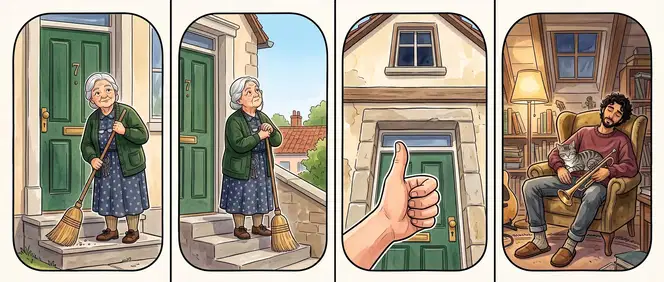 1 Lukas
morning, Mrs Walker. How are you?
Buenos días, señora Walker. ¿Cómo está?
2 Anne, thanks. And how was your night?
Bien, gracias. ¿Y qué tal ha pasado la noche?
3 LukasVery ! Jack isn’t playing.
¡Muy bien! Jack no está tocando.
4 AnneJack’s . So is Milo.
Jack está dormido. Milo también.
1 Lenamorning, Mrs Walker. How are you?
Buenos días, señora Walker. ¿Cómo está?
2 Anne, thanks. And how was your night?
Bien, gracias. ¿Y qué tal ha pasado la noche?
3 LenaVery ! Jack isn’t playing.
¡Muy bien! Jack no está tocando.
4 AnneJack’s . So is Milo.
Jack está dormido. Milo también.
Unidad terminada
 LernLaterne