Módulo 6Repaso de vocabularioPremium
Palabras del módulo 6: Por la ciudad
Los repasos practican ambos papeles: cuando Lukas y Lena dirían algo de forma distinta, lo haces una vez con cada personaje.
En este módulo has aprendido a
- ask the way and understand simple directions
- buy food at the market in kilos, bottles and pieces, and ask what it costs
- buy a train ticket, ask when and where the train leaves, and understand an announcement
- say where I'm from and where I live now, and how I get somewhere
- say where places are on a map and explain the way
De las escenas de este módulo

station
estación
Jack, where is the station?Jack, ¿dónde está la estación?
Jack, where is the station?Jack, ¿dónde está la estación?
Three routes to the station

lake
lago
Tomorrow Tom and I are going to Long Lake. By train.Mañana Tom y yo vamos a Long Lake. En tren.
Tomorrow Tom and I are going to Long Lake. By train.Mañana Tom y yo vamos a Long Lake. En tren.
Three routes to the station
train
tren
So to the train station. First left?Entonces, a la estación de tren. ¿Primero a la izquierda?
So to the train station. First left?Entonces, a la estación de tren. ¿Primero a la izquierda?
Three routes to the station
street
calle
I know. It’s far. First left, then straight on and right at the second street.Lo sé. Está lejos. Primero a la izquierda, luego todo recto y a la derecha en la segunda calle.
Three routes to the station
left
izquierda
So to the train station. First left?Entonces, a la estación de tren. ¿Primero a la izquierda?
So to the train station. First left?Entonces, a la estación de tren. ¿Primero a la izquierda?
Three routes to the stationthen
entonces
Far? No. Right, then left at the corner. Very close!¿Lejos? No. A la derecha, luego a la izquierda en la esquina. ¡Muy cerca!
Three routes to the station
straight on
todo recto
Straight on. By the river. Five minutes on foot.Todo recto. Junto al río. Cinco minutos a pie.
Three routes to the station
right
derecha
Far? No. Right, then left at the corner. Very close!¿Lejos? No. A la derecha, luego a la izquierda en la esquina. ¡Muy cerca!
Three routes to the station

corner
esquina
Far? No. Right, then left at the corner. Very close!¿Lejos? No. A la derecha, luego a la izquierda en la esquina. ¡Muy cerca!
Three routes to the station


bus
autobús
I mean the bus station. It’s close.Me refiero a la estación de autobuses. Está cerca.
Three routes to the station
market
mercado
Here is the market. Saturdays from seven to one. I need ten kilos of apples.Aquí está el mercado. Los sábados, de siete a una. Necesito diez kilos de manzanas.
Milo’s bill


tomato
tomate
A kilo of tomatoes and two kilos of potatoes, please.Un kilo de tomates y dos kilos de patatas, por favor.
A kilo of tomatoes and two kilos of potatoes, please.Un kilo de tomates y dos kilos de patatas, por favor.
Milo’s bill
potato
patata
A kilo of tomatoes and two kilos of potatoes, please.Un kilo de tomates y dos kilos de patatas, por favor.
A kilo of tomatoes and two kilos of potatoes, please.Un kilo de tomates y dos kilos de patatas, por favor.
Milo’s bill

bottle
botella
Half a kilo of cheese and a bottle of milk.Medio kilo de queso y una botella de leche.
Half a kilo of cheese and a bottle of milk.Medio kilo de queso y una botella de leche.
Milo’s bill
jacket
chaqueta
Cat hairs on your jacket! Milo comes every Saturday. Here is his bill for this month.¡Los pelos de gato de su chaqueta! Milo viene todos los sábados. Aquí está su cuenta de este mes.
Milo’s bill

platform
andén
Return. Is the train on platform two?Ida y vuelta. ¿Está el tren en el andén dos?
Return. Is the train on platform two?Ida y vuelta. ¿Está el tren en el andén dos?
Platform two
ticket
billete
Here are our two tickets.Aquí están nuestros dos billetes.
Here are our two tickets.Aquí están nuestros dos billetes.
Platform two


timetable
horario (de transportes)
At seventeen forty. Here is the timetable.A las diecisiete cuarenta. Aquí tiene el horario.
Platform twoexactly
exactamente
Good morning. Eight fifty-seven. Exactly according to plan.Buenos días. Las ocho cincuenta y siete. Exactamente según el plan.
Platform two
cancelled
cancelado / cancelada
Cancelled? What does that mean?¿Cancelado? ¿Qué significa eso?
Cancelled? What does that mean?¿Cancelado? ¿Qué significa eso?
Platform two
mean
significar
Cancelled? What does that mean?¿Cancelado? ¿Qué significa eso?
Cancelled? What does that mean?¿Cancelado? ¿Qué significa eso?
Platform two


play
jugar (a un juego, a un deporte)
But it is lovely. People are walking and playing football.Pero el parque es bonito. La gente pasea y juega al fútbol.
But it is lovely. People are walking and playing football.Pero el parque es bonito. La gente pasea y juega al fútbol.
Plan B
football
fútbol
But it is lovely. People are walking and playing football.Pero el parque es bonito. La gente pasea y juega al fútbol.
But it is lovely. People are walking and playing football.Pero el parque es bonito. La gente pasea y juega al fútbol.
Plan B


between
entre
Between the bank and the pharmacy. The supermarket is next to the station, on the corner.Entre el banco y la farmacia. El supermercado está al lado de la estación, en la esquina.
Nicky’s map
bank
banco (entidad financiera)
Between the bank and the pharmacy. The supermarket is next to the station, on the corner.Entre el banco y la farmacia. El supermercado está al lado de la estación, en la esquina.
Nicky’s map
pharmacy
farmacia
En inglés británico, chemist’s es la farmacia. Chemist también puede designar a una persona; aquí la expresión se refiere a la tienda.
Between the bank and the pharmacy. The supermarket is next to the station, on the corner.Entre el banco y la farmacia. El supermercado está al lado de la estación, en la esquina.
Nicky’s map
supermarket
supermercado
Between the bank and the pharmacy. The supermarket is next to the station, on the corner.Entre el banco y la farmacia. El supermercado está al lado de la estación, en la esquina.
Nicky’s map

bench
banco (asiento)
Milo likes the market, the café window, the park bench and the lake.A Milo le gustan el mercado, la ventana de la cafetería, el banco del parque y el lago.
Nicky’s map
roof
tejado
What is the red cross on the roof? And the little key?¿Qué es la cruz roja del tejado? ¿Y la llavecita?
What is the red cross on the roof? And the little key?¿Qué es la cruz roja del tejado? ¿Y la llavecita?
Nicky’s map
Palabras adicionales

bicycle
bicicleta
Bike es una palabra habitual en el habla para bicycle; en este curso significa bicicleta, no moto.
This is a bicycle.Esto es una bicicleta.
Three routes to the station (P)


Práctica 1/7 · Imágenes
Imágenes y palabras
Relaciona las palabras con las imágenes.
Imágenes y palabras
Relaciona las palabras con las imágenes.
Imágenes y palabras
Relaciona las palabras con las imágenes.
Imágenes y palabras
Relaciona las palabras con las imágenes.
Imágenes y palabras
Relaciona las palabras con las imágenes.
Imágenes y palabras
Relaciona las palabras con las imágenes.
Imágenes y palabras
Relaciona las palabras con las imágenes.
Imágenes y palabras
Relaciona las palabras con las imágenes.
Imágenes y palabras
Relaciona las palabras con las imágenes.
Imágenes y palabras
Relaciona las palabras con las imágenes.
Práctica 2/7 · Comprensión auditiva
Escucha y elige
Escucha y elige la palabra que oyes.
train: tren
station: estación
corner: esquina
then: entonces
street: calle
Práctica 3/7 · Significados
¿Qué significa?
¿Qué significa eso?
station
near
train
travel
hear
straight on
Práctica 4/7 · Relacionar
Frases del módulo
Relaciona las parejas.
Práctica 5/7 · Completa los huecos
Recuerda las conversaciones
Completa los huecos con las palabras del recuadro.
morning, Mrs Walker. Where is the station?
Buenos días, señora Walker. ¿Dónde está la estación?
morning, Mrs Walker. Where is the station?
Buenos días, señora Walker. ¿Dónde está la estación?
kilos? A lot!
¿Diez kilos? ¡Mucho!
kilos? A lot!
¿Diez kilos? ¡Mucho!
morning. Two tickets to Long Lake, please.
Buenos días. Dos billetes para Long Lake, por favor.
morning. Two tickets to Long Lake, please.
Buenos días. Dos billetes para Long Lake, por favor.
Are you ? To Long Lake?
¿Estás seguro? ¿A Long Lake?
Are you ? To Long Lake?
¿Estás seguro? ¿A Long Lake?
is by the park?
¿Qué hay junto al parque?
is by the park?
¿Qué hay junto al parque?
Como Lukas
Lukas is my . He’s from Hamburg.
Refiérete a quien aprende como tu vecino o vecina.
Como Lena
Lena is my . She’s from Hamburg.
Refiérete a quien aprende como tu vecino o vecina.
Como Lukas
Lukas is here. He in Millbrook.
Refiérete a Lukas o Lena con el pronombre adecuado.
Como Lena
Lena is here. She in Millbrook.
Refiérete a Lukas o Lena con el pronombre adecuado.
Práctica 6/7 · En situaciones
Usa las frases
Elige las palabras adecuadas para la situación.
Buenos días, señora Walker. ¿Dónde está la estación?
Tú dices:
Buenos días, señora Walker. ¿Dónde está la estación?
Tú dices:
¿Diez kilos? ¡Mucho!
Tú dices:
¿Diez kilos? ¡Mucho!
Tú dices:
Buenos días. Dos billetes para Long Lake, por favor.
Tú dices:
Buenos días. Dos billetes para Long Lake, por favor.
Tú dices:
¿Estás seguro? ¿A Long Lake?
Tú dices:
¿Estás seguro? ¿A Long Lake?
Tú dices:
¿Qué hay junto al parque?
Tú dices:
¿Qué hay junto al parque?
Tú dices:
Práctica 7/7 · Cómic
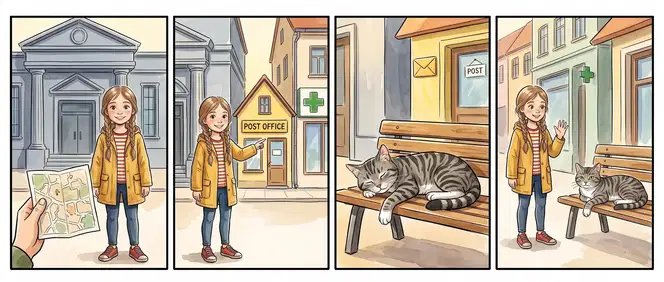
Nicky, where’s the post office? This is a bank!
Completa los bocadillos.
 1 Lukas
, where’s the post office? This is a bank!
Nicky, ¿dónde está la oficina de correos? ¡Esto es un banco!
2 Nickythe bank and the pharmacy. There!
Entre el banco y la farmacia. ¡Allí!
3 LukasAnd who’s that on the ?
¿Y quién es ese que está en el banco?
4 Nicky! This is his place.
¡Milo! Es su sitio.
1 Lena, where’s the post office? This is a bank!
Nicky, ¿dónde está la oficina de correos? ¡Esto es un banco!
2 Nickythe bank and the pharmacy. There!
Entre el banco y la farmacia. ¡Allí!
3 LenaAnd who’s that on the ?
¿Y quién es ese que está en el banco?
4 Nicky! This is his place.
¡Milo! Es su sitio.
Unidad terminada
 LernLaterne