Module 6Révision du vocabulairePremium
Les mots du module 6 : En ville
Les révisions font travailler les deux rôles : lorsque Lukas et Lena diraient quelque chose différemment, vous le faites une fois dans chaque rôle.
Dans ce module, vous avez appris à
- ask the way and understand simple directions
- buy food at the market in kilos, bottles and pieces, and ask what it costs
- buy a train ticket, ask when and where the train leaves, and understand an announcement
- say where I'm from and where I live now, and how I get somewhere
- say where places are on a map and explain the way
Tirés des scènes de ce module

station
gare
Jack, where is the station?Jack, où est la gare ?
Jack, where is the station?Jack, où est la gare ?
Three routes to the station

lake
lac
Tomorrow Tom and I are going to Long Lake. By train.Demain, Tom et moi allons à Long Lake. En train.
Tomorrow Tom and I are going to Long Lake. By train.Demain, Tom et moi allons à Long Lake. En train.
Three routes to the station
train
train
So to the train station. First left?Alors, pour la gare ferroviaire. D’abord à gauche ?
So to the train station. First left?Alors, pour la gare ferroviaire. D’abord à gauche ?
Three routes to the station
street
rue
I know. It’s far. First left, then straight on and right at the second street.Je sais. C’est loin. D’abord à gauche, puis tout droit et à droite à la deuxième rue.
Three routes to the station
left
à gauche
So to the train station. First left?Alors, pour la gare ferroviaire. D’abord à gauche ?
So to the train station. First left?Alors, pour la gare ferroviaire. D’abord à gauche ?
Three routes to the stationthen
ensuite
Far? No. Right, then left at the corner. Very close!Loin ? Non. À droite, puis à gauche au coin de la rue. Tout près !
Three routes to the station
straight on
tout droit
Straight on. By the river. Five minutes on foot.Tout droit. Au bord de la rivière. Cinq minutes à pied.
Three routes to the station
right
à droite
Far? No. Right, then left at the corner. Very close!Loin ? Non. À droite, puis à gauche au coin de la rue. Tout près !
Three routes to the station

corner
coin
Far? No. Right, then left at the corner. Very close!Loin ? Non. À droite, puis à gauche au coin de la rue. Tout près !
Three routes to the station


bus
bus
I mean the bus station. It’s close.Je parle de la gare routière. C’est proche.
Three routes to the station
market
marché
Here is the market. Saturdays from seven to one. I need ten kilos of apples.Voici le marché. Le samedi, de sept heures à treize heures. J’ai besoin de dix kilos de pommes.
Milo’s bill

kilo
kilo
Ten kilos? A lot!Dix kilos ? C’est beaucoup !
Ten kilos? A lot!Dix kilos ? C’est beaucoup !
Milo’s bill

tomato
tomate
A kilo of tomatoes and two kilos of potatoes, please.Un kilo de tomates et deux kilos de pommes de terre, s’il vous plaît.
A kilo of tomatoes and two kilos of potatoes, please.Un kilo de tomates et deux kilos de pommes de terre, s’il vous plaît.
Milo’s bill
potato
pomme de terre
A kilo of tomatoes and two kilos of potatoes, please.Un kilo de tomates et deux kilos de pommes de terre, s’il vous plaît.
A kilo of tomatoes and two kilos of potatoes, please.Un kilo de tomates et deux kilos de pommes de terre, s’il vous plaît.
Milo’s bill

bottle
bouteille
Half a kilo of cheese and a bottle of milk.Un demi-kilo de fromage et une bouteille de lait.
Half a kilo of cheese and a bottle of milk.Un demi-kilo de fromage et une bouteille de lait.
Milo’s bill
jacket
veste
Cat hairs on your jacket! Milo comes every Saturday. Here is his bill for this month.Les poils de chat sur votre veste ! Milo vient tous les samedis. Voici sa facture pour ce mois-ci.
Milo’s bill

platform
quai
Return. Is the train on platform two?Aller-retour. Le train est au quai deux ?
Return. Is the train on platform two?Aller-retour. Le train est au quai deux ?
Platform two
ticket
billet (de transport)
Here are our two tickets.Voici nos deux billets.
Here are our two tickets.Voici nos deux billets.
Platform two


timetable
horaires (des transports)
At seventeen forty. Here is the timetable.À dix-sept heures quarante. Voici les horaires.
Platform twoexactly
exactement
Good morning. Eight fifty-seven. Exactly according to plan.Bonjour. Huit heures cinquante-sept. Exactement comme prévu.
Platform two
cancelled
annulé / annulée
Cancelled? What does that mean?Supprimé ? Qu’est-ce que cela veut dire ?
Cancelled? What does that mean?Supprimé ? Qu’est-ce que cela veut dire ?
Platform two
mean
signifier
Cancelled? What does that mean?Supprimé ? Qu’est-ce que cela veut dire ?
Cancelled? What does that mean?Supprimé ? Qu’est-ce que cela veut dire ?
Platform two


play
jouer (à un jeu, à un sport)
But it is lovely. People are walking and playing football.Mais le parc est beau. Les gens se promènent et jouent au football.
But it is lovely. People are walking and playing football.Mais le parc est beau. Les gens se promènent et jouent au football.
Plan B
football
football
But it is lovely. People are walking and playing football.Mais le parc est beau. Les gens se promènent et jouent au football.
But it is lovely. People are walking and playing football.Mais le parc est beau. Les gens se promènent et jouent au football.
Plan B


between
entre
Between the bank and the pharmacy. The supermarket is next to the station, on the corner.Entre la banque et la pharmacie. Le supermarché est à côté de la gare, au coin de la rue.
Nicky’s map
bank
banque
Between the bank and the pharmacy. The supermarket is next to the station, on the corner.Entre la banque et la pharmacie. Le supermarché est à côté de la gare, au coin de la rue.
Nicky’s map
pharmacy
pharmacie
En anglais britannique, chemist’s désigne la pharmacie. Chemist peut aussi désigner une personne ; ici, il s’agit du magasin.
Between the bank and the pharmacy. The supermarket is next to the station, on the corner.Entre la banque et la pharmacie. Le supermarché est à côté de la gare, au coin de la rue.
Nicky’s map
supermarket
supermarché
Between the bank and the pharmacy. The supermarket is next to the station, on the corner.Entre la banque et la pharmacie. Le supermarché est à côté de la gare, au coin de la rue.
Nicky’s map

bench
banc
Milo likes the market, the café window, the park bench and the lake.Milo aime le marché, la fenêtre du café, le banc du parc et le lac.
Nicky’s map
roof
toit
What is the red cross on the roof? And the little key?Qu’est-ce que la croix rouge sur le toit ? Et la petite clé ?
What is the red cross on the roof? And the little key?Qu’est-ce que la croix rouge sur le toit ? Et la petite clé ?
Nicky’s map
Mots supplémentaires

bicycle
vélo
Bike est un mot courant à l’oral pour bicycle ; dans ce cours, il désigne un vélo, pas une moto.
This is a bicycle.C’est un vélo.
Three routes to the station (P)


teacher
enseignant / enseignante
This is a teacher.C’est un enseignant ou une enseignante.
Nicky’s map (P)
Exercices 1/7 · Images
Images et mots
Associez les mots aux images.
Images et mots
Associez les mots aux images.
Images et mots
Associez les mots aux images.
Images et mots
Associez les mots aux images.
Images et mots
Associez les mots aux images.
Images et mots
Associez les mots aux images.
Images et mots
Associez les mots aux images.
Images et mots
Associez les mots aux images.
Images et mots
Associez les mots aux images.
Images et mots
Associez les mots aux images.
Exercices 2/7 · Écoute
Écoutez et choisissez
Écoutez et choisissez le mot que vous entendez.
train: train
station: gare
corner: coin
then: ensuite
street: rue
Exercices 3/7 · Sens
Que signifie cette phrase ?
Que signifie cela ?
station
near
train
travel
hear
straight on
Exercices 4/7 · Associations
Phrases du module
Associez les paires.
Exercices 5/7 · Complétez les phrases
Souvenez-vous des conversations
Complétez les espaces avec les mots de l’encadré.
morning, Mrs Walker. Where is the station?
Bonjour, madame Walker. Où est la gare ?
morning, Mrs Walker. Where is the station?
Bonjour, madame Walker. Où est la gare ?
kilos? A lot!
Dix kilos ? C’est beaucoup !
kilos? A lot!
Dix kilos ? C’est beaucoup !
morning. Two tickets to Long Lake, please.
Bonjour. Deux billets pour Long Lake, s’il vous plaît.
morning. Two tickets to Long Lake, please.
Bonjour. Deux billets pour Long Lake, s’il vous plaît.
Are you ? To Long Lake?
Vous êtes sûr ? Pour Long Lake ?
Are you ? To Long Lake?
Vous êtes sûr ? Pour Long Lake ?
is by the park?
Qu’y a-t-il près du parc ?
is by the park?
Qu’y a-t-il près du parc ?
Dans le rôle de Lukas
Lukas is my . He’s from Hamburg.
Désignez la personne qui apprend comme votre voisin ou votre voisine.
Dans le rôle de Lena
Lena is my . She’s from Hamburg.
Désignez la personne qui apprend comme votre voisin ou votre voisine.
Dans le rôle de Lukas
Lukas is here. He in Millbrook.
Faites référence à Lukas ou à Lena avec le pronom approprié.
Dans le rôle de Lena
Lena is here. She in Millbrook.
Faites référence à Lukas ou à Lena avec le pronom approprié.
Exercices 6/7 · En situation
Utilisez les phrases
Choisissez les mots qui conviennent à la situation.
Bonjour, madame Walker. Où est la gare ?
Vous dites :
Bonjour, madame Walker. Où est la gare ?
Vous dites :
Dix kilos ? C’est beaucoup !
Vous dites :
Dix kilos ? C’est beaucoup !
Vous dites :
Bonjour. Deux billets pour Long Lake, s’il vous plaît.
Vous dites :
Bonjour. Deux billets pour Long Lake, s’il vous plaît.
Vous dites :
Vous êtes sûr ? Pour Long Lake ?
Vous dites :
Vous êtes sûr ? Pour Long Lake ?
Vous dites :
Qu’y a-t-il près du parc ?
Vous dites :
Qu’y a-t-il près du parc ?
Vous dites :
Exercices 7/7 · Bande dessinée
Nicky, where’s the post office? This is a bank!
Complétez les bulles.
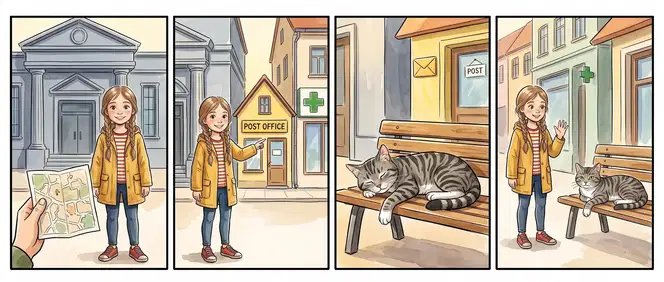 1 Lukas
, where’s the post office? This is a bank!
Nicky, où est la poste ? Ici, c'est une banque !
2 Nickythe bank and the pharmacy. There!
Entre la banque et la pharmacie. Là !
3 LukasAnd who’s that on the ?
Et qui est sur le banc ?
4 Nicky! This is his place.
Milo ! C'est sa place.
1 Lena, where’s the post office? This is a bank!
Nicky, où est la poste ? Ici, c'est une banque !
2 Nickythe bank and the pharmacy. There!
Entre la banque et la pharmacie. Là !
3 LenaAnd who’s that on the ?
Et qui est sur le banc ?
4 Nicky! This is his place.
Milo ! C'est sa place.
Unité terminée
 LernLaterne