From the scene

¿Qué tal?
how are you?
Buenos días. ¿Qué tal?Good morning. How are you?
¿Y tú?
and you? (informal)
no muy bien
not very well
allí
there
Vive allí arriba. La cafetería está abajo.She lives up there. The café is downstairs.
cada
each / every

el díamasc.
day
Learn el día together: the article shows this noun's grammatical gender.
Buenos días. ¿Qué tal?Good morning. How are you?
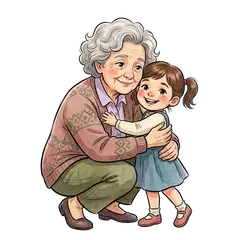
la nietafem.
granddaughter
Learn la nieta together: the article shows this noun's grammatical gender.
No, pero está aquí todos los días. Lucía es mi nieta.No, but she is here every day. Lucía is my granddaughter.

señorafem.
Ms / Mrs, polite address
Learn señora together: the article shows this noun's grammatical gender.
Lo siento, señora Martín.I am sorry, Ms Martín.

el jefemasc.
boss
Learn el jefe together: the article shows this noun's grammatical gender.
Aquí y allí. Arriba y abajo. ¡Michi es el jefe de la casa!Here and there. Upstairs and downstairs. Michi is the boss of the house!

la mañanafem.
morning

la tardefem.
afternoon / early evening
buenas tardes
good afternoon / early evening
Use buenas tardes before night; after dark use buenas noches.
New in this unit

el salónmasc.
living room
Learn el salón together: the article shows this noun's grammatical gender.
Michi está en el salón.Michi is in the living room.

el dormitoriomasc.
bedroom
Learn el dormitorio together: the article shows this noun's grammatical gender.
El dormitorio está arriba.The bedroom is upstairs.
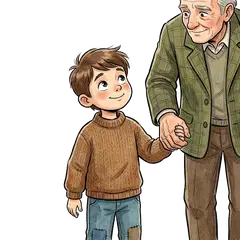
el nietomasc.
grandson
Learn el nieto together: the article shows this noun's grammatical gender.
Mi nieto está aquí.My grandson is here.

contento / contenta
happy
Estoy contento.I am happy.
Estoy contenta.I am happy.
Practice 1/7 · Pictures
Pictures and words
Match the words to the pictures.
Practice 2/7 · Listening
Listen and choose
Listen and choose the word you hear.
el salón: living room
¿Qué tal?: how are you?
no muy bien: not very well
la nieta: granddaughter
el jefe: boss
Practice 3/7 · Meanings
What does it mean?
la mañana
contento / contenta
buenas tardes
la nieta
cada
no muy bien
Practice 4/7 · Fill the gaps
Words in a useful message
Fill the gaps with the words from the box.
Clara vive .
Clara lives upstairs.
Michi está en el .
Michi is in the living room.
Lucía es mi .
Lucía is my granddaughter.
Michi es el .
Michi is the boss.
Practice 5/7 · Comic strip
A small comic
Fill the speech bubbles.
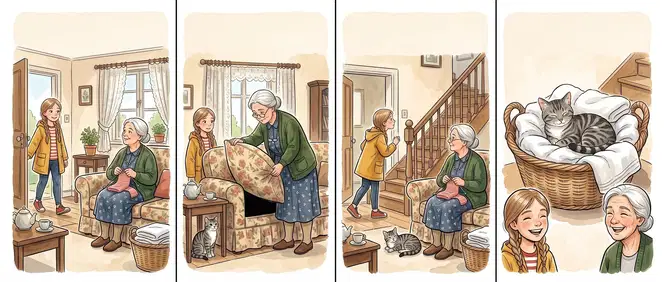 1 Lucía
Abuela, ¿ está Michi?
Grandma, where is Michi?
2 ElviraNo está en el .
He is not in the living room.
3 Lucía¿Está ?
Is he upstairs?
4 Elvira¡Está !
He is here!
Practice 6/7 · Matching
Match the meanings
Match the pairs.
Practice 7/7 · In situations
What fits this moment?
Choose the right words for the situation.
Elvira asks how you are. You feel well and want to ask her too.
You say:
Answer the greeting and politely return the question.
Elvira asks how you are. You feel well and want to ask her too.
You say:
Answer the greeting and politely return the question.
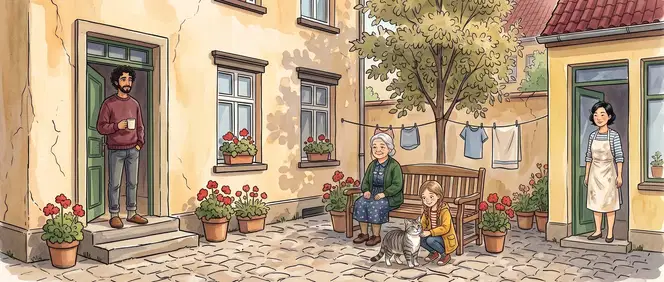
Unit complete